




The full story
By the Storedwatts editors · Published Nov 20, 2026
The Power 500 is DJI's smallest station, built first for pilots of its drones. The sources we read agree on what it does well, and their complaints all concern the same few missing ports.
A day of drone batteries and laptops, a fridge only until morning8.6/10
The Power 500 holds enough for a day of small electronics, not for a weekend of appliances. Watt-hours (Wh) are how much a station stores, and DJI rates this one at 512 Wh. That covers many phone charges, a laptop, camera batteries and a day of drone flying.
About four fifths of the label reaches the outlet. The Solar Lab ran it near the inverter's limit and called the result "about 79% efficient at almost the max of the inverter".1 Todd Parker's measurement on a light load landed in the same place, and he called it average.2
A fridge is the limit. Chris Stead ran one overnight and woke to a cold fridge and an empty station: "it just doesn't have the battery capacity to do that for very long".3 Treat it as a way to bridge a short outage, not to keep food cold through a second day.
A wall refill in little over an hour, solar only through an adapter8.2/10
Wall charging is quick and widely liked. Fenchel & Janisch report "100% in about 70 minutes", and several others saw much the same.4 A switch on the unit selects the faster rate, and it plugs in with an ordinary power cord, with no separate charging brick.
Not every test matched that figure. The Solar Lab timed its unit "from absolutely dead to 100% full in an hour and 23 minutes", which is still fast for the size.5 USB-C charging also works, but it is far slower.
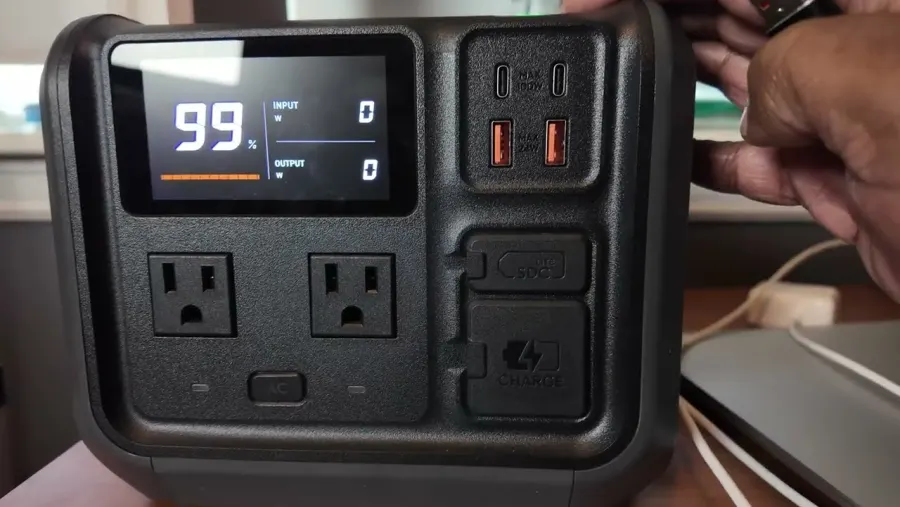
Solar and car charging are the catch. There is no built-in solar input: panels connect through DJI's SDC port with an adapter module that is sold separately, and car charging needs another adapter.6 That port is also the one that fast-charges drone batteries, so charging from the sun means giving that up while the panels are connected.
1000 W from two outlets, and no car socket or light7.7/10
The inverter is the strong part of the design. Watts (W) are how much a station can run at once, and surge is the brief start-up kick some appliances need. DJI rates the AC outlets at 1000 W, about double what a battery this size usually gets, and the output is pure sine wave for sensitive electronics.
Measured tests found a little headroom above the rating. Todd Parker found his unit "could run a 1,100 W load continuously and a 1,200 W load for 20 seconds".7 Beyond that, the overload protection shuts the output off.
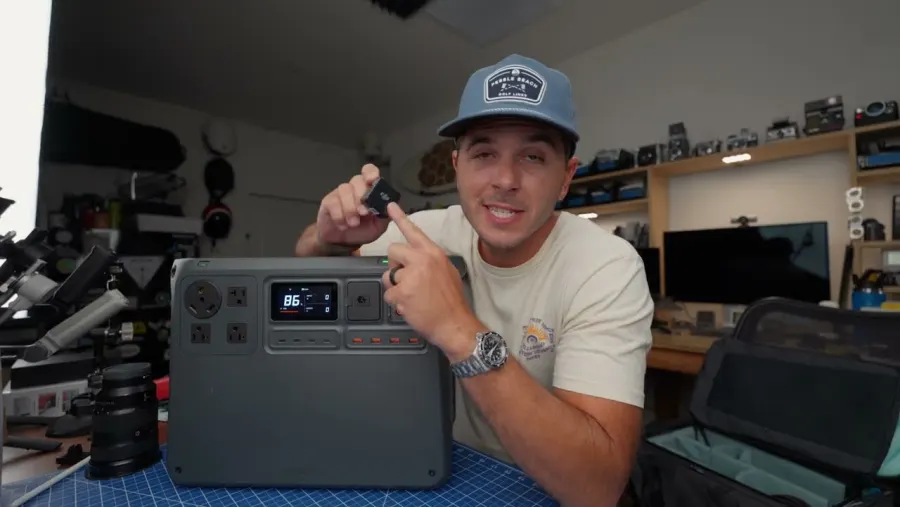
The complaints are about what is missing. Two USB-C ports handle laptops well, but there is no car-style DC socket and no light, and Chris Stead counts both against it.8 The SDC port fast-charges DJI drone batteries one at a time, which matters a great deal to pilots and not at all to everyone else.
Close to silent, with no weather rating8.9/10
Quietness is the Power 500's most praised trait. It stays hushed while recharging at full speed and while running heavy loads, which makes it easy to live with in a bedroom, a tent or an office.
“it's very quiet super quiet possibly the quietest Power Station I've ever heard or not heard”
The casing is described as rigid and well made, and TechRadar saw no heat problems. The same review points out that there is no IP rating, so this is not a station to leave out in the rain.9
Long-term life rests on the maker's figures for now. TechRadar relays that "DJI estimates the unit will maintain over 70% capacity after 4000 cycles".10 None of the sources ran a unit long enough to check that.
Approx. 7.3 kg that some call light and others notice8.5/10
Most find the Power 500 easy to carry and easy to stow. At approx. 7.3 kg it goes in a car boot or on a shelf without fuss, and every port faces the front, so it can sit wedged on a back seat and still be used.
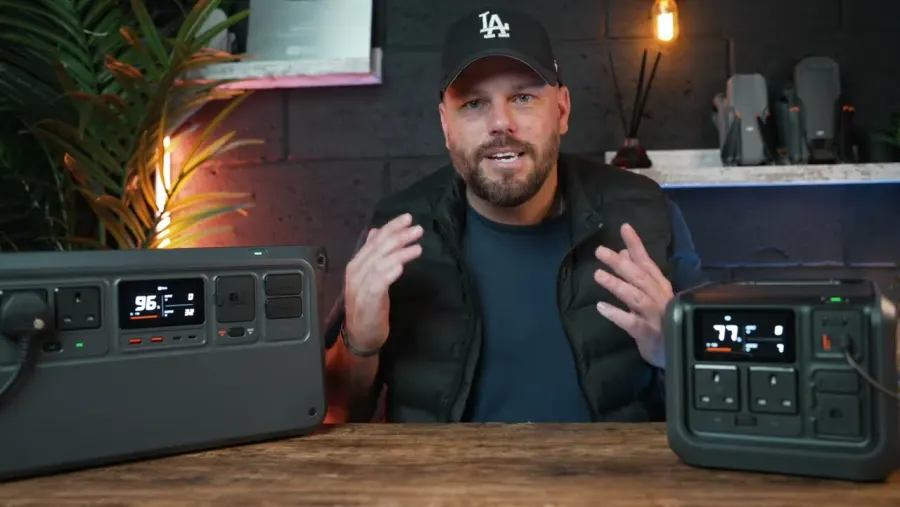
It is not the lightest in its class. Todd Parker found it heavier than the EcoFlow he compared it with.11 TechRadar judged it a one-hand carry for anyone of moderate strength, then added: "you certainly know you have it in your hand".12
The practical reading is that it carries well from car to campsite or launch spot. It is less suited to a long walk in.
A clear screen, a quick UPS and no app7.0/10
The display is widely liked and the lack of an app is the main complaint. The screen is bright and shows charge level and power flow at a glance. Todd Parker states the cost of the missing app plainly: "there's no smartphone app, which means no remote monitoring or advanced settings".13
Firmware updates are possible but clumsy, since they need a computer and a USB connection. If you like to check a station from the sofa or schedule its charging, this one will frustrate you.
It does work as a small uninterruptible power supply. Fenchel & Janisch cite "a switch time of only 20 milliseconds" when wall power drops, and the outlets stay live while the station charges.14 That is the maker's rating as relayed, not a measured result, so check any sensitive equipment against it.
Fairly priced until the adapters go in the cart7.9/10
At $379 for the station alone, most sources call the Power 500 good value, and it is often discounted. Buyers pay for the quiet running, the fast charge and the DJI name, and several think that is a fair deal.
The case against it is about ports and extras. TechRadar's verdict: "You can find similarly specced units cheaper without sacrificing port-space".15 The Solar Lab objects that no accessories come in the box, so solar and car charging add to the bill.16
Who it suits depends on the drone. Chris Stead's view is that without a DJI drone and a use for the SDC port, most buyers will end up preferring a different station.17 For pilots, the fast battery charging is the reason to pay.
Our verdict
Buy the DJI Power 500 if you fly DJI drones, or if you want a very quiet small station for laptops, cameras and a short outage and will refill it at the wall. Skip it if you need a car socket, a built-in solar input or an app, or if a fridge has to run past the first morning. Before ordering, add up the adapters you would need and compare that total with rivals that include those ports.
5 sources quoted in this story (17 notes)
- 1The Solar Lab · 6:20 “it actually lasted 27 which makes this thing about 79% efficient at almost the max of the inverter which is pretty good”
- 2Todd Parker · 4:33 “I ran 100 W load for 5 hours to measure its AC efficiency and got 80%, which is just average.”
- 3Chris Stead · 10:46 “it's going to recharge your phone like a dozen plus times if not more tablets your cameras” but “it just doesn't have the battery capacity to do that for very long and by the time got in the morning the fridge was freezing but the battery was was was was was gone”
- 4Fenchel & Janisch · 2:05 “Recharging is impressively fast, reaching 80% in just 50 minutes and 100% in about 70 minutes.”
- 5The Solar Lab · 6:39 “this thing went from absolutely dead to 100% full in an hour and 23 minutes which is pretty good” but “the solar input on this unit also works but it needs adapters and just annoying that we'll touch on later”
- 6Chris Stead · 12:25 “I found it to charge quite quickly I know it said 70 minutes but I it actually charged a bit faster than that in my experience” but “but you can't you can't just plug the solar in I can't just charge it in a car and uh those type of things do hold it back slightly in my opinion”
- 7Todd Parker · 4:23 “the DJI could run a 1,100 W load continuously and a 1,200 W load for 20 seconds”
- 8Chris Stead · 6:12 “you got no 12vt uh Port as you can see there's no light”
- 9techradar.com · written review “it was, impressively, near-silent in operation throughout, with no issues with heating” but “this isn’t designed for rugged outdoor use, as evidenced by the lack of IP rating”
- 10techradar.com · written review “DJI estimates the unit will maintain over 70% capacity after 4000 cycles.”
- 11Todd Parker · 7:52 “Now the DJI 500 weighs roughly 2 and 1/2 lb more than the EcoFlow.”
- 12techradar.com · written review “for anyone of moderate strength, one-handed carry isn’t a pipe-dream” but “That’s not to say it’s super lightweight - you certainly know you have it in your hand”
- 13Todd Parker · 3:51 “I much prefer the Power 500's design because all the ports are easily accessible and the display is much brighter and better looking than EcoFlow's.” but “First, there's no smartphone app, which means no remote monitoring or advanced settings.”
- 14Fenchel & Janisch · 2:17 “includes an uninterruptible power supply mode with a switch time of only 20 milliseconds, ensuring critical devices stay powered without interruption”
- 15techradar.com · written review “You can find similarly specced units cheaper without sacrificing port-space”
- 16The Solar Lab · 7:39 “the first one that drives me absolutely nuts is that it comes with no accessories”
- 17Chris Stead · 13:31 “unless you've got a drone and unless you've going to use this SDC Port uh you're probably going to end up wanting to go a different direction”