

The full story
By the Storedwatts editors · Published Nov 20, 2026
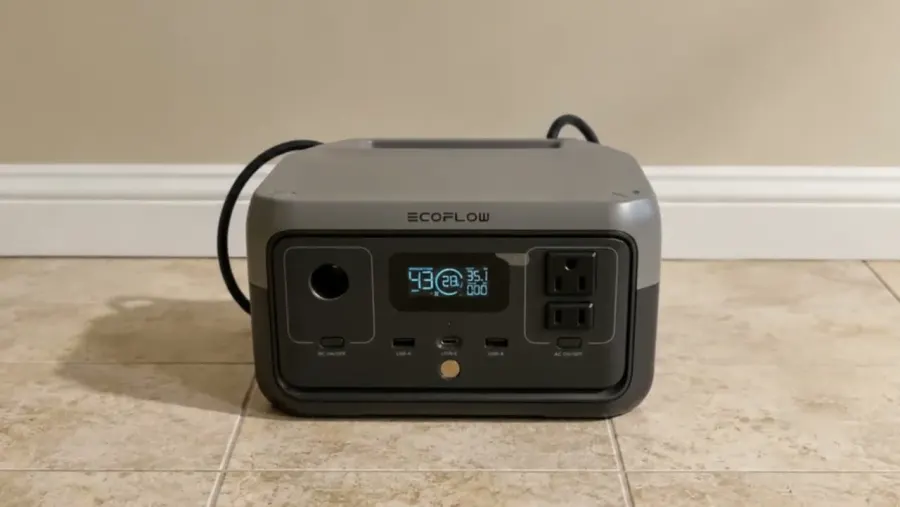
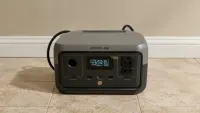
The RIVER 2 is the smallest of EcoFlow's RIVER 2 line, and the evidence on it is unusually consistent. Charging speed, carry weight and cell life are praised nearly everywhere. The disagreement is about how far such a small battery really goes.
Enough to charge things, too little to run them for long4.7/10
The battery is the limit, and it is smaller in practice than on the label. Watt-hours (Wh) are how much a station stores, and measured tests on the AC outlets came back well short of the rated figure. HOBOTECH's discharge test "scored 190 Watt hours out of 256 for 74 percent", a result he called the lowest he had seen from an EcoFlow product.1 Trusted Reviews drained it fully and got less than two thirds of the rating.2
The picture is better on USB. AllThingsOnePlace measured more through the USB-C port than through the inverter, where he recorded "202 Watt hours from the AC output".3 The lesson is practical: charge devices over USB where possible, and turn the AC outlets off when they are not in use, because the inverter draws power while idle.
For small electronics this is plenty. Phones, cameras, lights, a router and a laptop can go several days between top-ups. For anything that runs continuously it is not. The Den of Tools tried it overnight and it gave out before the night was half over.4

“I mean don't get me wrong it's enough to charge stuff but it's not enough to run stuff”
A lunch-hour wall refill, and solar that needs its own cable6.3/10
Wall charging is the best thing about the RIVER 2. The charger is built in, so a plain kettle-style cord is all it needs, and timed runs match EcoFlow's one-hour claim. AllThingsOnePlace clocked a full charge from empty in "57 minutes".5 The charge rate can be turned down in the app, which also calms the fan.
Solar is more modest. The Review Hub notes the input accepts "up to 110 W" and that the solar cable is not in the box, so add it to the bill if panels are part of the plan.6 A single small folding panel is the sensible match. Larger panels are wasted on it, and on an overcast day the charge slows to a crawl.
Two smaller catches. Charging through the USB-C port is slow, taking hours where the wall cord takes one. The inputs also do not add together, so plugging in a second source will not speed things up.
Slow cookers and monitors yes, fridges and heaters no6.0/10
The inverter handles small appliances cleanly and nothing larger. Watts (W) are how much a station can run at once, and surge is the brief start-up kick a compressor or motor needs. Within its rating the RIVER 2 puts out a clean sine wave, and it has run slow cookers, a mixer grinder, a projector and a large monitor without complaint.
The ceiling arrives quickly. Sanding Shit plugged in a household refrigerator and watched the display: "it goes to 308 and it turns itself off".7 Heaters, kettles, hair dryers and most coffee machines are out for the same reason. When it does overload it shuts the AC side down and resets once the load is removed.
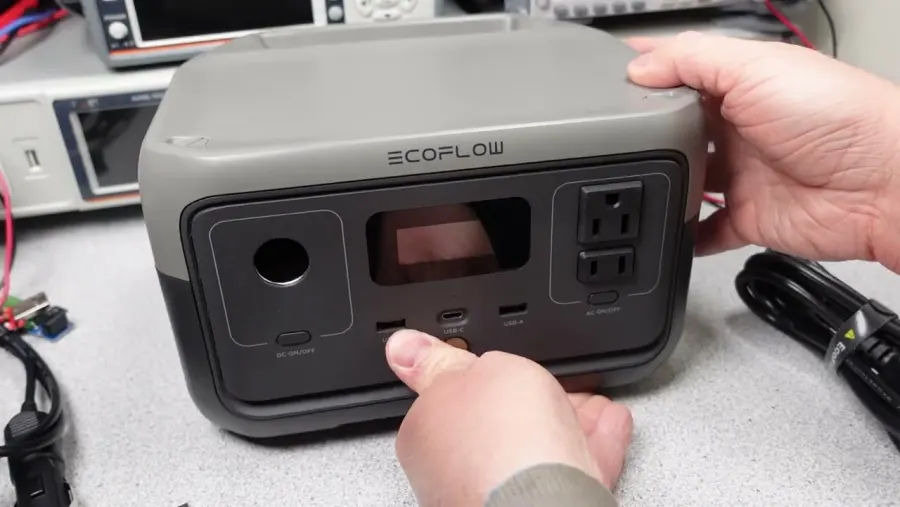
X-Boost needs explaining. It lets some heating appliances run at reduced power, but it does not make the inverter any bigger. HOBOTECH found he had to switch X-Boost on "in order for it to run at 300 watts" at all, or the station shut down.8 The port count is also thin: one USB-C socket, two USB-A, two AC outlets and a car socket, and a second USB-C port is the most common wish.
A rear handle, a flat top and an easy lift7.8/10
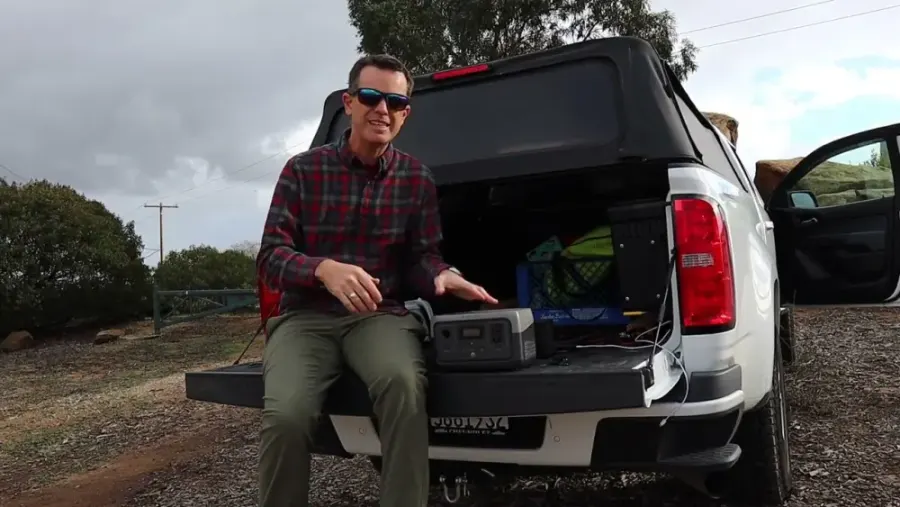
Carrying it is no effort. It is among the smallest stations with real AC outlets, and moving it between the car, a tent and a desk takes one hand.
“That is genuinely portable. You pick it up with one hand without thinking about it.”
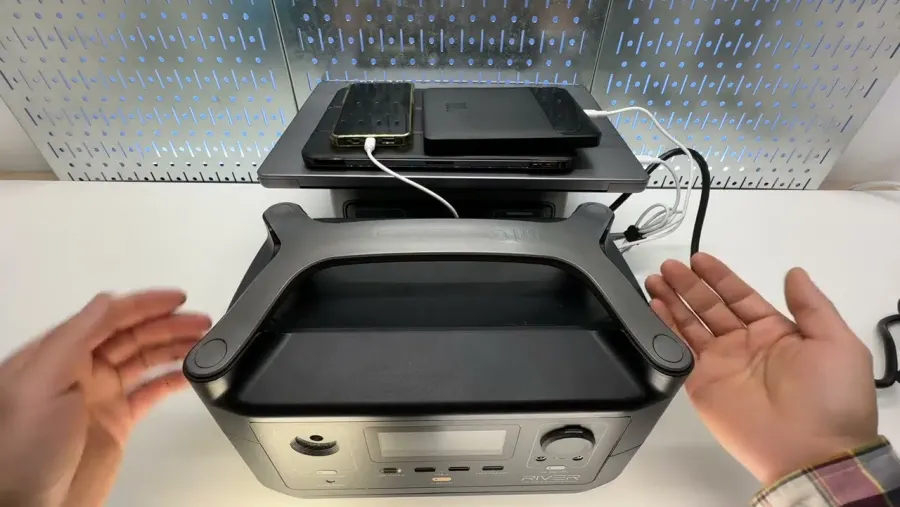
The handle is fixed to the back, not the top. That keeps the top surface flat for resting phones and chargers, and it is widely liked. The trade-off is that the fixed handle adds depth, so it takes up more shelf or trunk space than a folding one would.
It is light for a power station, not for a backpack. The LiFePO4 cells weigh more than older lithium-ion ones, and it is a car-camping item, not something to hike with.
A working UPS in a very small box8.1/10
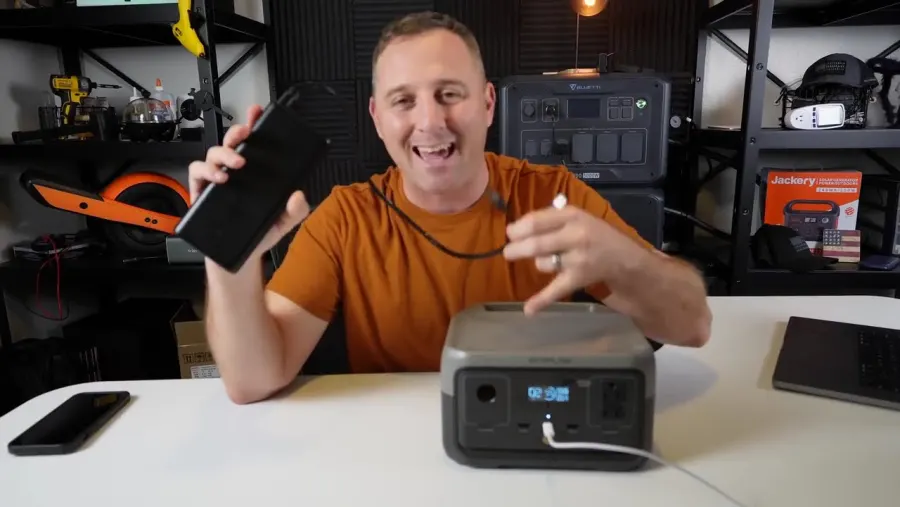
The extras are better than the size suggests. Left plugged into the wall with a device attached, it switches to battery when the grid drops. HOBOTECH verified the feature and counts the RIVER 2 among the smallest stations with a UPS that works.9
The switchover is quick, though not instant. Laptops and routers ride through it. AllThingsOnePlace cautions that a motor load such as a refrigerator may trip off if it is running at the moment of the changeover, and very sensitive equipment deserves a proper UPS.10
The app connects over Bluetooth and Wi-Fi and covers monitoring, charge and discharge limits, charging speed and firmware updates. It asks for a registered account before it will pair. The screen is clear and easy to read, with one quirk: very small loads show as zero. There is no path to add an expansion battery.
Long-life cells, open ports and a fan heard two ways8.9/10
The build is solid and the battery chemistry is the reason to expect a long service life. Trusted Reviews cites the rating as "3000 charge cycles until the battery is at 80% capacity", which is years of daily use.11 The casing feels well made and the buttons have a quality feel.
The fan is where accounts differ. Trusted Reviews found the fan rarely came on in ordinary use.12 Fast wall charging is another matter, and The Review Hub says of that mode, "I could hear it clearly".13 Slowing the charge rate in the app is the fix when it sits in a bedroom or an office.
Two cautions. The ports are open, with no covers and no water-resistance rating, so keep it out of rain and dust. The warranty is also reported in more than one way: HOBOTECH describes a "five-year warranty", while Top Solar Gear lists a shorter term.14 Confirm the terms with the seller before buying.
A budget price for the charging speed and the cell life7.9/10
At $163.93 this is one of the cheaper ways into a name-brand station with long-life cells. The Gloves Man sums up the common view, calling it "one of the best budget power stations that you can get".15 It is frequently discounted, so the list price is rarely the one to pay.
The case is less clear on pure capacity per dollar. Trusted Reviews points to an Anker rival that costs slightly less at the same capacity.16 What the RIVER 2 adds for the money is the one-hour refill, the app and the UPS function. If none of those matter, a plainer station with the same battery will do the job.
Our verdict
Buy the RIVER 2 as a fast-charging, easy-to-carry supply for electronics: phones, laptops, cameras, a router and a light through a short outage or a camping weekend. Skip it for fridges, heaters or anything that must run all night, because both the battery and the inverter are too small for those jobs. Before paying, check the warranty term with the seller, add a solar cable if panels are planned, and look for a sale price.
7 sources quoted in this story (16 notes)
- 1HOBOTECH · 4:55 “the river 2 scored 190 Watt hours out of 256 for 74 percent”
- 2trustedreviews.com · written review “That’s not terrible, given that the inverter that converts DC power from the battery to AC power for the outlet draws considerable power.” but “Draining the battery fully, I measured the power output at 164Wh. That’s a 64% efficiency”
- 3AllThingsOnePlace · 8:32 “I measured the output capacity at 217.5 Watt hours through the usb-c port and 202 Watt hours from the AC output” but “this is not the best but it is still a strong performance on the DC side on the AC side compounding losses are not so great for a smaller unit like this”
- 4The Den of Tools · 2:03 “it lasted not even half the night it was I was really disappointed in that”
- 5AllThingsOnePlace · 6:39 “because of this high input power capability this unit charges from zero to one hundred percent in 57 minutes”
- 6The Review Hub · 2:34 “Solar charging is supported as well, up to 110 W, though I should mention the solar charging cable is not included in the box.”
- 7Sanding Shit · 2:38 “it will not power my refrigerator refrigerators pull 300 800 watts and you see it goes to 308 and it turns itself off”
- 8HOBOTECH · 7:20 “120 volts of 60 hertz with a perfect sine wave under Max load” but “I did have to turn on X boost in order for it to run at 300 watts otherwise it would shut down”
- 9HOBOTECH · 16:32 “this verifies it does have a functional uninterruptible power supply making this one of the smallest products on the market with a functional ups”
- 10AllThingsOnePlace · 7:49 “this is a small delay but inductive loads like a refrigerator May trip off if running while this change over happens”
- 11trustedreviews.com · written review “Using a LiFeP04 battery, the Ecoflow River 2 can handle 3000 charge cycles until the battery is at 80% capacity.”
- 12trustedreviews.com · written review “There is a fan in this unit, although it rarely turned on, so I found the Ecoflow River 2 very quiet.”
- 13The Review Hub · 4:47 “It uses LiFePO4, which I prefer for something like this because of the longer cycle life and better long-term use.” but “The cooling fan is noticeable. During fast AC charging, I could hear it clearly”
- 14HOBOTECH · 3:40 “ecoflow offers a class leading five-year warranty on the river 2 Series”
- 15The Gloves Man · 12:53 “I think the EcoFlow River 2 is one of the best budget power stations that you can get”
- 16trustedreviews.com · written review “Adjusted for the Ecoflow River 2’s price that’s around 35p per kWh stored. Not bad for the size of device” but “The main competition is the Anker PowerHouse 521, which is slightly cheaper at the same capacity.”