


The full story
By the Storedwatts editors · Published Nov 20, 2026
The FlashSpeed 300 is easy to sum up: light, quick to refill, cheap, and small. Where the accounts differ is on how much that small battery really does, and on whether the AC outlets stay on when asked.
A fan through the night, a slow cooker for about an hour6.7/10
The 230Wh battery is plenty for small loads and quickly spent on anything that heats. Watt-hours are how much a station stores, and this is a small tank. Whether that is enough depends entirely on the job.
Most of what VTOMAN rates does reach the outlet. Eric Hernandez drained it on a fixed AC load and worked out "a usable capacity of 87.8%", a little better than he usually sees at this size.1 TechWalls worked a full day on a laptop from one charge, and We're the Roberts ran a small fan all night.
“that thing ran the whole night and when I woke up it still had about 50% of the battery” but “the battery inside this power station only has a capacity of 230 W hours of storage so you really have to be aware of how much power you're using”
The catch arrives with bigger appliances. The Roberts estimate that with a Crockpot you are "only going to get like an hour's worth of usage out of it".2 The station also draws a few watts for itself whenever it is switched on, so turn it off between uses.
Clean AC for small devices, with cut-outs and a weak USB-C port6.9/10
The 300W inverter runs laptops, speakers and small appliances cleanly, but it has shut off on heavier and longer loads. Watts are how much a station can run at once; surge is the brief start-up kick above that. TechWalls found the pure sine wave output consistent, and the-gadgeteer.com had no trouble with the AC devices it tried.3
The limit is closer than the label suggests. Charles BridgTec advises staying well below the rating.
“I believe this is 300 watts max, which is still uh a lot of power. Uh you can easily run small appliances.” but “Uh you don't want to push it too much cuz it'll automatically shut off.”
Trellis Axis reports something worse on his unit: the display shows AC as on, yet the plugs lose power "in about 8 to 11 minutes on average".4 Charles BridgTec saw one load run for a short while and then stop too.
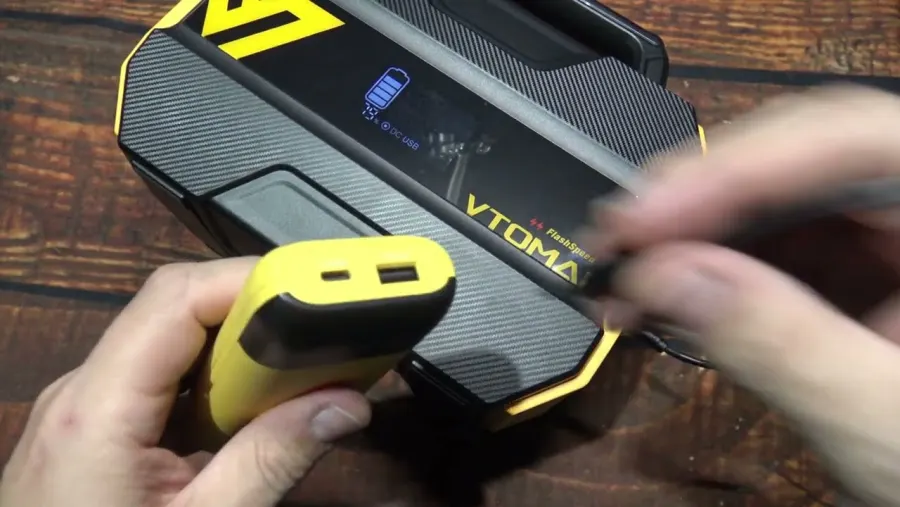
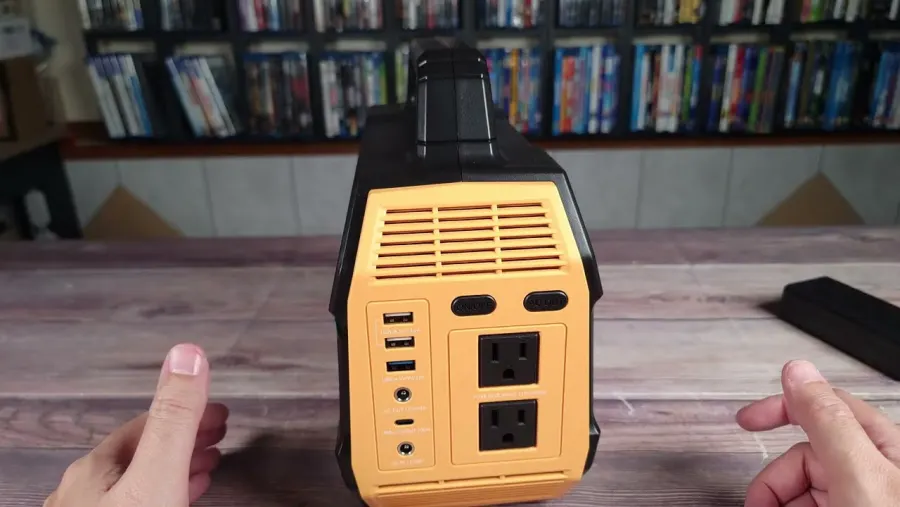
The ports are generous in number, with a pair of AC outlets, several USB-A sockets and a 12 V barrel, but there is only a single USB-C. TechWalls found its charging speed "underwhelming" with a phone and a MacBook.5
2.5 h at the wall, and a slow last stretch9.2/10
Charging is the best thing about this station, and it is praised almost without exception. VTOMAN gives 2.5 h for a full wall charge. Eric Hernandez timed it from empty, by AC adapter and by USB-C, "in about 2.4 to 2.6 hours".6
There are four ways in: the wall brick, a car socket, the two-way USB-C port and a solar panel. Hernandez says it accepts "up to 100 watts of solar", so a single small folding panel is the sensible match.7 It also charges while powering other things.
The one complaint is the taper. Charles BridgTec found the final stretch from 80% to full took noticeably longer than the rest.8
7.4 lbs on a big top handle8.6/10
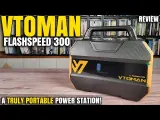
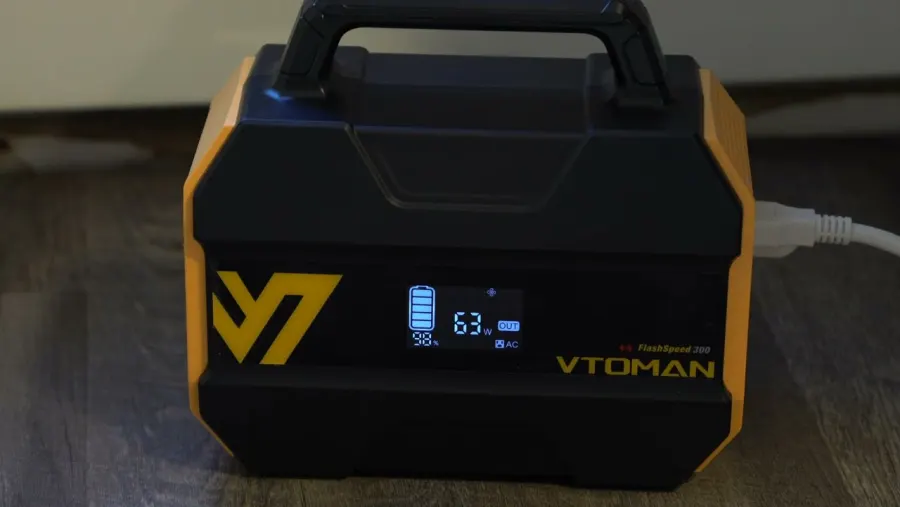
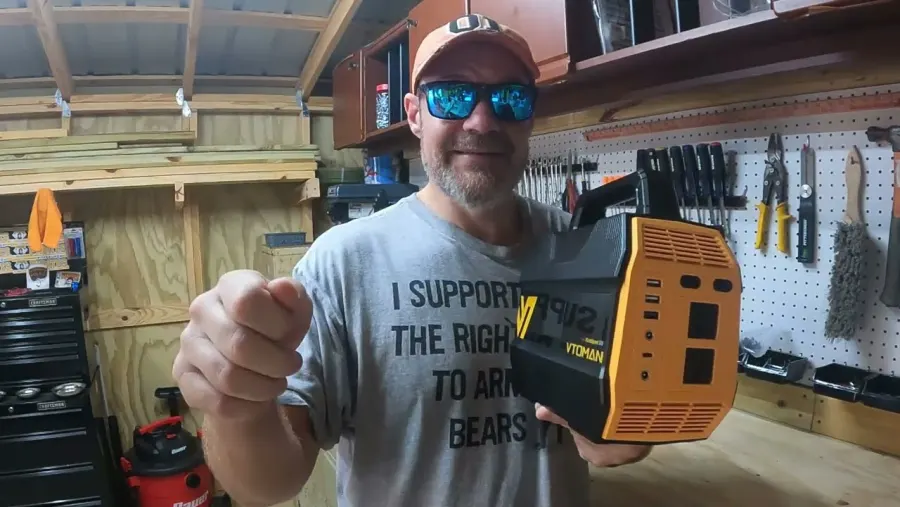
This is a station you carry in one hand without planning for it. TechWalls calls it "remarkably lightweight", and the shape draws comparisons to a lunchbox and a small boom box.9 Eric Hernandez notes it tucks into the side of a trunk and takes almost no room.
Part of the low weight comes from keeping the charger outside the case, which means a separate brick to pack. No bag is included for the cables.
It is light for a power station, not for a hike. We're the Roberts point out that after a while in the hand it "starts to get heavy", and Papa's Product Reviews thinks it is a bit much for a backpack.10
A built-in lamp, and outlets that go dark when the wall power does6.7/10
The extras are simple, and it should not be bought as a backup switch. There is no mention of an app anywhere. What you get is a readable display and an LED lamp with SOS and strobe modes, which Charles BridgTec liked as an area light in an outage.
It does power devices while charging. But Trellis Axis found that when the house power feeding it went out, the station's AC outlets turned off too, so anything plugged in lost power.11 Treat it as a battery you switch to by hand.
Smaller gripes: the lamp sits at the opposite end from the ports, inputs and outputs are not clearly separated, and the buttons are easy to press by accident in transit.
Long-life cells, a loud fan and a plastic screen7.5/10
The casework and battery chemistry are widely liked for the price. The LiFePO4 cells are rated for a long cycle life, which Papa's Product Reviews sets well ahead of older lithium-ion packs.12 Charles BridgTec found the ABS shell sturdy enough to be knocked around.
The fan is the main annoyance. TechWalls heard it start at a modest workstation load and says it "can be quite loud" in a quiet room.13
Two smaller faults are on record. The display cover is plastic, and the-gadgeteer.com scratched it while cleaning off a mark.14 Trellis Axis also saw LED bulbs keep glowing faintly with the AC outlets switched off.
Cheap for LiFePO4 cells and this charging speed
Price gets less attention than anything else here, and what is said is positive. VTOMAN lists it at $269.99 for the station alone. TechWalls, working from the lower price it paid, put the cost at "less than 65 cents per W hour" and called it attractive for buyers on a budget.15
Eric Hernandez also rates it as very affordable for how it performs. The value case rests on small loads, though. If the outlet cut-outs show up on your unit, a low price is little comfort.
Our verdict
Buy the FlashSpeed 300 for camping weekends, car trips and short outages where the job is a fan, a laptop, phones and a light. Skip it for fridges, cooking or anything that must stay on unattended, because 230Wh runs out fast and the AC outlets have shut off on some units. When it arrives, run your real overnight load once at home and confirm the outlets stay live before you depend on it.
7 sources quoted in this story (15 notes)
- 1Eric Hernandez · 3:09 “doing the math that gives this unit a usable capacity of 87.8% most power stations of this size put out about 80 to 85% on average”
- 2We're the Roberts · 5:21 “if you're using a Crockpot with this you're only going to get like an hour's worth of usage out of it”
- 3TechWalls · 1:31 “The Flash speed 300 delivers consistent and efficient power through its AC pure sign wave output”
- 4Trellis Axis · 6:58 “It'll say it's on, but it'll turn the power off to the plugs in about 8 to 11 minutes on average.”
- 5TechWalls · 1:48 “its Peak Performance of 600 watts allows it to handle short bursts of high power demand while the steady 300 Wat output meets most common energy needs” but “the performance of its USB port can be underwhelming during testing the USBC Port charged my iPhone at 7 to 8 wats”
- 6Eric Hernandez · 2:28 “when it comes to charging times from both the AC adapter and the USBC Port this charges from 0 to 100 in about 2.4 to 2.6 hours”
- 7Eric Hernandez · 2:51 “this accepts up to 100 watts of solar if you're charging this from 0 to 100 this will charge off solar within 3 to 6 hours”
- 8Charles BridgTec · 16:53 “So, if you do misplace this cord, you can still charge this bad boy up on the go.” but “And by that time, 80% to 100 took quite a bit for this.”
- 9TechWalls · 0:23 “the most notable feature of the VTO man is its portability at only 7. 4 lb it is remarkably lightweight”
- 10We're the Roberts · 0:59 “it only weighs like 7 lb so you could really take this thing anywhere” but “7 lbs after you hold it for a while starts to get heavy”
- 11Trellis Axis · 8:01 “when you have it plugged into your power at the house, an outlet, and the power at the house turns off, it turns off the 120”
- 12Papa`s Product Reviews · 2:34 “this is a life po 4 guys so your battery life on this is going to be a lot longer usually over 3,000 uh cycles”
- 13TechWalls · 2:11 “the life po 4 battery offers over 3,000 Cycles this battery lasts six times longer than traditional lithium ion batteries” but “while this power draw is relatively low the fan noise can be quite loud which may be distracting in quiet environments”
- 14the-gadgeteer.com · written review “looks similar to other small power stations, rather like a thick and sturdy lunchbox with an oversized handle.” but “I had to scrub it off with rubbing alcohol and a microfiber cloth, which scratched the display, as it’s plastic and not glass.”
- 15TechWalls · 4:24 “a price of under $150 this translates to a cost of less than 65 cents per W hour this makes it an attractive option for budget conscious buyers”