How to choose between EcoFlow and Jackery
Where the two brands differ on charging, solar and expansion, and which fits your use.
By the Storedwatts editors · 5 min read · Published Nov 20, 2026

You have two tabs open, one EcoFlow and one Jackery, at about the same price and about the same size. Maybe the power went out last month and the fridge worried you, or there's a camping trip coming and no hookup at the site. Both brands make stations that will do the job.
The logo matters less than three things on the spec sheet: how fast the station takes power in, whether it can grow, and whether it's sized for what you'll plug in. EcoFlow has tended to lead on input. Jackery has to be judged model by model. Settle those three points and the choice usually makes itself.
Charging speed is the biggest difference between them
If your grid comes back in short bursts between failures, charging input is the spec to buy on. A station that needs a couple of hours at the wall will miss a brief window of power; one that takes power in quickly will leave it close to full. Here EcoFlow has the edge on paper. Its maximum input has run well above Jackery's at similar capacity.1
The spec sheet doesn't settle it. Stations waste some energy as they charge and discharge, so the fair measure is usable energy gained per minute, and on that basis Project Farm found a Jackery the quickest of the units it compared.2 Advertised charge rates are also sometimes missed, so look for a measured test of the exact model.
One habit to adopt with either brand: save the fastest charge mode for when you're in a hurry, because constant use wears the battery sooner. If outages near you are long and the grid stays down, charging speed drops down the list and capacity moves up.
Let your recharge plan decide. How will you refill the station?
- Wall power in short windows: Buy the highest AC charging input at your size
- Mostly from the sun: Compare solar input watts and the voltage range
- Rarely, during long outages: Put capacity ahead of charging speed
For solar, read the input limits before the panel wattage
The station's solar input, not the panel, sets how fast you recharge in the sun. Whatever that rating is, extra panels cannot push past it. EcoFlow generally accepts more solar watts, which counts if the sun is your main charger. Jackery is less consistent: one recent model dropped from 800 W of solar input to 400 W.3
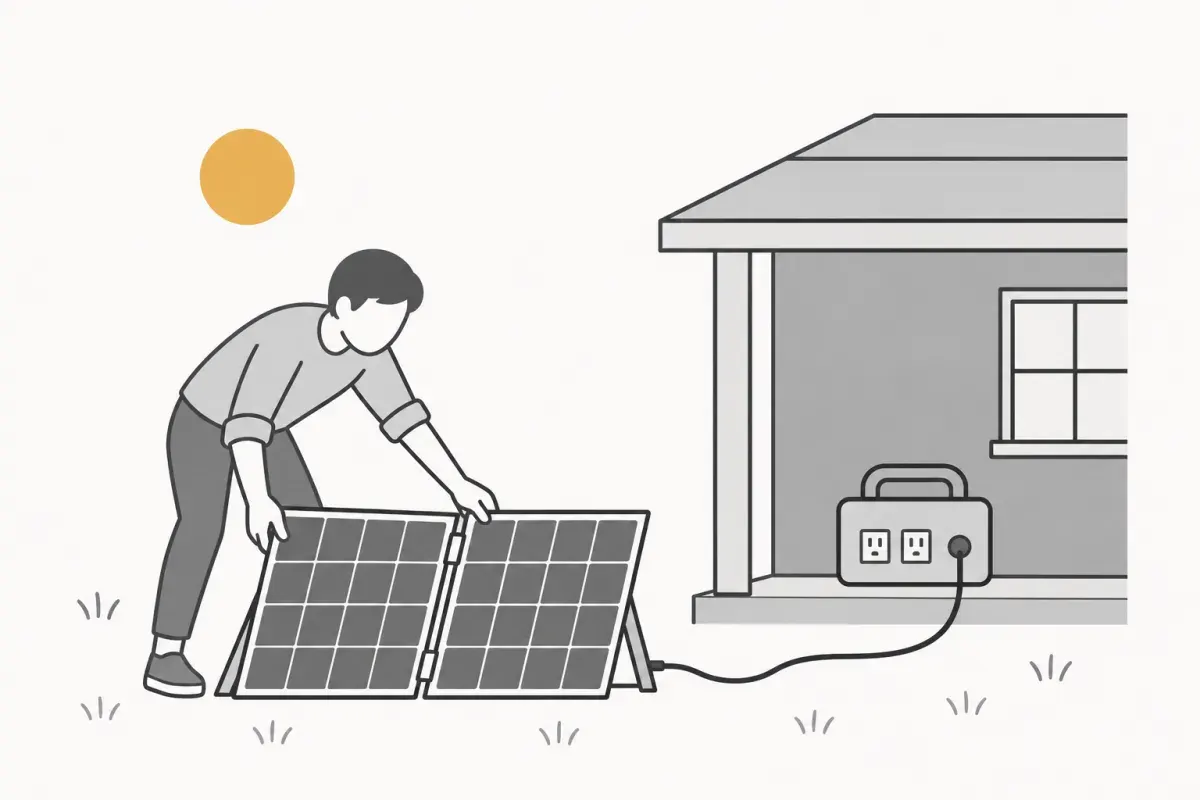
Watts are half of it. Every station also has a voltage window, and a high wattage rating paired with a low voltage ceiling is hard to reach with ordinary panels. A panel above the maximum voltage can destroy the station.4 Some stations with a high minimum won't start charging from a single panel, so match the panel's open-circuit voltage to the station's range before you buy either.
Each brand's own panels are the easy route and usually charge fastest on its stations. Other makes work, but check the voltage first. Remember, too, that a station feeds whatever is plugged in before it charges the battery, so a running fridge eats into your solar. Our ranking of portable solar panels is the place to compare panels.
Expansion is a model feature, so check it on the box
If you think you'll want more runtime later, buy a station that takes add-on batteries. It lets you start with a mid-size unit and add storage when a longer outage shows the need, in place of replacing the whole thing. Neither logo guarantees this. Some compact models leave expansion out to save size.5
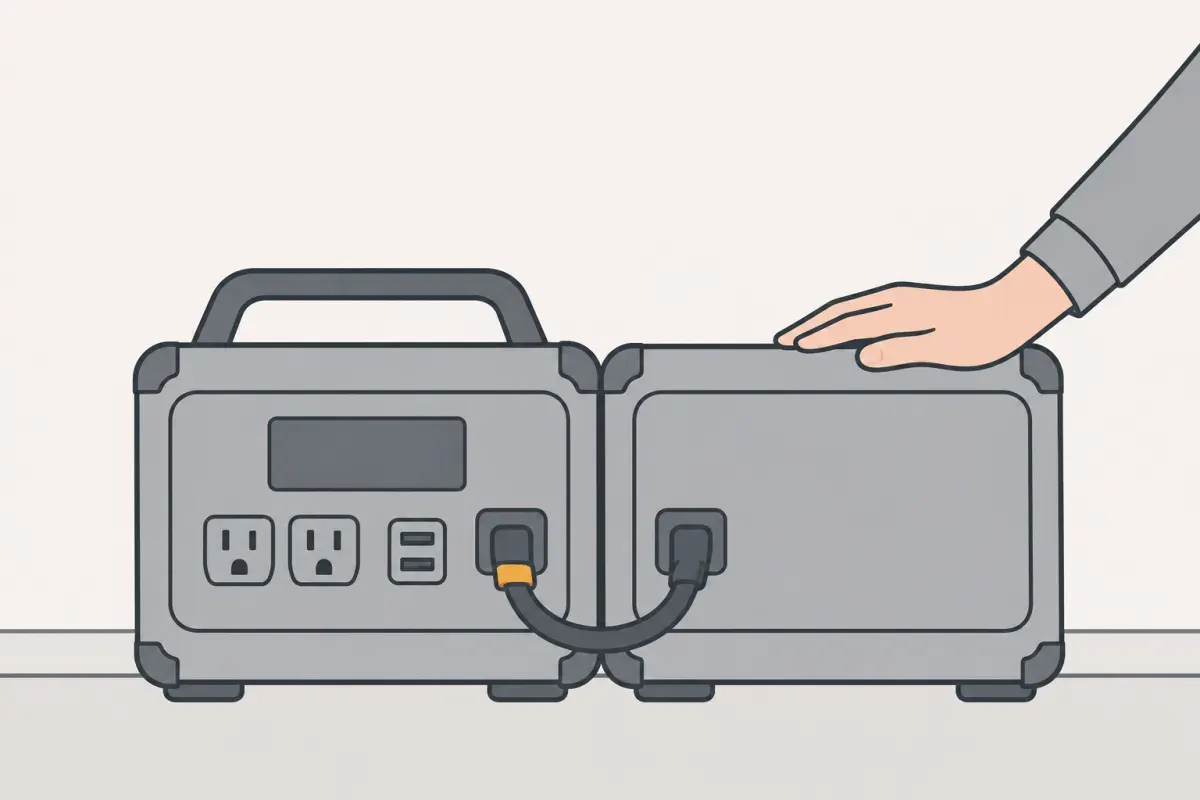
Then check that the batteries exist. A station sold as expandable is only useful if you can buy the matching battery today.6 Look at how the expanded system recharges, too: more storage on the same input means a longer refill.
There is another route: two smaller stations in different rooms can serve a house better than one big one, and either can go to a campsite. The trade is less total storage than one large unit. If you want one system feeding the house, expand; if you want power in two places, buy two.
Size the station before you pick the brand
A station that's too small is the wrong one whichever name is on it. Three terms do the work. Watt-hours (Wh) are how much it stores, watts (W) are how much it can run at once, and surge is the brief start-up kick a fridge or pump needs. Read the label on your largest appliance and choose a continuous output comfortably above it.
Then be honest about runtime. Plan on getting about 80% of the rated capacity out of any station.7 For a kitchen fridge through a full day's outage, 2,000 Wh is the floor.8
Advice splits on how much margin to buy. If your outages are short and the list is phones, lights and a router, buy small and save the money and the lifting. If the fridge has to last days, or something important depends on it, buy up, and know where the next charge is coming from.
“A large battery isn't helpful at all without a practical way to recharge it.”
Check chemistry and warranty on the exact model
Battery chemistry and warranty vary inside each brand, so read them for the model in your cart. You want lithium iron phosphate, written LFP or LiFePO4, which lasts several times as many charge cycles as older NMC cells. Current models lean that way, but earlier Jackery stations used NMC with far shorter cycle ratings, and not every EcoFlow has been LFP either.9 That matters most with clearance stock and used units.
Warranty length is a moving target. Published figures for Jackery run from three years to five, so look up the current term yourself, note whether it starts at purchase or delivery, and register the station, since registration can add time. Read the exclusions as well: using another brand's panels or cables can void the cover.10
If a desktop computer has to stay on through a flicker, confirm the model has a UPS mode and find a test of its switchover. Not every station is fast enough.
What to do next
Start at home, not on a product page. Write down what you need to run, read the wattage labels, and if the fridge is on the list, put a cheap plug-in meter on it for a day. That gives you a capacity and an output to shop for.
Then pull up one EcoFlow and one Jackery at that size and compare four lines: charging input from the wall, solar input and voltage range, whether it takes extra batteries, and weight. Past a certain size you'll be rolling it, not carrying it, so look for wheels and a sturdy handle. Prices on both move often, so check what each costs today.
If the two are close, let your recharging plan break the tie. Short grid windows or a solar-first setup favour the higher input. A station that mostly waits in a closet for the next outage can be the simpler, cheaper one. Our rankings of portable power stations and home backup power stations show how current models compare.
Before you buy either brand
- What is my biggest appliance?: Continuous output should sit comfortably above its wattage
- How long must it run?: Plan on about 80% of the rated watt-hours
- Where does the next charge come from?: Wall, solar or generator, decided before you size up
- Can this model take extra batteries?: And can you buy those batteries today
- Is it LFP, and what's the warranty?: Check both for the exact model, not the brand
Those two tabs are easier to close than they look. Once you know what you need to run and how you'll refill the battery, one of the stations will fit that plan better, and that's the one to buy. Size it right and either name can do the job.
Reviews and rankings
- 1Primal Survivor “The maximum input on EcoFlow products is much higher than similar-capacity Jackery models.”
- 2Project Farm · 16:41 “To make this an apples-to-apples comparison while also taking into consideration power bank efficiency, the Jackery came out on top as the fastest charging power station.”
- 3Foremost Picks · 5:58 “The main compromise Jackary made was cutting the solar charge rate from 800 W down to 400. For solar focused users, that means longer recharge times out in the field.”
- 4collinstech · 20:16 “If you mistakenly go and carry a solar panel that the voltage is higher than the volt of your PV input for your power station, you are going to fry your power station instantly.”
- 5Foremost Picks · 4:01 “Before buying, keep in mind that you can't expand this later with extra batteries. They remove that to keep it compact.”
- 6The Old Jarhead · 7:58 “if you're buying a power station that says it is expandable, make sure you can get batteries for it”
- 7The Old Jarhead · 2:33 “So, it's a good rule of thumb to always figure you're only going to get about 80% of that total capacity.”
- 8poweroutage.us “For a 24-hour outage scenario, 2,000 Wh (Bluetti Elite 200 V2 or comparable) is the minimum recommended capacity.”
- 9poweroutage.us “Earlier Jackery models used NMC chemistry with shorter cycle ratings of 500 to 800 cycles.”
- 10Primal Survivor “the warranty will be void if you use the power station with other brands of solar panels or other cables, try to fix it yourself, or forget to charge it regularly!”