




The full story
By the Storedwatts editors · Published Nov 20, 2026
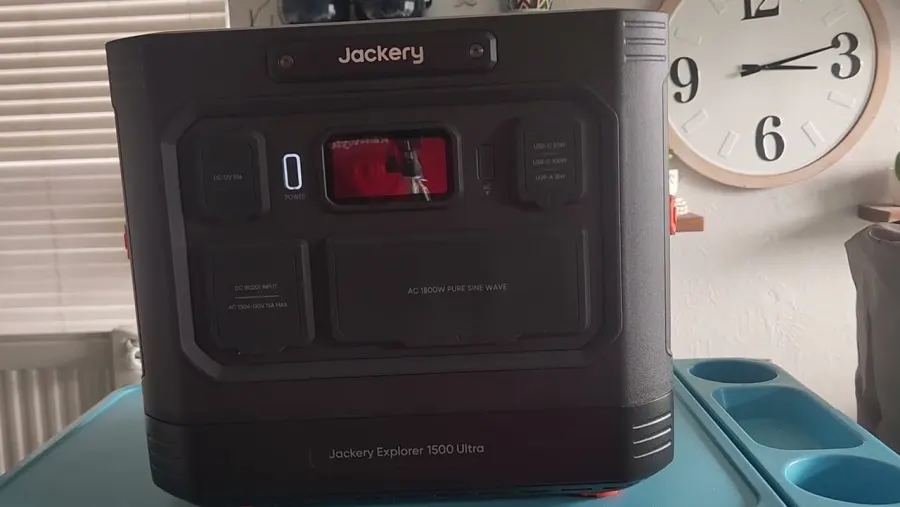
The Explorer 1500 Ultra is Jackery's rugged mid-size station, and most of what has been written about it agrees on the strengths. The disagreements are about motors: what it will start, and what makes it shut off. Here is how it holds up, starting with the fridge.
A kitchen fridge overnight from 1536 Wh, with an idle draw to budget for8.3/10
It will run a full-size kitchen fridge through the night, and usually well past it. Watt-hours (Wh) are how much a station stores, watts (W) are how much it can run at once, and surge is the brief start-up kick a fridge or pump needs. This one stores 1536 Wh, and usable capacity is widely liked.
The measured tests are strong. The Solar Lab's result was the best that channel has recorded: "This power station was 98% efficient."1 GySgt67 reports the longest fridge run: "I have gotten 21 hours out of this solar generator and powering my kitchen refrigerator."2 Minute Man Solar's fridge and EBPMAN's large double-door model both ran for a shorter stretch, still comfortably overnight.
The catch is the inverter's own appetite. The Solar Lab found the idle draw slightly above some rivals, and John Cadogan describes the same overhead. Leave the AC outlets on with nothing plugged in and the battery drains by itself, so switch them off between jobs.
Kettles and an air fryer at 1800W, a well pump and a small compressor refused7.4/10
Heating appliances are easy for it; motors that start under load are a gamble. Jackery rates the inverter at 1800W continuous with a 3600W surge peak. The Solar Lab saw it reach that surge figure without complaint, and The Electric Viking ran a pair of big appliances together, to his own surprise.3
The failures are specific. GySgt67's air fryer ran, but his well pump would not start.4 John Cadogan ran a grinder, drill press, band saw and circular saw, "but not a small compressor."5 The Breakdown YT saw it pass a compressor start on a full battery, then trip into overload protection on a later restart at a lower charge, needing a manual reset.
“A unit that passes at full charge, but trips at 30% is not a reliable backup.”
A few smaller notes. Better Together Homestead's miter saw ran only once, though the saw itself may have been at fault. Minute Man Solar disliked seeing the voltage sag as the load continued, and there is no split-phase output for large household appliances. The port count is modest, with USB-C on the lean side, though a 12-volt car socket remains.
1.5 Hours at the wall, and 800W Max of solar through a pair of Jackery ports8.3/10
Wall charging is fast and simple. Jackery quotes 1.5 hours for a full charge, and the cable goes straight from outlet to station.6 The Solar Lab beat the maker's figure: "it went from zero to full in an hour and 21 minutes in our testing".7 Tech Man Pat found the standard mode slower than that, and the quiet charging mode slower again.
Solar is good for the size, with limits. The 800W Max is split across a pair of inputs, and Better Together Homestead credits Jackery for raising the ceiling while noting it is small beside a true off-grid system. GySgt67 refilled it from a pair of folding panels in a single sunny day.
The fine print matters if you own other brands' panels. Minute Man Solar is "not a fan of the charge controller because it's only from 16 to 60 V and up to 12 amps per input."8 The inputs use Jackery's own plug, so an adapter may be needed, and Turner Way points out there is no dedicated fast vehicle charger for it yet.
Dropped on concrete, hosed down and hard to hear9.1/10
Build quality is praised almost without exception. It has been dropped onto concrete by several channels, left out in the rain while charging and had water poured or sprayed straight onto it, and it kept working each time.

“We dropped this thing from over a meter multiple times and it has survived all of the drops.” but “it's just sitting on the ground, all the dust that accumulates around it is going to get sucked up into here.”
It is also quiet. EBPMAN Tech Reviews places it among the quietest stations the channel has handled, and The Solar Lab says the same of it against other Jackery units.9 Jackery rates the LiFePO4 cells for thousands of cycles, and the warranty extends when you register.
The water rating has conditions. Turner Way notes that Jackery's marketing shows it in the rain while the manual carries strong cautions against that, and the protection depends on the port covers being shut.10 The bottom-mounted vent can pull in dust from the ground. The Breakdown YT recorded the fan stepping up sharply under a sustained load, with the rear panel running noticeably hot.11
About 38.6 lbs on a centered fold-out handle8.3/10
For this much battery it is easy to move. At about 38.6 lbs it is lighter than most stations of its capacity, and portability is widely liked. Turner Way credits the centrally mounted handle for making the lift feel balanced, and The Solar Lab calls picking it up easy.
Light for the class is not the same as light. Tech Man Pat puts it best: "This is portable, not weightless."12 It suits a carry from vehicle to campsite, garage or work area, not a long walk. There are no tie-down points for securing it in a truck bed.
A UPS that kept a toaster running, no light and no battery port7.3/10
The backup features work, within limits. EBPMAN pulled the plug mid-toast and mid-engraving and both jobs carried on, and Turner Way recommends the fast switchover for a computer, a network or a security system. Minute Man Solar found the ceiling: "this will only run about 1,300 W as a UPS" before it switches to straight battery power.13
The app is simple and connects easily, with charge limits, schedules and mode settings. Tech Man Pat wanted deeper customization, and Minute Man Solar notes there is no automatic AC restart after a full shutdown. The screen is bright and shows the basics.
Two omissions come up again and again. There is no built-in light, which puzzled Better Together Homestead: "I don't know why they did not put a light on the 1500 Ultra."14 And the battery is fixed at 1536 Wh, with no expansion pack of any kind.
A steep price per watt-hour, paid for the toughness
Price gets less attention than anything else here, and what is said is cautious. At $1,199 it is not an entry-level buy. Minute Man Solar ran the sums and called the cost per watt-hour "a pretty steep $1.06."15
There is a case for it. GearJunkie points out that it is both cheaper and lighter than Goal Zero's comparable Yeti, though with fewer ports and a thinner accessory range. Better Together Homestead rates it level with Jackery's own larger station for farm use, which costs less. You are paying for the weather resistance and the quiet, not for cheap storage.
Our verdict
Buy the Explorer 1500 Ultra if the station will live outdoors, in a truck, at a campsite or on a job site, and its main outage job is a fridge and small electronics. Skip it if you need to start a well pump or an air compressor, or if you expect to add capacity later, because it has no expansion port. Before ordering, look up the start-up draw of any motor you plan to run and compare it with the 3600W surge peak. Then register the unit, since that is what extends the warranty.
10 sources quoted in this story (15 notes)
- 1The Solar Lab · 5:18 “This power station was 98% efficient. That's higher than any power station we have ever seen here at the lab ever.” but “it used about 21 watts every hour just sitting there on, which is a little higher than some other units”
- 2GySgt67 · 12:05 “I have gotten 21 hours out of this solar generator and powering my kitchen refrigerator.”
- 3The Electric Viking · 4:00 “Surprised because I didn't think this thing would be capable of running both of them at the same time, but yeah, it was.”
- 4GySgt67 · 23:15 “This even went ahead and powered my air fryer. I was so astonished.” but “Now, I tried to run my well pump off of this. Unfortunately, it would not do it.”
- 5Auto Expert John Cadogan · 12:17 “for devices that suck a lot of electricity briefly on startup, it will surge up to 3.6 kilowatts or 3,600 watts. That's pretty impressive.” but “it'll run my grinder, my drill press, my band saw, and my circular saw for wood cutting, but not a small compressor.”
- 6Auto Expert John Cadogan · 11:04 “You just plug the supplied cable straight into the wall and straight into the Explorer 1500 and the charging is a done deal in about an hour and a half.”
- 7The Solar Lab · 5:51 “it went from zero to full in an hour and 21 minutes in our testing, which is pretty good” but “But we've seen other brands where if you say yes, charge fast, it will charge in like in this case it would be like 40 minutes.”
- 8Minute Man Solar · 5:20 “this charges at almost 1,200 W from an outlet. I was getting around 1,163 pretty consistently.” but “I'm not a fan of the charge controller because it's only from 16 to 60 V and up to 12 amps per input.”
- 9EBPMAN Tech Reviews · 10:35 “This is one of the quietest battery backup solutions or generator solar generators that I've had. It is super quiet”
- 10Turner Way · 3:05 “Jackery actually show this on their website as being waterproof, and they show it being used in the rain. But, in the manual, there are some strongly worded cautions against that.”
- 11The Breakdown YT · 12:18 “that exterior durability is real. It is not marketing.” but “around the 14-minute mark, the fan stepped up hard. A noticeable jump, not a gradual ramp.”
- 12Tech Man Pat · 1:19 “But it is packed into a body that weighs only 17.5 kilos with a really nice bold flat handle” but “17.5 kilos is good for the class, but it's still 17.5 kilos. This is portable, not weightless.”
- 13Minute Man Solar · 5:32 “this will only run about 1,300 W as a UPS before it just switches over to straight battery power.”
- 14Better Together Homestead · 12:32 “this one doesn't have a light. I don't know why they did not put a light on the 1500 Ultra.”
- 15Minute Man Solar · 10:32 “But the price per whole watt on the 1500 Ultra is at a pretty steep $1.06.”