





The full story
By the Storedwatts editors · Published Nov 19, 2026 · Updated Nov 20, 2026
The R1500 gets good marks nearly everywhere and one serious question mark. The price, the charging and the port selection are liked; the doubts are all about how far the AC side can be trusted. The chapters below start with what you pay and what you get out of it.
A low price for 1152Wh, and a warning to spend more9.4/10
Value is the R1500's strongest suit, praised almost without exception. At $899 it stores 1152Wh on LiFeP04 cells, and it is often sold for less. Jasonoid priced it at a discount, did the sum per watt-hour and said "that is a crazy price".1
EEVblog2, Eric Hernandez and Darbin Orvar all reach the same conclusion in calmer words: fair or better for the capacity and the inverter you get.
The dissent comes from The Solar Lab, which liked the price and little else. It named two rival stations as more reliable and efficient, and worth paying extra for.2 That is the trade to weigh: the saving is not in doubt, the inverter is.
Less than the 1152Wh label on AC, and fridge runtimes that range widely7.3/10
Expect a good part of the rated capacity at the outlet, not all of it. Watt-hours (Wh) are how much a station stores; some of that is always lost in the inverter that makes household AC. Jasonoid's first measurement came in a little under his own target for usable capacity, and a second run did better.3 Eric Hernandez called his result on par with stations of this size, while EEVblog2 could not get the full rated figure out of it.
For a fridge, the answer depends heavily on the fridge. Our Kilkenny Homestead reports that "the unit ran the fridges for 25 1/2 hours" before it shut down.4 The Gadgeteer's household got far less: "our fridge and freezer running for about 5 hours".5 Non Lost Souls reports a longer run still from a single fridge freezer.
One detail to plan around: the AC inverter switches off with a small reserve still in the battery, as TDCatTech and Eric of East Texas Homestead both found. The DC ports keep going to empty.
Saws and kettles at 1800W, table saws and big surges refused7.5/10
The 1800W inverter handles most household and job-site loads, and stops at large motors. Watts (W) are how much it can run at once; surge is the brief start-up kick a motor needs. Tech Man Pat ran a drill and a circular saw from it on site.6 Eric of East Texas Homestead pushed it slightly past its continuous rating and it held, and landpet ran an angle grinder.
Table saws are the limit. GoTechGeek ran a microwave and a band saw, then reports that with the table saw "the overload protection kicked in so it killed all power".7 Jasonoid's large table saw failed to start as well, and The Solar Lab's unit shut off at once on a heavy surge.
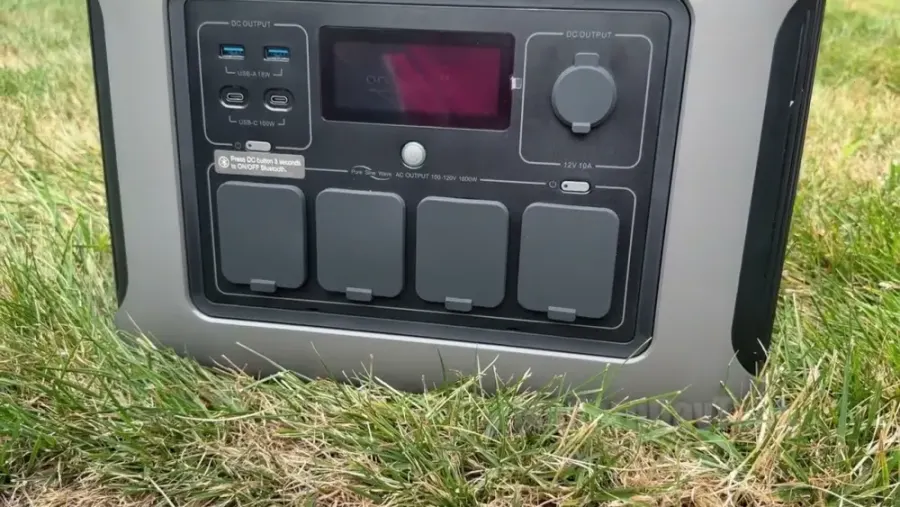
The front panel is well liked. Eric of East Texas Homestead: "two USBC 100 watt ports", both at full power together.8 There are four AC outlets and two wireless charging pads on the lid. Power quality is argued: EEVblog2 saw a clean sine wave at high power, while The Solar Lab measured low output voltage and TDCatTech watched the frequency waver under load.
0-80% in 45 min on the box, over two hours on one stopwatch7.7/10
Wall charging is quick in most hands, though seldom as quick as the maker's figure of 0-80% in 45 min. Tech Man Pat timed a charge at "roughly more like an hour" and was still impressed.9 Our Kilkenny Homestead reports about the same.
The Solar Lab's unit is the outlier, and a large one.
“Instead of the advertised 45 minutes, it took 2 hours and 8 minutes to charge fully. Another major failure.”
Part of the gap is settings. Eric of East Texas Homestead found the charge rate is capped by default and the faster mode has to be chosen in the app, something the manual does not make clear. Eric Hernandez and Darbin Orvar both saw the full input rate in fast mode; Jasonoid and The Solar Lab did not.
The solar input is rated by ALLPOWERS at 650 W, generous for a battery this size. Jasonoid got close to that ceiling with enough panels, while The Solar Lab fell well short. A single folding panel will fill it slowly.
A switchover a PC never noticed, and a UPS that TDCatTech would not trust7.1/10
The switch from wall power to battery is fast. Jasonoid measured it quicker than ALLPOWERS advertises, and Tech Man Pat found it "fast enough for my PC and monitor to not flicker at all".10 The Gadgeteer pulled the plug repeatedly with the same result.
Speed is not the same as dependability. TDCatTech had the inverter drop out without warning and concluded that for a fridge on UPS duty "it's just not reliable enough".11 EEVblog2 says plainly that it should not be treated as an uninterruptible supply.
Expansion is listed as a feature, and the two battery ports are there. Jasonoid and Eric Hernandez both describe add-on batteries, but The Solar Lab and TDCatTech could not find any to buy.12 The app splits opinion too: Eric Hernandez found it clean and easy, The Gadgeteer called it thin, and Jasonoid struggled with Wi-Fi setup.
Quiet at light loads, with inverter faults and an overheat on record7.1/10
The casework and the noise level are liked; the fault reports are what hold it back. EEVblog2 opened one up and was impressed by the inside, less so by the outer shell. TDCatTech and The Gadgeteer both call it quiet until the load climbs, though Tech Man Pat found the fan loud enough to matter when sleeping nearby.
The trouble is on the AC side. TDCatTech returned one unit to ALLPOWERS for an unreliable inverter and saw error codes on the replacement.13 The Solar Lab ran a heavy load and reports "it overheated and died after just 25 minutes".14 Our Kilkenny Homestead had the AC outlets refuse to switch back on once after a deep discharge.
Others had the opposite experience. Darbin Orvar ran one for a week of constant charging and discharging and says "we haven't had one single issue".15 Eric of East Texas Homestead ran his at full output down to shut-off with no overheating. It is not waterproof, and it comes with a multi-year warranty.
16.7 kg on deep side handles, in a bulky case6.0/10
It lifts well and carries poorly over distance. The handles get near-universal approval: EEVblog2 calls them "nice, big, beefy" and likes the undercut grip.16 Darbin Orvar and The Solar Lab say much the same.
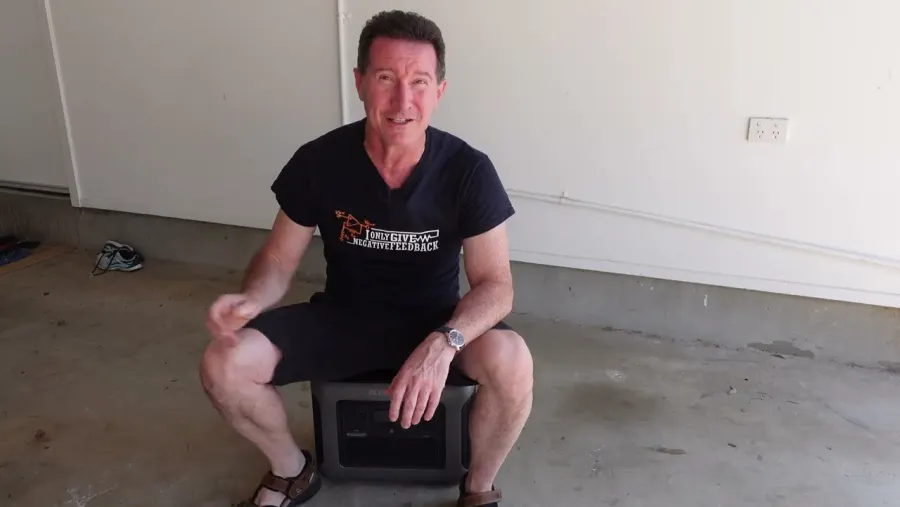
The case is the complaint. Jasonoid finds it bulkier than other stations with the same battery and inverter, and TDCatTech calls it large for the capacity.17 At 16.7 kg with handles on the sides only, it is a two-hand lift; GoTechGeek found it awkward with one hand. Tech Man Pat's advice is to stay close to the car.
Our verdict
Buy the R1500 if price per watt-hour matters most and the job is forgiving: a fridge in a short outage, a campsite, tools from the truck. Skip it if a computer, a medical device or an unattended fridge depends on the AC output never dropping, because the inverter has faulted in more than one test. When it arrives, run it hard on AC for a day and time a full wall charge while the return window is open. Confirm that expansion batteries are in stock before counting on them.
10 sources quoted in this story (17 notes)
- 1Jasonoid - Solar Power, Batteries, and More! · 2:16 “you can get the price down to $422 or about 36 per wat hour that is a crazy price”
- 2thesolarlab.com · written review “At $499, the price point is one of the best things the R1500 has going for it.” but “Both alternatives are more reliable and efficient, making them worth the extra investment.”
- 3Jasonoid - Solar Power, Batteries, and More! · 10:48 “13 hours is a pretty decent run time for a medium-sized Power Station like this” but “I measured only 950 WS of usable capacity this result is 82.4% of the advertised capacity which is a little below my goal of at least 85%”
- 4Our Kilkenny Homestead · 5:14 “the unit ran the fridges for 25 1/2 hours before shutting down when it reached 5% battery life to protect the battery”
- 5the-gadgeteer.com · written review “Real world for us had our fridge and freezer running for about 5 hours”
- 6Tech Man Pat · 6:18 “Now, using it on the job, you know, construction works well. that handled my drill and circular saw”
- 7GoTechGeek · 2:40 “this Powers most appliances so a microwave yes you can do a microwave you can do a band saw” but “when I turned on the table saw the overload protection kicked in so it killed all power”
- 8Eric | East Texas Homestead · 2:37 “we actually have two USBC 100 watt ports which is great I love having these high power PD ports on the front”
- 9Tech Man Pat · 3:51 “And in my testing, it was roughly more like an hour, which is still insanely fast.”
- 10Tech Man Pat · 5:51 “That's fast enough for my PC and monitor to not flicker at all.”
- 11TDCatTech · 7:38 “another thing I like about it which you don't get on all of these kinds of devices is the DC is a switchable button” but “if you want to have something like a fridge running on this and using it as a UPS or something similar on a fridge you can't because it's just not reliable enough”
- 12thesolarlab.com · written review “We actually really loved the addition of these on the top of the unit.” but “The ALLPOWERS website claims the unit is expandable, but no compatible expansion batteries are available.”
- 13TDCatTech · 5:00 “one of the biggest selling points for me for this product is that it's so quiet” but “the AC output so the AC inverter is unreliable I have already returned a unit to all powers”
- 14thesolarlab.com · written review “At 43.5 minutes, it lasted longer, translating to about 83% efficiency—acceptable” but “When we tested it by running a 1,560W load, it should have lasted about 44 minutes. Instead, it overheated and died after just 25 minutes.”
- 15Darbin Orvar · 2:10 “this really taxes the inverter inside and we haven't had one single issue”
- 16EEVblog2 · 4:15 “I do like how the handles are nice, big, beefy, and they're undercut in there, too.”
- 17Jasonoid - Solar Power, Batteries, and More! · 27:02 “just be aware it is a little bit more bloated or bulky than other brands that have tested with the same size battery and inverter combo”