


The full story
By the Storedwatts editors · Published Nov 19, 2026
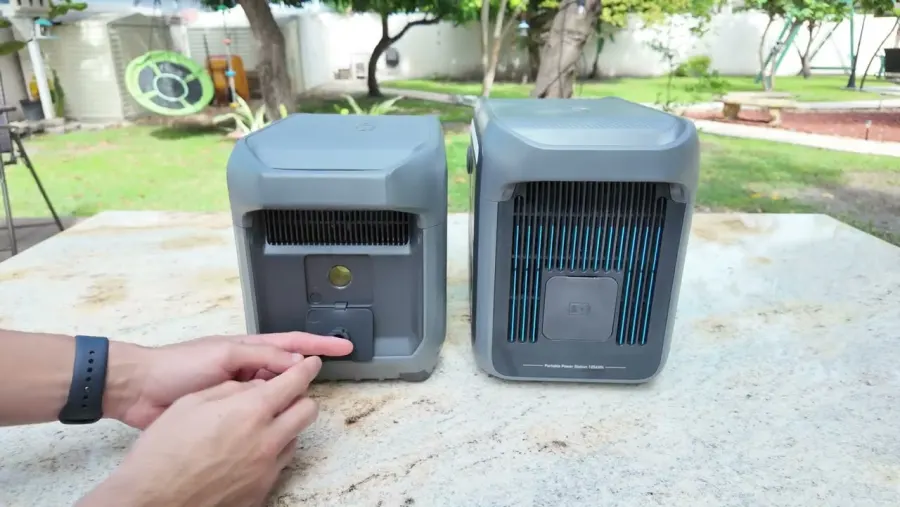
Anker rebuilt the C1000 to be smaller, lighter and faster to charge, and gave up the expansion port and the light to get there. The measured tests largely support the trade. What follows is how much power it really holds, what it will and will not run, and where the cuts hurt.
Most of the label reaches the outlet9.3/10
Usable capacity is praised almost without exception. Watt-hours (Wh) are how much energy a station stores, and every station loses some of it converting battery power to AC. Anker rates this one at 1,024 Wh, and Outdoor Gear Lab's load test put the usable figure well above the average for power stations: "we measured 890 Wh out of its advertised 1,024 Wh".1
For an outage, that means roughly half a day of full-size fridge. Fer's Reviews ran one until the battery shut off and reports "the fridge ran for 12 hours and 38 minutes".2 Other fridge tests land in the same range, and lighter loads such as a router, lights and a laptop stretch much further.
The limit is the size of the battery, not how well it uses it. Heavy loads drain it quickly, and nothing can be added later.
“If your plan is a space heater, a hair dryer, or a power tool for hours, this is not the unit.”
Kettles and microwaves are fine, big motors are not8.4/10
The 2,000 W inverter is strong for a station this size and is consistently praised. Watts (W) are how much it can run at once, and surge is the brief start-up kick a compressor or motor needs. MrYouWho made toast and boiled a kettle on it at the same time, and counts induction cooktops and fridges as fair game.3 The high-wattage USB-C ports also charge laptops without tying up an AC outlet.
The ceiling is firm. ReeWray Outdoors found that "if you exceed 2,000 watts, even by a little bit, it will start throttling that voltage on you until it eventually cuts off".4 The Technology Man could not get a large induction-motor table saw to start, because the start-up current was too high.5
It is also a standard household-voltage unit. As Texas Home Lab puts it, "it won't power a central air conditioner, an electric dryer, or a well pump on its own".6
A 49-minute wall charge, and slow solar with small panels7.3/10
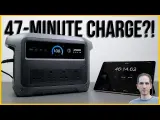
Wall charging is the standout, and Anker's 49-minute claim holds up when independently timed. Several stopwatch tests came in at or just under the maker's figure. The fastest mode is not enabled when the unit arrives; Nest Nomad & Beyond and others point out that it has to be switched on in the Anker app.7
Solar is the weaker half of the charging score. Anker rates the input at 600 W, and with the right panels in ideal sun that means a refill in a couple of hours. Reaching that figure takes higher-voltage, heavier panels. With common portable ones, thepowerstationguide.com warns, "you'll hit a practical ceiling around 170–200W rather than the rated 600W".8
Car charging is slower still. From a standard vehicle socket a full charge takes most of a day's driving, and the faster alternator charger is a separate Anker accessory. Check whether your panels need an adapter cable for the solar input, as one is not always in the box.
One-hand carry at 11.3 kg9.3/10
Portability is praised almost without exception. The station weighs 11.3 kg, and The Technology Man calls it the lightest of this capacity he has tested to date.9 It is also more compact than the first generation, which matters under a desk or in a packed camper van.
The side handles make it simple to move from room to room or into a car. The praise stops at the trailhead: this is a station for vehicles and houses, not for carrying any distance on foot.
“It's portable in the sense of vehicle friendly, not backpack friendly.”
A quick UPS, but no expansion port and no light6.3/10
App and UPS features divide opinion, mostly because of what Anker removed. The UPS function itself works well: plug a computer or router through the station and it switches to battery when the grid drops. MrYouWho says "it's so quick your computer doesn't even reboot".10 The display is widely liked too, with port-by-port detail on the unit so the app is optional for daily use.
The cost is flexibility. The first C1000 accepted an expansion battery and this one does not, so in thepowerstationguide.com's words "you're locked into 1,024 Wh forever".11 The built-in light bar is gone as well, and Beard's missed it during a nighttime outage.12
The app earns mostly good marks for charge limits, adjustable input and time-of-use scheduling. MacRumors had a firmware update fail repeatedly for several days, so expect the occasional rough edge. Anyone planning to run a CPAP or other medical device should check with the device maker.
Solidly built, and loud when pushed8.1/10
Build quality is consistently praised, and the complaints are almost all about fan noise. The case is described as sturdy and rugged, the LFP cells are rated by Anker for a long cycle life, and the warranty is long for the category.
Noise depends on what you ask of it. Under light loads MrYouWho found it so quiet he asked "is it even on?"13 Charge at full speed or run a heavy appliance and that changes: CleanTechnica says the fans "make it sound like the unit is going to take flight".14
There is a workaround for bedrooms and offices. Turning the charging speed down in the app keeps the fans quiet or off, at the cost of a longer refill.
Good value at the street price8.3/10
Value is consistently praised, with one condition: few think it should be bought at list. Anker's MSRP is $699.99, and that figure is the one thing that gives buyers pause. Tech Aeris notes it is usually sold for much less and is well worth the sale price.15
At its discounted price, Outdoor Gear Lab and thepowerstationguide.com both rank it among the stronger buys in its class on performance and cost together. If the listing shows full MSRP, waiting for the next sale is the sensible move.
Our verdict
Buy the C1000 Gen 2 if you want a light station that covers a fridge, router and lights through an outage of several hours and refills from the wall before the next one. Skip it if you need room to grow, since the capacity is fixed, or if small portable panels will be your main way to recharge. Before paying, check that the price is well under the $699.99 list, then enable fast charging in the app and keep the unit out of the bedroom when it charges.
11 sources quoted in this story (15 notes)
- 1outdoorgearlab.com · written review “Using our light bar load bank, we measured 890 Wh out of its advertised 1,024 Wh.”
- 2Fer's Reviews · 11:19 “Before the battery finally shut off, the fridge ran for 12 hours and 38 minutes. And according to my power meter, it used 0.73 kWh.”
- 3MrYouWho · 2:01 “Four AC outlets can do up to 2,000 W continuous and 3,000 W peak. So, kettles, portable induction cooktops, fridges, all that stuff is fair game.”
- 4ReeWray Outdoors · 7:49 “if you exceed 2,000 watts, even by a little bit, it will start throttling that voltage on you until it eventually cuts off.”
- 5The Technology Man · 6:24 “all with a pure sine wave output important for sensitive electronics, which I confirmed with my oscilloscope” but “It couldn't run my 1800 W table saw, also with an induction motor. The startup current was too high.”
- 6Texas Home Lab · 3:45 “because it puts out 2,000 W, it can handle things smaller stations just can't, like a microwave, a coffee maker, or a space heater on low.” but “It runs 120 V devices, so it won't power a central air conditioner, an electric dryer, or a well pump on its own.”
- 7Nest Nomad & Beyond · 3:30 “The genuinely clever bit is that the Anker can charge from the mains and the solar at the same time and it prioritizes the solar.” but “you need to switch on the fast charging mode in the [music] app. It's not on out of the box.”
- 8thepowerstationguide.com · written review “The 49-minute full charge claim held up under independent testing.” but “you'll hit a practical ceiling around 170–200W rather than the rated 600W”
- 9The Technology Man · 0:41 “This is a lightest 1,024Wh power station I've tested to date at just 11.3 kg.”
- 10MrYouWho · 5:39 “It switches over in about 10 milliseconds. So, if you've got your PC or your NAS or your modem router plugged into it and the grid drops, it's so quick your computer doesn't even reboot.”
- 11thepowerstationguide.com · written review “The app lets you dial input anywhere from 100W to 1,600W in 100W increments, which gives you genuine flexibility” but “The trade for a lighter, faster, more capable base unit is that you're locked into 1,024 Wh forever.”
- 12Beard's · 7:01 “There is also no built-in light bar. I missed it during a nighttime outage”
- 13MrYouWho · 4:24 “under lighter loads, under about 200 W, it's down around the 20 dB mark, which is basically, guys, is it even on?”
- 14cleantechnica.com · written review “Specifically, this unit can support 4,000 charge cycles, which is excellent.” but “has integrated fans that kick on and make it sound like the unit is going to take flight.”
- 15techaeris.com · written review “But the price is usually much lower when it’s on sale and well worth that sale price.” but “The only major point that might have some buyers thinking twice is the price.”