



The full story
By the Storedwatts editors · Published Nov 20, 2026
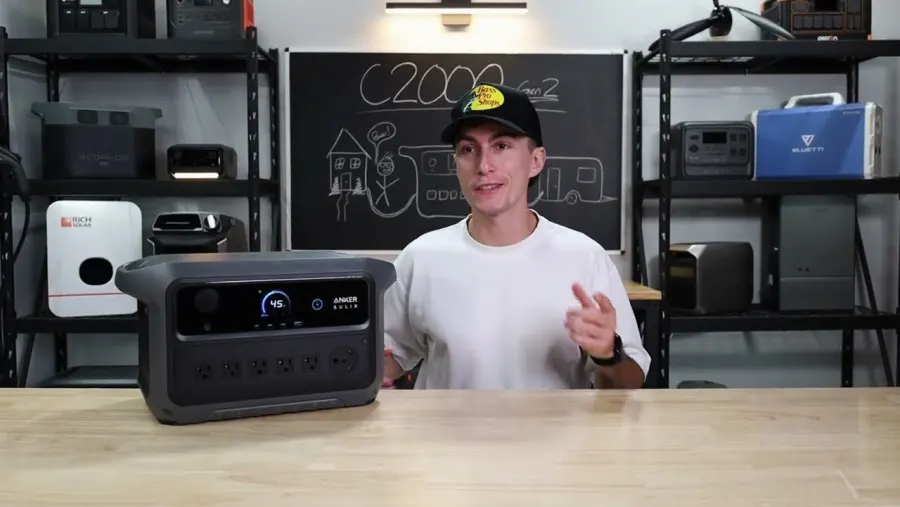
The C2000 Gen 2 is Anker's smaller, lighter successor to the F2000, and it has been run through measured capacity tests, RV weekends and real outages. The picture is consistent: strong on capacity, wall charging and noise, weaker on solar and whole-home hookups.
About a day of kitchen fridge, and an idle figure that depends on the outlets8.9/10
Most of the 2,048Wh reaches the outlet. Jasonoid "measured 1760 W hours of usable capacity" on AC, and other measured runs land a little higher.1 That is a normal to good share for a station with a built-in inverter.
In fridge terms, that is roughly a day. The Gadgeteer ran a household refrigerator "with typical usage for 22 hours", and other fridge runs fall on either side of that depending on the fridge.2 Anker's own fridge figure is longer than any of them, so treat it as a best case.
Air conditioning is the wrong job for it. J-Rod's Reviews tried it on a camper and got "at max like 2 hours on the air conditioner".3 Heaters and electric cooking drain it at a similar pace.
Idle draw is where the numbers split. Anker advertises a very low standby figure and several measured tests agree with it, but The Solar Lab saw "about 18 watts" with the AC outlets on.4 Switch the outlets off when nothing is plugged in and the question mostly goes away.
Kettles, microwaves and saws at 2,400W, with one shut-off warning8.6/10
The inverter runs nearly anything with a standard household plug. It is rated at 2,400W continuous / 4,000W peak, and it held up under kettles, microwaves, air fryers, a miter saw and fridge compressors. Tommy Callaway ran two kettles at full power without the output being cut back.5
Past the rating it protects itself: it sags the voltage or shuts down instead of carrying a sustained overload. Jasonoid adds a warning that pulling "over 1,800 watts for a significant amount of time" will shut off charging and the AC inverter.6 Other tests ran at the full rating without that happening, so check how it behaves with your own heaviest appliance.
The port mix is generous on AC and high-power USB-C, thinner elsewhere. The car socket and USB-A port are low-powered, and van users wanted more DC outlets. A few people also needed a moment to find the button that turns the AC outlets on.
An hour at the wall, most of a day in the sun7.2/10
Wall charging is the strong suit. The Electric Viking went from "0 to 100% in 1 hour and 3 minutes" on a plain wall outlet, and other timed runs came in somewhat longer but still well under two hours.7 The app can turn the charge rate down so a shared circuit or a small generator does not trip.
Solar is the limit. The input tops out at 800W Max, which is small for a 2,048Wh battery, and the expansion battery refills through the same ceiling.8 Versus Lab would not pick this station for a recovery plan built around panels.
The practical details are mixed too. Connecting panels is simple and the input accepts full-size ones, but panels with MC4 or Anderson plugs need an adapter cable. Charging from a car socket is slow enough to be a last resort.
Near silent, cleanly built, and prone to sliding on its feet9.0/10
Noise is the build point almost everyone lands on. The fans stay very quiet under heavy load and during a full-rate wall charge, which is unusual for a station of this output.

“It's near silent pretty much all the time, even when you're thrashing this thing, fully charging at 2,300 W, boiling a kettle, things like that.”
The casework is described as sturdy and tidy, and Anker's warranty and support come up as reasons to trust it. There is no long-term record yet, so that is a statement about fit and finish, not about years of service.
Two small complaints repeat. The feet do not grip, so the station can slide when a cord is tugged or a stiff plug is pushed in.9 And it is still a real lift: TechLine calls it "roughly 25% lighter than many power stations in this class", which helps on the way to the car but not on stairs.10
An RV outlet and a quick UPS, short of whole-house backup6.3/10
This is appliance backup, not panel backup. The RV-style outlet lets it feed a travel trailer or a light manual transfer switch, and that is as far as home integration goes. Transfer switch work belongs with a licensed electrician.
The outlet is not split-phase. Millis Construction plugged it into a backup panel and reported: "My 220 stuff wouldn't work, but everything that is regular 110 would."11 PowerStationHub makes the wider point that rivals offer automatic whole-house integration and Anker does not.12
The UPS mode is quick. Jasonoid measured a switchover of a few milliseconds, and computers and routers stayed on through it.13 For a CPAP or other medical device, check with the device maker before relying on it.
Expansion is real but bounded. An add-on battery roughly doubles capacity, yet sources disagree on how far it can go, and Android Authority says it is limited to a single extra pack.14 The app is widely liked, with storm-alert charging and time-of-use scheduling. The station has no built-in light, and the glossy display is hard to read in daylight for some.
Good value on sale, with a price that moves8.6/10
At its sale prices this is one of the better deals in the class. Anker lists it at $1,199.99, and the cost per watt-hour drew praise at launch, alongside the point that it undercuts the older F2000 it replaces.
The catch is that the price has moved around a lot. Android Authority's advice is to treat the lower sale figure as the real price and wait for it.15 The expansion battery is priced separately, so add it to the total if a two-day plan is the goal.
Our verdict
Buy the C2000 Gen 2 for a quiet station that covers a fridge and the kitchen basics for about a day and resets from a wall outlet or generator in about an hour. Skip it if solar is your main way to recharge, or if you need split-phase power or automatic whole-house backup. Before ordering, check the current price against $1,199.99, since it has swung widely, and decide up front whether you will want the expansion battery.
11 sources quoted in this story (15 notes)
- 1Jasonoid - Solar Power, Batteries, and More! · 7:24 “measured 1760 W hours of usable capacity. This result is 85.9% of the advertised capacity, which is right on par with our goal of 85%.”
- 2the-gadgeteer.com · written review “In my testing, I ran our refrigerator with typical usage for 22 hours.”
- 3J-Rod's Reviews · 11:35 “we'd only get at max like 2 hours on the air conditioner. So, this isn't made for that.”
- 4The Solar Lab · 5:58 “In terms of efficiency, it was about 89% which is [music] huge. That's like better than most other power stations.” but “it uses about 18 watts, which is not the worst compared to other units in its class. It's kind of average.”
- 5Tommy Callaway · 8:45 “Two kettles going at full power. It didn't uh cut the power down like some of those other inverters do.”
- 6Jasonoid - Solar Power, Batteries, and More! · 22:32 “Just be aware if you pull a over 1,800 watts for a significant amount of time, it will shut off charging and the AC inverter.”
- 7The Electric Viking · 3:58 “In our real-world testing, using only basic AC wall charging, I went from 0 to 100% in 1 hour and 3 minutes.”
- 8Versus Lab · 3:52 “the wall alone gets you there in 88 minutes” but “that bigger pack still refills through the same 800 W solar limit.”
- 9Tommy Callaway · 5:53 “The C2000 Gen 2 is also very quiet. It operates at 30 dB and the F2000 operates at around 40 dB.” but “so it'll slide around really easily if bumped or moved or the cords are pulled or tugged on”
- 10TechLine · 2:04 “It weighs about 18.9 kg, which is roughly 25% lighter than many power stations in this class.”
- 11Millis Construction · 4:05 “You could also plug it directly into your backup panel.” but “My 220 stuff wouldn't work, but everything that is regular 110 would.”
- 12PowerStationHub · 2:31 “For homeowners who want seamless automatic whole-house backup, rather than individual appliance backup through extension cords, EcoFlow's integration is a capability Anker cannot”
- 13Jasonoid - Solar Power, Batteries, and More! · 9:52 “Now when it comes to the UPS, the UPS was also very good at only 7.2 milliseconds.”
- 14androidauthority.com · written review “This is automated disaster preparedness, and I like it!” but “The C2000 Gen 2 is limited to just one booster.”
- 15androidauthority.com · written review “I would take that latter figure as the baseline when you’re considering buying one, and at that price, it’s a fantastic deal.” but “Volatile pricing, wait until it's $999 or below”