Home battery backup without solar panels
A battery charged from the wall can carry your essentials through an outage, if you size it and plan the refill.
By the Storedwatts editors · 5 min read · Published Nov 20, 2026
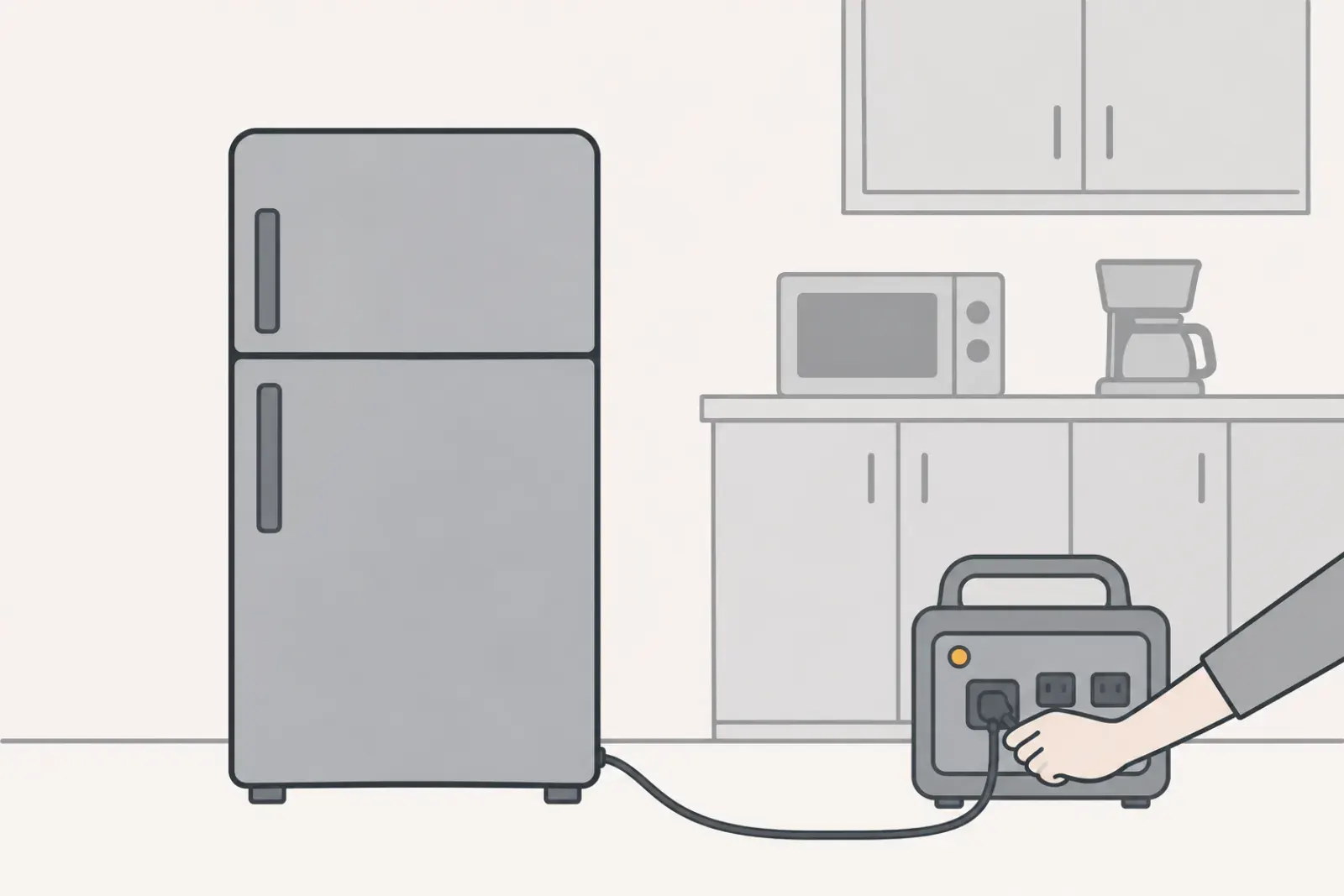
The power goes out, the fridge goes quiet, and you start doing sums about the food inside. You don't have a roof for panels, or you rent, or you simply don't want a solar project. You want something that takes over when the grid drops.
A battery charged from an ordinary wall outlet, or wired to your home's panel, does that job. It needs no solar to work. The catch is that it holds one tankful: what you stored before the outage is what you get. So the right size and a refill plan matter more than any feature.
“this is a misconception that a lot of people have, that you can only get batteries for your house if you have solar. And it's not the case.”
Size it to your essentials, not your house
Buy for the loads you can't do without, and no bigger. Three terms first. Watt-hours (Wh) are how much energy the battery stores, watts (W) are how much it can run at once, and surge is the brief start-up kick a fridge or pump motor needs.
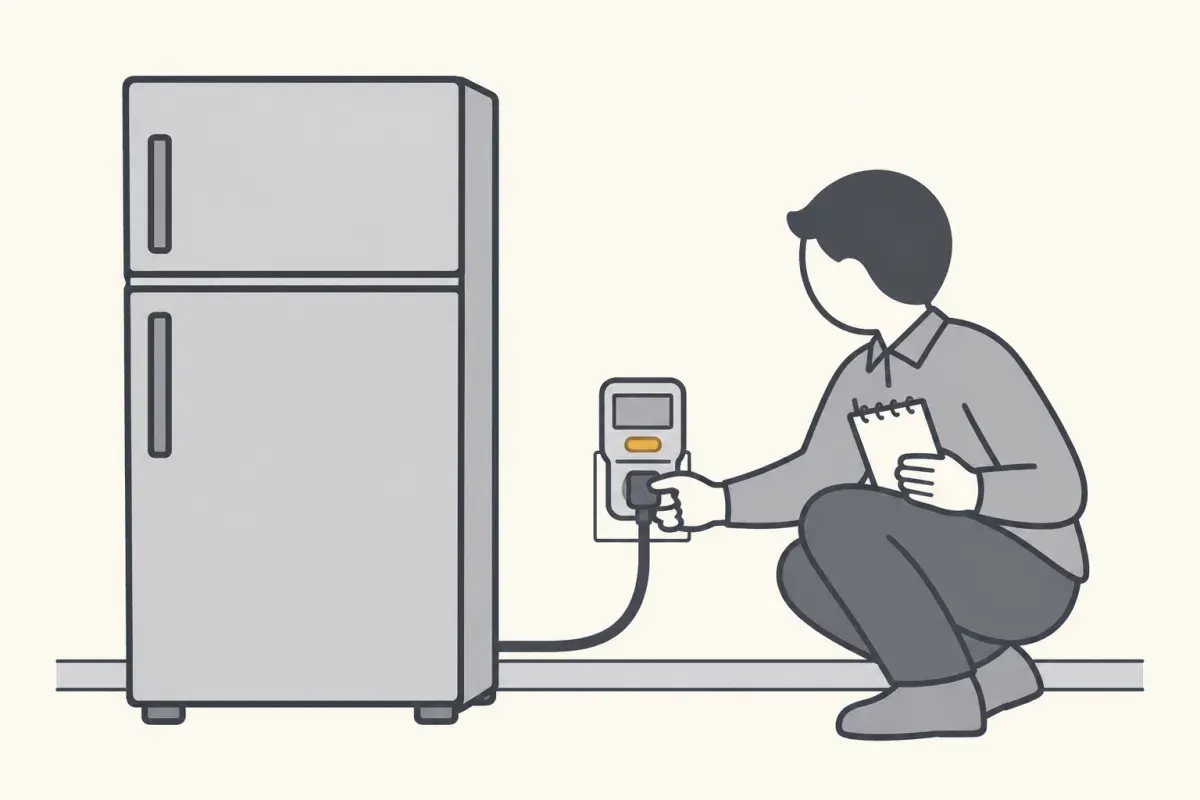
Write down each thing you'd run in an outage, its watts from the label, and the hours you need it. Multiply, add it all up, then add 20 to 30 percent, because the inverter wastes some energy and you shouldn't plan to hit empty.1
Fridges, freezers and pumps cycle on and off, so label maths misleads. Plug the appliance into a cheap watt meter and read its total over a full day.2 Expect any battery to give back less than its label says, so treat the rated figure as a ceiling. Measure first, shop second.
Back up a few circuits and leave the big appliances out
A short list of circuits is the right target for most homes: fridge and freezer, the router, some lights, the furnace in a cold climate, and a sump pump if your basement depends on one. These loads are small or intermittent, and a battery carries them for a long time.
Central air, heat pumps, electric water heaters and space heaters are different. They can empty a single battery in a few hours. An average home uses about 30 kWh a day, more than one typical home battery holds, so running everything means buying several.3
Whole-home backup also changes the hardware. In the US it usually calls for 240 V split-phase output, which dryers, ovens and water heaters need.4 If that is your goal, pick a system that makes that voltage on its own and accepts extra batteries. If it isn't, don't pay for it.
How much backup do you need?. What has to keep running in an outage?
- Fridge, router, a few lights: A plug-in station by the fridge; no installer needed
- Essential circuits, furnace, sump pump: One installed battery feeding a critical loads panel
- The whole house: Several batteries with 240 V split-phase output
Without panels, plan how you'll refill it
Once the battery is empty, it stays empty until the grid returns or you bring power to it. That is the one cost of skipping solar, and you can plan around it.
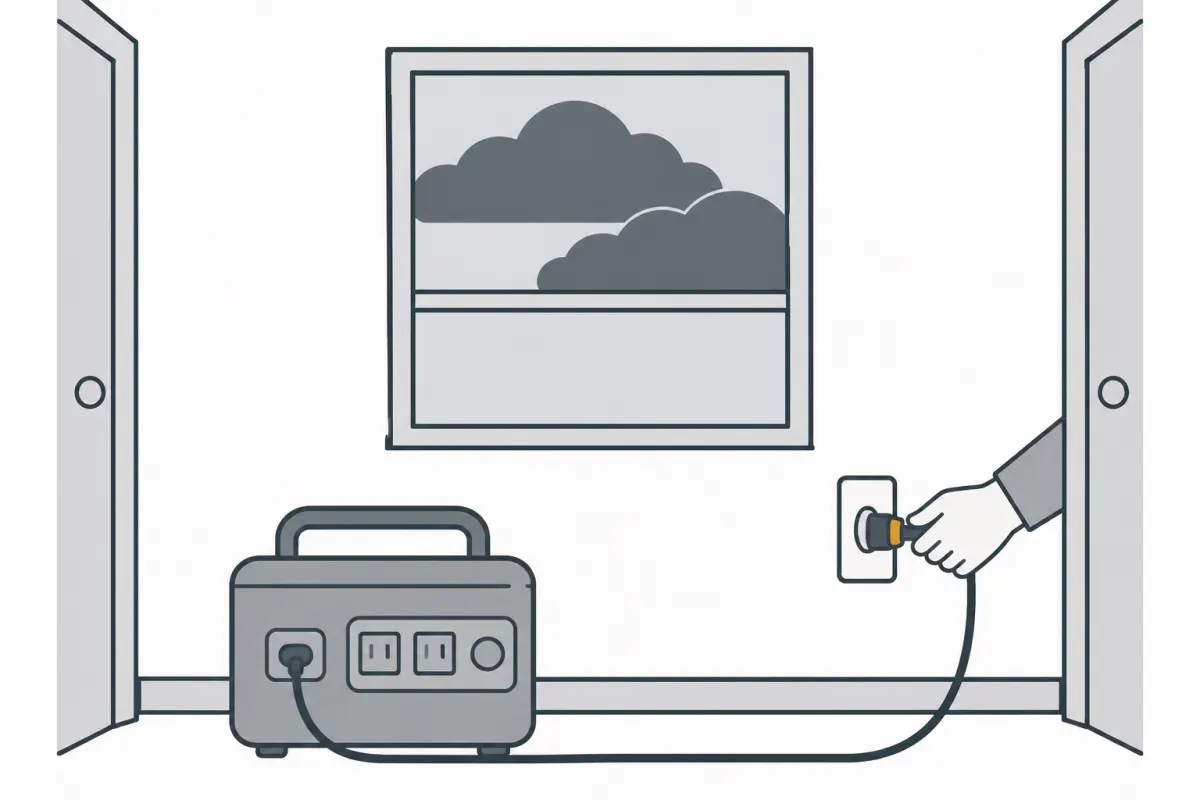
First, favor fast wall charging. It lets you top up in the window between a storm warning and the outage, and refill quickly at a friend's house or anywhere with a working outlet. A small station is easy to carry to that outlet. A large one isn't.
Second, for long outages, think about pairing the battery with a fuel generator. The generator runs for a short stretch to refill the battery, the battery carries the house quietly overnight, and both last longer than either would alone. Not every battery accepts a generator, so check for that input.5 Look for pass-through power too, which keeps your loads running while the unit charges.
Apartment living often rules a generator out. Then buy a little more capacity and know where your nearest working outlet is likely to be.
“A grid-tied battery without solar is, effectively, a one-time reserve. Once it's empty, you're waiting for the grid to come back on like everyone else.”
Check output, switchover and chemistry before price
Capacity tells you how long; the inverter tells you what. If the continuous watt rating is too small for everything running at once, the unit shuts off with plenty of battery left. Add up the loads that could overlap, then check the surge rating against your biggest motor.
Switchover speed matters if a desktop computer or network gear is on the circuit. Many batteries take over too slowly to act as an uninterruptible power supply, and some setups need up to two seconds.6 A fridge won't notice. A PC will.
For chemistry, choose lithium iron phosphate, written LiFePO4 or LFP. It typically lasts 2,500 to 6,000 cycles.7 Older NMC cells wear out much sooner, and a spec sheet that only says "lithium-ion" probably means NMC. Check the exact model, because one brand can sell both.
Decide whether it moves or stays
Portable and installed backup are different purchases. A plug-in station sits by the fridge, runs it from its own outlets and needs no electrician. An installed battery connects to your panel through a transfer switch or smart panel and takes over the chosen circuits automatically, with no extension cords.
Weight decides more than you'd think. The big units are hard to move even on wheels, and cheaper ones often drop the wheels and pull handle altogether. In an apartment, a small plug-in unit is the practical choice, and two smaller stations in different rooms can serve you better than one giant.
Wherever it lives, keep it somewhere temperature controlled. Charging an LFP battery below freezing can damage it permanently.8 Check a stored unit's charge every few months, and keep it full if outages are the reason you bought it.
| Model | Weight (lb) |
|---|---|
| BLUETTI Elite 100 V2 | 25 |
| Goal Zero Yeti 1500 | 52.8 |
| Anker SOLIX F3000 | 91.5 |
| Anker SOLIX F3800 Plus | 136.7 |
Buy it for outages, then take these steps
A battery without solar earns its place where outages are frequent or long. Its value is protection, much like insurance, so payback is hard to pin down. An installed battery sized for essential circuits typically costs $6,000 to $8,000.9 A plug-in station that covers a fridge costs a fraction of that, and it can pay for itself the first time it saves a freezer full of food.
Bill savings are less certain. On a time-of-use rate you can charge at cheap night prices and run on the battery at peak, but the saving is modest unless the gap between those rates is wide.10 Our take: buy for outages and count any saving as a bonus.
Then work through the steps below in order.
- Look up how often outages hit your area and how long they last
- List your essential loads and measure the fridge with a watt meter
- Choose plug-in or panel-connected; for an installed system, get several quotes and ask about state and utility rebates
- Pick LFP chemistry with enough continuous watts and surge for your loads
- If solar might come later, buy a solar-compatible, expandable system now
The next time the fridge goes quiet, you want to know exactly what happens: which loads stay on, for how long, and where the next charge comes from. Do the sums on your essentials, choose a battery that fits them, and settle the refill plan while the grid is still up. Panels can wait, or never come at all.
Reviews and rankings
- 1blank2done-rebuild.pages.dev “Always add 20-30% to your total. Inverters aren't 100% efficient, and you don't want to drain the battery to 0%.”
- 2ReeWray Outdoors · 9:21 “with one of these watt meters, you can precisely measure just how much power your fridge consumes over, say, a 24 or 12 hour period”
- 3Palmetto “If you want to power your whole home during an outage, you’ll likely need multiple batteries.”
- 4ReeWray Outdoors · 24:55 “in most cases, you're going to want a backup power solution that can deliver 240 volt split phase”
- 5poweroutage.us “You can charge some batteries with a generator, but not all. It depends on the system controller and inverter.”
- 6poweroutage.us “A battery system switches over in anywhere from 20 milliseconds to two full seconds depending on the setup. This is fine for most appliances, but don't expect near-zero switchover time from a battery.”
- 7The Outdoor Post · 3:18 “LifePO4 lithium iron phosphate lasts 2,500 to 6,000 cycles and does not release oxygen when heated, which is what feeds battery fires.”
- 8Pacific Pines Ranch · 21:21 “Lithium iron phosphate batteries perform poorly in extremely cold weather, and charging below freezing can cause permanent damage.”
- 9DEV Community “A 10 kWh home battery system with installation typically runs between $6,000 and $8,000.”
- 10Palmetto “Savings from this scheme can be modest and are really only successful in places with significant differences between peak and off-peak rates”