





The full story
By the Storedwatts editors · Published Nov 20, 2026
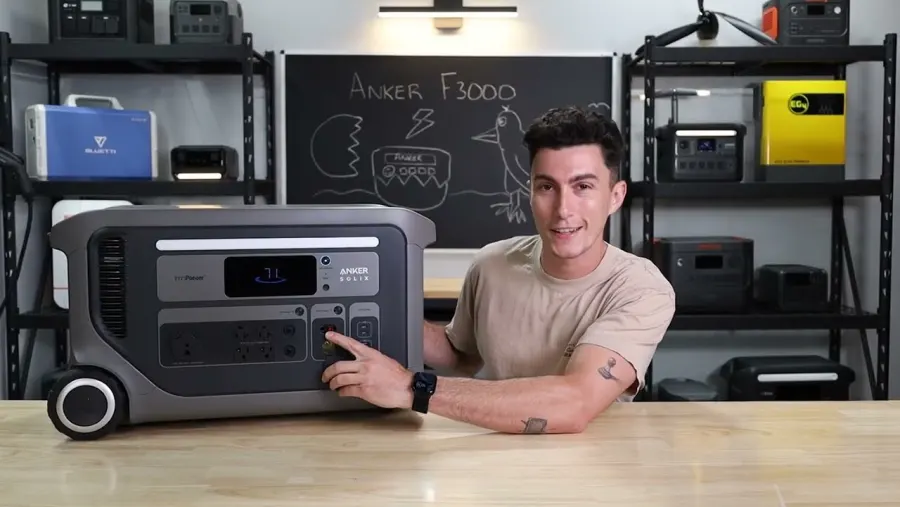
The F3000 is Anker's mid-size home backup station, and the evidence on it is unusually deep: many measured discharge tests, long-term follow-ups and a few full home installs. The picture is consistent on capacity, charging and noise, and less settled on how well it fits into a house.
A high share of the 3,072Wh under real loads, less at a trickle8.4/10
Most of the rated capacity is usable, and that is the strongest reason to buy it. Watt-hours (Wh) are how much a station stores, and Anker rates this one at 3,072Wh. Eric Hernandez ran it to empty and reported "a usable capacity of 94.2%"1, and notebookcheck.net drew most of the rating at a heavy continuous load.2
Not every test lands that high. HOBOTECH scored it at "a respectable, but totally average 86%"3, and notebookcheck.net found efficiency fell when the draw was small. The pattern is simple: the harder the inverter works, the less of the battery it wastes.
For an outage, that translates to about a day of essentials such as a fridge, freezer, lights and Wi-Fi, by Minute Man Solar's reckoning. Erin Lawrence found it could run a new full-size refrigerator for "as long as two or even three or more days"4, then saw runtime fall sharply once an old, inefficient fridge joined it.
The caveat is idle draw. Several measurements put it low for a unit this size, but Minute Man Solar first saw a much higher figure than Anker quoted, and The Solar Lab Plus measured a higher idle a year on than it had when new. If the inverter will sit on for days with little plugged in, expect that to eat into the total.
A generator fills it fastest, through a cable sold separately7.9/10
Charging is quick by any route, and quickest from a generator or an RV pedestal. Anker gives a charge time of 1 hr 18 min, and notebookcheck.net's measured run backed that up, "taking just 1:20 hours"5. A standard household circuit charges at about half the top rate, so The Electric Viking and cleantechnica.com both saw noticeably longer from an ordinary wall outlet.
“This is literally the fastest I've ever been able to recharge a portable power station. This is awesome.”
The full-rate input runs through the RV-style cable, and it is not in the box. The diysolarforum.com write-up put it bluntly: "That's another $100."6 The same cable lets a compatible generator pass its full output through to the house while the battery charges, which few rivals match.
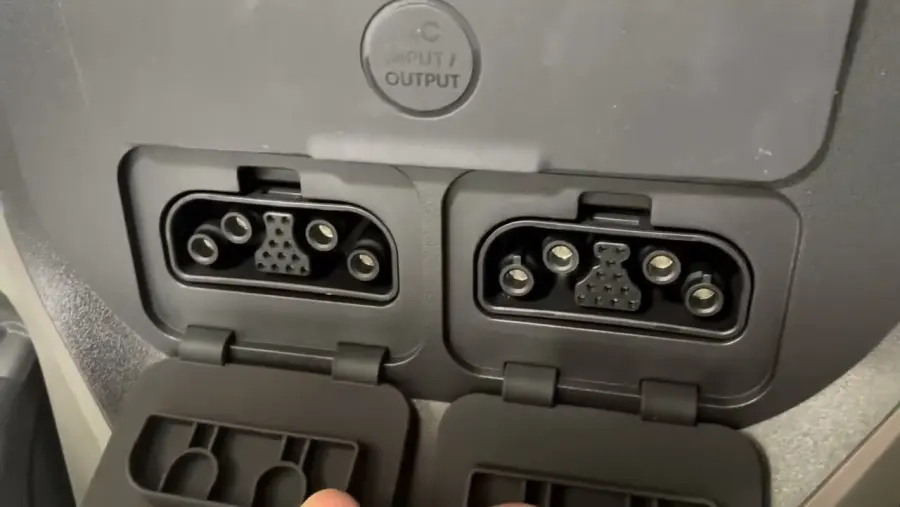
Solar input is 2,400W Max, per Anker, split across two ports. Only the lower-voltage port uses a standard connector; the high-voltage solar port and the wall charging lead are both proprietary, a choice that draws complaints from HOBOTECH, Silver Cymbal and Minute Man Solar alike. Lose the wall lead and a spare from another device will not fit. HOBOTECH also warns it cannot be charged from a standard car socket, and there is no alternator charger.
Full power from the RV outlet only, and household sockets packed tight7.1/10
The inverter is strong, but where the plug goes matters. Watts (W) are how much a station can run at once, and surge is the brief start-up kick a motor needs. Anker rates this one at 3,600W / 7,200W surge, yet the full continuous figure is available only from the RV outlet. The household outlets together are capped lower.
Within those limits it runs demanding gear. Jasonoid started a table saw, Jack Out The Back ran a welder, Acavedo Nicolas kept an RV roof air conditioner going well beyond a demo, and The Solar Lab Plus pushed the surge past its rating. The limit shows when two big kitchen loads share the household outlets: The Review Hub tripped an overload with an air fryer and a microwave together.7
The outlet layout is the common gripe. HOBOTECH asked who decided to "cram four standard 20 amp outlets into an area smaller than a drink coaster"8, and bulky power bricks do block their neighbours. Two smaller notes: the AC output shuts itself off when the load stays very low for a while, and cleantechnica.com could not charge a Cybertruck from it because the output is not grounded.
One unit powers selected circuits by hand, and split-phase takes a second station6.9/10
Home integration is where the F3000 suits some houses and not others. A single unit puts out one voltage only, so it cannot feed a well pump, dryer or other split-phase appliance alone. That takes a second F3000 and Anker's Double Voltage Hub, which doubles the bill.
For ordinary circuits it works. The Solar Pit connected it to a transfer panel and ran several circuits in a simulated grid-down test. Cleanerwatt's point is the catch: the switchover is not automatic, and the F3000 is not compatible with Anker's own home power panel.9
Anker's inlet box and smart meter add time-of-use and self-consumption modes, and ChiefBossJawn built a working bill-saving setup with a pair of stations that way. Those accessories are sold separately. Capacity can grow with expansion batteries, but only the F3000-specific ones; packs from the F3800 do not fit.
A switchover quicker than advertised, and an app that drops out7.5/10
The backup switchover is fast enough for desktops and routers. Jasonoid measured the gap on a scope and found "it's only 9.8 milliseconds"10, quicker than Anker's own claim, and The Review Hub's computer and router rode through a real outage. Silver Cymbal still considers the advertised figure slow for a computer. The Solar Lab adds a limit: the UPS cannot carry more than the charging rate of whichever cable is plugged in.
The app is easy and useful when connected. It shows runtime, lets the charge rate be dialled down for a weak circuit, and works over Wi-Fi from another room. Acavedo Nicolas and Discovery Review Hub both report it losing its connection more often than they would like.11
The sharper complaint comes from Erin Lawrence, who found it too easy to slip into EV mode, which disables the outlets, and said "sometimes they just wouldn't turn on without the app"12. The screen is bright but times out after a fixed interval with no always-on option, and it washes out in direct sun.
Hushed under heavy load, with a port flap that wore out in a year8.0/10
It is quiet and feels well made. The Solar Pit found it near silent at modest loads and still restrained at maximum output and input13, and Eric Hernandez heard nothing while drawing more than its rating. HOBOTECH's sound meter read higher than others, and Jasonoid called the fans a touch loud, so expect some noise when it is working flat out.
The case shows almost no flex, and Anker backs it with what HOBOTECH describes as "a 5-year manufacturer warranty"14. The small parts are weaker. On The Solar Lab Plus's long-term unit a rubber port flap did not last the year15, Silver Cymbal found the rubber feet very small, and Erin Lawrence wanted tougher wheels. There is no weather protection.
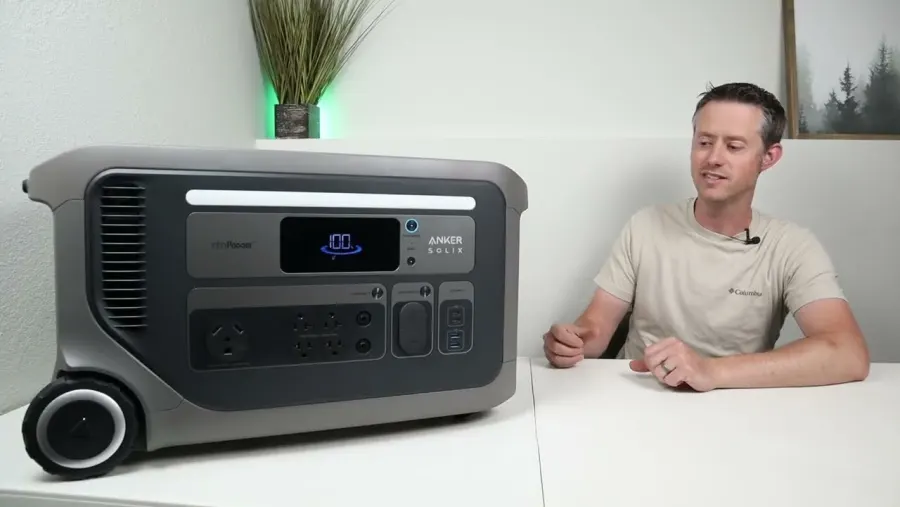
At 91.5 lb / 41.5 kg this is a roll-it, not carry-it, station. The wheels and telescoping handle make flat floors easy. Stairs and car boots are a two-person lift.
Worth it at street prices, harder to justify at list7.7/10
Value depends almost entirely on what is paid. Anker lists it at $2,599, and at sale prices HOBOTECH, Jasonoid and Cleanerwatt each rated it among the cheapest watt-hours for a large station. The Solar Lab's rule of thumb is that it is a good buy as long as the price "stays under two grand"16.
At full price the case weakens. Erin Lawrence names the price as the bigger downside of the package17, and The Solar Lab warns that more competitive units appear if it creeps up. The diysolarforum.com write-up prefers a rival for simple AC-only backup. Budget for the generator cable and RV cable too, since neither comes in the box.
Our verdict
Buy the Anker SOLIX F3000 for a quiet station that returns most of its 3,072Wh, covers a day of household essentials and refills quickly from a generator or a big solar array. Pass on it if the house needs split-phase power or automatic switchover from a single box, or if it has to be lifted often. Before ordering, price in the charging cables and any inlet box or hub the setup needs, and wait for a sale rather than paying list.
12 sources quoted in this story (17 notes)
- 1Eric Hernandez · 5:01 “it put out a total of 2,894 W hours. Doing the math, that gives this unit a usable capacity of 94.2%”
- 2notebookcheck.net · written review “we were able to draw almost 2,800 Wh at a continuous load of 1,800 W, which corresponds to a very good 91 percent” but “the Anker Solix power pack was not 100 percent convincing in terms of efficiency - at least in the lower load range”
- 3HOBOTECH · 4:13 “it scored 2650 W hours out of 3072 for a respectable, but totally average 86%”
- 4Erin Lawrence · 7:04 “I tried plugging in my brand new 36 cubic foot my refrigerator and was surprised to find the Solus could power it for as long as two or even three or more days.”
- 5notebookcheck.net · written review “The value for AC charging was also good, taking just 1:20 hours thanks to a charging speed of up to 2,992 W.”
- 6diysolarforum.com · written review “The Anker high voltage plug has a nice design, however. A button on the top of it signals to the power station to stop pulling current from the panels.” but “You also don't get a 3600 watt 30 amp generator charging cord either. That's another $100.”
- 7The Review Hub · 5:34 “I did run into overload once when I tried to run an air fryer and a microwave at the same time.”
- 8HOBOTECH · 6:45 “The 3600 watt outlet I was able to pull again 4,800 watts and hold it for several seconds without issue.” but “I'm wondering who thought it was a great idea to cram four standard 20 amp outlets into an area smaller than a drink coaster”
- 9Cleanerwatt · 17:26 “you can back up certain circuits in your home that way, but it wouldn't be automatic.”
- 10Jasonoid - Solar Power, Batteries, and More! · 6:13 “if we measure the distance between these two points, it's only 9.8 milliseconds. So, much faster than advertised.”
- 11Acavedo Nicolas · 3:51 “You can use the power station without it, but the app makes it easier to monitor what is going on.” but “It can lose connection more often than I would like.”
- 12Erin Lawrence · 9:09 “The app connection also means you can see what's charging and how long your power station has left” but “I did find it too easy to accidentally switch to EV mode, which disables the outlets, and sometimes they just wouldn't turn on without the app.”
- 13The Solar Pit · 5:21 “this one is virginly silent with modest loads and rather surprisingly quiet even under max loads and max charging inputs”
- 14HOBOTECH · 3:50 “As for the warranty, Anker does offer a 5-year manufacturer warranty.”
- 15The Solar Lab Plus · 1:01 “This power station has a very sleek yet rugged design. You can tell a bunch of thought and care went into [music] actually making the power station.” but “And under this flap that didn't make it a year, you have a Anderson output and a 12-volt car socket”
- 16The Solar Lab · 10:29 “As long as the price, in our opinion, stays under two grand, it's a good buy.”
- 17Erin Lawrence · 9:55 “I suppose the bigger downside might be the price of all this power.”