





The full story
By the Storedwatts editors · Published Nov 20, 2026
The AC200MAX has been measured, wired into vans and run through outages by a long list of independent channels and publications. They agree on its strengths and on its one obvious weakness. Here is what holds up, in the order a buyer should care about it.
About four fifths of the 2048Wh on AC, more by one measurement8.3/10
Expect roughly four fifths of the 2048Wh rating at the AC outlets. Watt-hours (Wh) are how much a station stores, and some is always lost in the inverter that turns battery power into household current. HOBOTECH's AC test: "we were able to score 1610 watt hours on a 2048 for 79 usable capacity".1 Minute Man Solar landed in nearly the same place on a steady load.
Will Prowse saw better, reporting "88 percent of its rated capacity at the inverter's output" on his unit.2 These are different tests on different loads, so plan around the lower figure and treat the higher one as a bonus.
For an outage, that is a kitchen fridge through the night and well into the next day. Scott Turner's unit still showed more than half its charge after the better part of a day on a fridge.3 Pinball Preparedness got a much shorter run from a different refrigerator, so the appliance matters as much as the battery.
One habit helps. UrbanArkOverland found the AC inverter eats into the battery just by being switched on, while the DC side barely does. Turn AC off when nothing is plugged in.
Kitchen loads and saws at 2200W, compressors hit or miss8.0/10
It runs ordinary household loads without fuss. Watts (W) are how much a station can run at once, and BLUETTI rates this inverter at 2200W continuous with a 4800W surge, the brief start-up kick a fridge or pump needs. Microwaves, kettles, toasters, an induction hob and miter saws all ran across the tests, and HOBOTECH found the ceiling a little above the label: "2600 watts seems to be about as far as we can push the 200 max".4
Motors are less predictable. AZ Expert's compressor tripped the AC output on start-up.5 The Kelley's Country Life ran a one-horsepower well pump, and HOBOTECH ran a small air conditioner fitted with a soft start. For an RV roof air conditioner, a soft start is the pattern that works.
The RV outlet is the favourite port, with a limit. A rig's shore power cord plugs straight in, but the inverter behind it is the same 2200W, and Verified Reviews puts it plainly: "you are limited to around 18A continuous".6 Smaller gripes are the rubber covers over the AC sockets, which get in the way, and the lack of an Anderson outlet.
The full 900W from solar, ≈5.5–6 hours from the wall brick5.6/10
Solar is the strong side and the wall is the weak one. BLUETTI rates solar input at 900W max through a built-in MPPT controller, and measured tests met it. HOBOTECH: "we were able to push 920".7 Minute Man Solar and The Kelley's Country Life saw the same on their arrays.
From the wall, the included brick takes ≈5.5–6 hours. CleanTechnica calls that "extremely slow when most comparable units can pull down between 1,000 and 1,800 watts from an AC outlet".8 The brick is large, has its own fan and uses a proprietary plug.
The workaround is to charge from the wall and solar together, which cut the wait to a couple of hours in several tests. A second brick does the same job but is sold separately.
A few details to check on arrival. Ray Loveless found the DC input defaults to car charging and must be switched to solar in the settings. Verified Reviews notes it blocks charging below freezing. Tool Review Zone had poor results with other brands' panels, though third-party arrays worked well elsewhere.
Plug-in power for an RV or tiny house, single-phase only at a home panel7.9/10
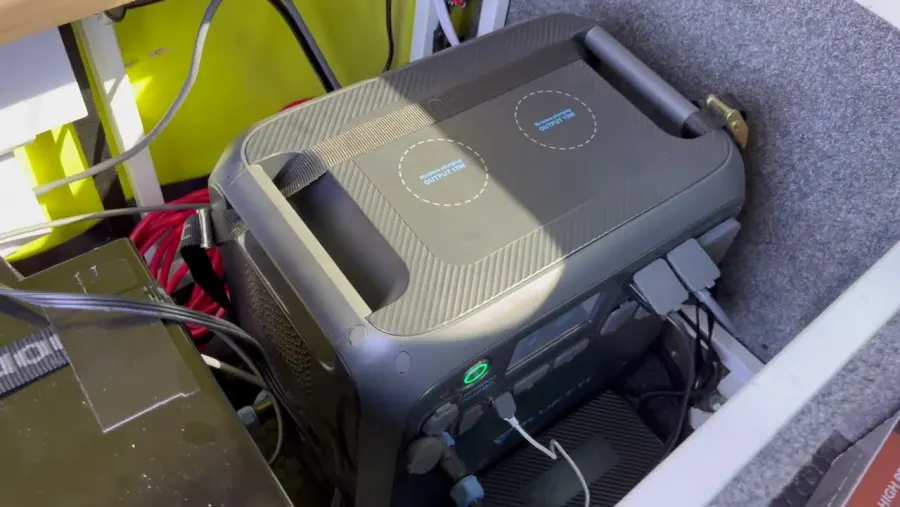
It suits an RV, van or tiny house better than a house panel. The RV outlet lets a rig plug in as if it were at a campsite pedestal. Tiny House Expedition ran a whole tiny house that way, and Dmitriy Adv dropped the station into a van as the complete electrical system with no separate inverter or charge controller to wire.
At home it is a single-phase station. The Kelley's Country Life fed a breaker box through an inlet plug that powers both sides of the panel, with the double-pole breakers switched off. Nothing that needs the higher voltage will run, and Pinball Preparedness ruled it out for his well pump.

“this is only 120 volts though and i really wish there was a 240 volt receptacle that would be very nice”
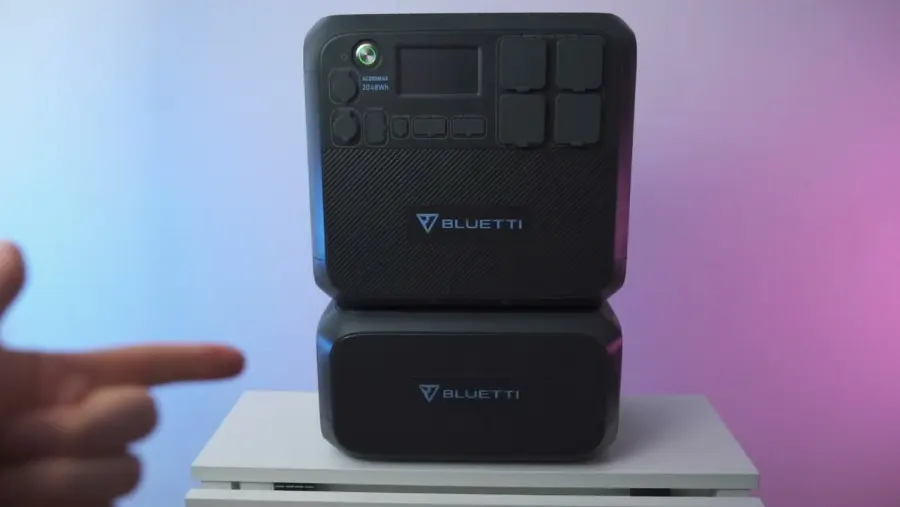
Expansion is the other half of the appeal. Two BLUETTI batteries plug into the side, and the station is widely described as a good starting point for a system that grows later. Check what BLUETTI requires before connecting any station to a home panel.
A simple Bluetooth app, no runtime clock and a UPS in dispute6.4/10
The app is easy and the extras are thin. It pairs over Bluetooth in seconds with no account, which is widely liked. There is no Wi-Fi, so nothing can be checked from away, and neither the screen nor the app shows time remaining, a complaint from both Tiny House Expedition and Minute Man Solar.
Do not buy it as a UPS. Tech Made Easy and HOBOTECH both say it has no UPS function at all.9 Verified Reviews ran it in pass-through and reports "transfer time is about 20 ms", fine for a router or TV and not for sensitive equipment.10
Expansion has a flaw worth knowing before buying the extra batteries. Will Prowse found that when solar starts up in the morning it charges only the main unit and leaves the expansion batteries asleep, and he would not buy them until that was fixed.11 Ray Loveless likewise had to switch outputs back on by hand after the battery ran down overnight.
The touchscreen is responsive and clear indoors. In direct sun it is dim, and Tool Review Zone found it hard to read even straight on.
Long-life cells in a 61.9 lb case, and a fan that splits the room7.6/10
The cells are the reason to expect a long service life. LiFePO4 chemistry and BLUETTI's cycle rating are praised across the board, and the casework and thick handles get the same treatment. The reliability record itself is thin, so read this as build quality, not a track record.
Fan noise depends on what the station is doing. The Kelley's Country Life calls it about the quietest unit he has tested, even near full load.12 Dmitriy Adv never hears the fan on DC loads. On wall power the story changes: the fan runs the whole time, and the brick adds its own.
“When recording audio, I had to switch off the AC200 Max as the fans under load became noticeable.”
Early software was the open question. Will Prowse's touchscreen locked up: "the screen would not respond to any form of input and this lasted for four hours".13 He advised waiting for firmware fixes at launch, and AskIve Solar expected updates to cure it.
At 61.9 lb with no wheels, it is a two-hand lift and awkward for one person on stairs. Decide where it will live and leave it there.
A fair price for the RV plug, the solar input and the room to expand8.8/10
Value is the most consistently praised thing about it. For $1,699, the station alone, the buyer gets LiFePO4 cells, an RV outlet, a large solar input and expansion ports, a combination rivals at similar money often lacked. Ray Loveless and AZ Expert both compare it favourably with building the same system from separate batteries, inverter and controller.

“i think the 200 max is hitting a real sweet spot of size power price and functionality”
Two caveats. Much of the praise was earned at launch and sale prices, and AskIve Solar was far cooler on it at a higher figure. Expansion batteries are priced separately and cost close to what the station does, so the grown system is a much bigger purchase than the first box.
Our verdict
Buy the AC200MAX for an RV, van or tiny house with panels on the roof, or as home backup for a fridge, lights and kitchen appliances. Skip it if the plan depends on a quick wall refill, split-phase circuits or UPS duty. Before paying, compare the current price with $1,699, and budget for solar panels or a second charging brick, because the included one needs ≈5.5–6 hours.
8 sources quoted in this story (13 notes)
- 1HOBOTECH · 5:08 “as for the ac battery capacity test which uses the inverter we were able to score 1610 watt hours on a 2048 for 79 usable capacity”
- 2DIY Solar Power with Will Prowse · 2:38 “when i first got the unit i got 88 percent of its rated capacity at the inverter's output so the inverter is also efficient”
- 3Scott Turner · 10:14 “after running the fridge for 19 hours the blue it is down to 55”
- 4HOBOTECH · 9:57 “2600 watts seems to be about as far as we can push the 200 max”
- 5AZ Expert · 38:45 “it's actually built very well it's fairly quiet it has good access and a lot of good outputs on it” but “it could not handle the surge load of the compressor and it turned off the AC output”
- 6Verified Reviews · 2:36 “It handled both no flicker thanks to the 2200W inverter and 4800W surge headroom” but “you are limited to around 18A continuous. It is not a full 30Ashore power replacement”
- 7HOBOTECH · 5:27 “blue eddy says 900 watts into the solar we were able to push 920 which is good”
- 8cleantechnica.com · written review “That translates to a charge time of about 5 hours, which is extremely slow when most comparable units can pull down between 1,000 and 1,800 watts from an AC outlet.”
- 9Tech Made Easy · 11:27 “I didn't even know this but the ac200 max doesn't have a UPS”
- 10Verified Reviews · 3:10 “transfer time is about 20 ms. That is fine for a router or TV, but not a true double conversion UPS”
- 11DIY Solar Power with Will Prowse · 0:08 “there is 4 000 watt hours of expansion batteries which means you can have a plug-in place 6000 watt-hour lithium iron phosphate system” but “if you have solar connected and it starts to recharge in the morning it only charges the main unit's battery it does not wake up the expansion packs”
- 12The Kelley's Country Life · 8:35 “I want to say it's still probably the most quiet unit I've ever tested a fan noise is a concern of yours well this thing is quiet”
- 13DIY Solar Power with Will Prowse · 4:29 “the screen would not respond to any form of input and this lasted for four hours”