





The full story
By the Storedwatts editors · Published Nov 20, 2026
The Elite 200 V2 does the basics unusually well: it stores a lot, wastes little and charges quickly. What it leaves out matters just as much, because the missing ports decide whether it fits your home or your rig.
Close to the full 2,073.6Wh on AC, and about a day of fridge9.4/10
Usable capacity is the best thing about this station, and it is praised almost without exception. Watt-hours (Wh) are how much energy it stores, and several independent measured tests found that well over nine tenths of the rated 2,073.6Wh comes out of the AC outlets.
“The efficiency came in at 94%, which is the highest we’ve ever seen in a portable power station.”
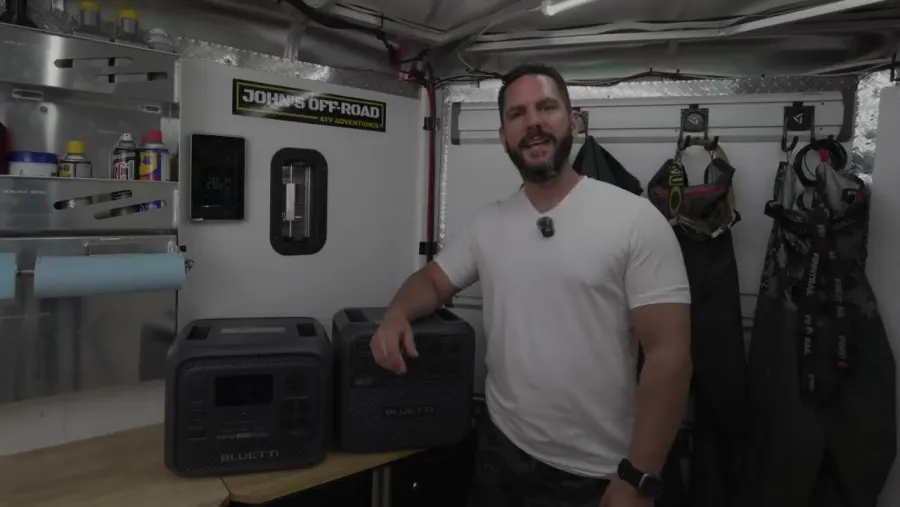
For an outage, that means roughly a day of full-size fridge. John Cuppi worked out he could "run my refrigerator and protect it for 24 hours off of one full charge"1, and other accounts land in the same range. Small loads such as a CPAP, a router or a camping fridge stretch to multiple nights.
The station also wastes little while idling, with a standby draw that one test called the lowest it had seen on a unit this size.2 The caveats are modest. The DC outputs return a smaller share of the capacity than the AC side3, and a space heater or kettle at full power will empty it in about an hour.
A kettle and a heater together at 2,600W, with thin DC options7.9/10
The 2,600W inverter runs almost any single household appliance and many pairs of them. Watts (W) are how much it can run at once, and surge is the brief start-up kick a compressor or saw needs. Next Life Caravan Adventures loaded it close to the limit and said it "handled it like a pro".4
There is headroom past the rating too. The Solar Lab pushed beyond the limit and found "it was able to sustain a 3,000W surge for over 2 minutes".5 Push further and it shuts off, as it should. Fridges, microwaves, air fryers, induction hobs and circular saws all appear on the list of loads it ran.
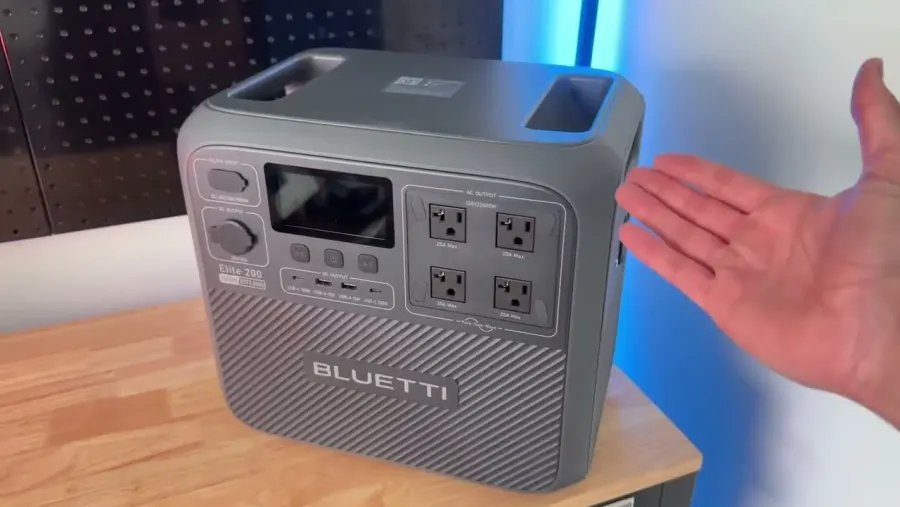
The DC side is where it is pared back. As The Van Conversion puts it, "the cigarette-lighter output is limited to 10A"6, and there is no high-current DC port for a distribution block. UK and Australian units also have only a pair of AC sockets, which drew complaints.
80% in 1 hour at the wall, and a solar voltage ceiling to plan around8.0/10
Wall charging is fast and widely liked. BLUETTI's figure is 80% in 1 hour, and that matches what was seen in use: NSMB reports that with Turbo Charging enabled the station "drinks up 1800W of electricity and charges up to 80% capacity in an hour".7 The charger is built in, so there is no power brick, only a standard cable.
Solar input is rated by BLUETTI at 1,000W through a standard, non-proprietary connector, which is generous for this capacity. The catch is a low voltage ceiling that limits how many panels can be wired in series. The Solar Lab could not reach the full rating with its panels: "we maxed out at 800W".8
Charging from a car socket is the weak route. The cable is not in the box, and the rate is slow enough that Tamara and Dennon's advice is "don't even bother".9 BLUETTI sells a separate alternator charger for anyone who needs to refill while driving.
No split-phase, no RV outlet and no way to add battery2.5/10
Home integration is the clear weakness. This is a plug-your-appliances-in station, and it has none of the hardware that connects a battery to a house.

“you cannot connect it to additional inverters to create a 240 volt system and this power station does not have a 30 amp output for rving or connecting to a small transfer switch”
That rules out well pumps, dryers and other split-phase loads entirely. Versus Lab is blunt about it: "the Elite is out of the conversation, and no amount of watt hours changes that".10 Capacity is fixed as well, so a longer outage means a second station, not an add-on battery.
Simple setups still work. Caravan owners have run a whole van by plugging its shore-power lead into the station's AC outlet, and extension leads to a fridge and a furnace-free household load are all most outage plans need. Anything involving a home panel calls for a different product and whatever the maker of that product requires.
An unnoticed switchover, a clear screen and a dated app7.5/10
The UPS function works and is widely liked. With the station plugged in between the wall and a computer, pulling the wall plug left desktops and laptops running in more than one test, with at most a flicker.11 It can also restore its outlets automatically once power returns after a full drain.
The app is where opinion splits. Remote monitoring over Wi-Fi and Bluetooth is handy for checking solar input from inside a van. But The Solar Lab found that "The app looks old, lacks advanced features"12, and others report occasional reconnecting.
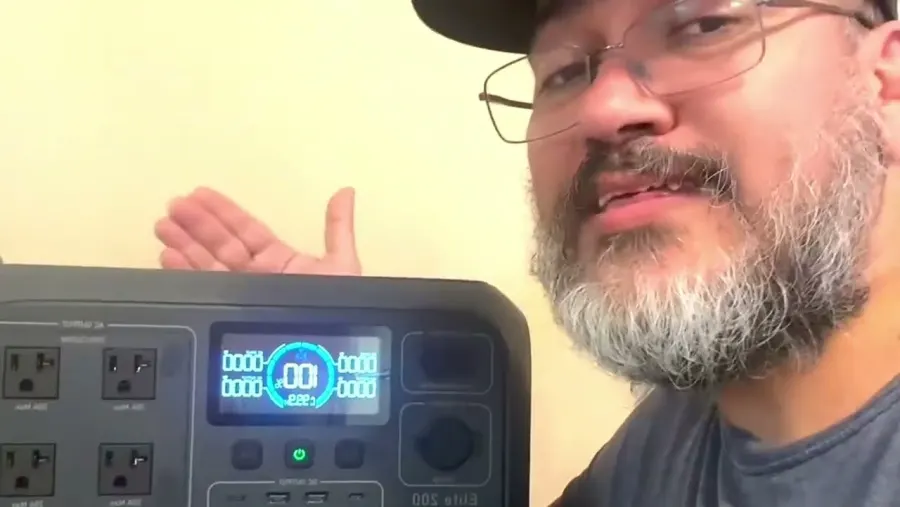
The built-in screen is easy to read indoors and shows input, output and time remaining, though it washes out in bright sunlight. There is no built-in light and no wireless charging pad.
Quiet, long-life cells at 53.4 lbs, with no rain rating8.9/10
Build quality is consistently praised, mostly for quiet running and long-life cells. ReeWray Outdoors sums up the paper case: "a 5-year warranty and an industry leading 6,000 plus cycle rating".13 Those are BLUETTI's figures for its LiFePO4 cells, not something anyone has had time to verify.
Fan noise is low under most loads, quiet enough to sleep beside in a van. It is louder while fast charging from the wall than under a normal load.14
Weight is the common complaint. At 53.4 lbs it is a two-hand lift that suits a fixed spot in a vehicle or a closet near the fridge. The case has no water or dust rating, so it needs cover outdoors, and long-term ownership evidence is still thin.
Cheap per watt-hour, still a large sum up front8.9/10
Value is widely liked, because few stations in this capacity class cost less per watt-hour.15 The list price is $1,399, and sale prices well below list come up often enough that waiting for one is sensible.
Part of the saving comes from what is left out: no expansion port, no RV outlet, no high-current DC. If you would never use those, you are not paying for them.
It is still a lot of money for one box, and some find the outlay hard to swallow even while recommending it.16 For phones and a lamp, a much smaller station does the job.
Our verdict
Buy the Elite 200 V2 for plug-in backup: a fridge for about a day, a CPAP and a home office through an outage, or a van or caravan that needs one efficient, quiet box. Skip it if you need split-phase power, a dedicated RV outlet or room to add batteries, because none of those can be added later. Before ordering, check your solar panels against the input's voltage limit, budget for the car charging accessory if you need it, and compare the current sale price with $1,399.
9 sources quoted in this story (16 notes)
- 1John Cuppi · 11:53 “so I can run my refrigerator and protect it for 24 hours off of one full charge”
- 2thesolarlab.com · written review “Even the idle power draw was impressive, coming in at just 9.5W per hour, which is also the lowest we’ve seen on a unit this size.”
- 3John Cuppi · 2:51 “so you can expect 89% of the total capacity if you use the DC side of this unit”
- 4Next Life Caravan Adventures · 22:14 “within seconds, the screen showed an AC output of 2,481 W. That's a serious load by anyone's standards. And the Elite 200 V2 handled it like a pro.”
- 5thesolarlab.com · written review “Even when we pushed the thing beyond its inverter’s 2,600W limit, it was able to sustain a 3,000W surge for over 2 minutes.”
- 6thevanconversion.com · written review “Cutting plywood with the circular saw (which has a high startup surge) was no issue” but “The DC side has one major bottleneck: the cigarette-lighter output is limited to 10A.”
- 7nsmb.com · written review “When plugged in to the wall and Turbo Charging enabled, the Elite drinks up 1800W of electricity and charges up to 80% capacity in an hour.”
- 8thesolarlab.com · written review “While our panels couldn’t quite hit that due to voltage constraints (we maxed out at 800W), it still charged really quickly with solar power.”
- 9Tamara and Dennon · 4:29 “For driving though, our experience with cigarette lighter charging is that don't even bother. It's not worth relying on.”
- 10Versus Lab · 1:58 “If you need 240-V power, the Elite is out of the conversation, and no amount of watt hours changes that.”
- 11ReeWray Outdoors · 19:38 “not so much as a blip on the computer screen so UPS test definite pass” but “maybe the lack of battery expansion Port is is maybe one other thing that I could think of”
- 12thesolarlab.com · written review “The app looks old, lacks advanced features, and often detects unrelated devices, like random Rich Solar batteries we had in the garage”
- 13ReeWray Outdoors · 23:12 “let's not forget that it does come with a 5-year warranty and an industry leading 6,000 plus cycle rating”
- 14Tamara and Dennon · 4:21 “When it is charging from the wall, it is definitely louder than what it is just sitting under a normal load.”
- 15thevanconversion.com · written review “Still, price-per-Wh and per-watt, it’s one of the best values around.”
- 16Off Track · 13:51 “if you have the money to spend on this, it's definitely worthwhile buying.” but “Now, let's talk about the elephant in the room. That's pretty bloody expensive.”