




The full story
By the Storedwatts editors · Published Nov 20, 2026
The second version of DJI's mid-size station fixes most of what held the first one back: more outlets, a stronger inverter, faster charging and a built-in app connection. What it keeps is DJI's habit of selling solar and car connections as separate modules. Here is what that means for an outage, a campsite and a work day.
Heaters and a bandsaw yes, a 12 V fridge only with an adapter7.7/10
Output is the reason to choose this station. Watts are how much it can run at once, and surge is the brief start-up kick a motor or compressor needs. On both counts the Power 1000 V2 is rated well above most stations of its capacity, and the measured tests back that up.
“An inverter rated at 2,600 watt continuous output on a power station this size is a big deal.” but “If I was being picky, I'd have liked a couple of extra USB-C ports, like on the Power 2000.”
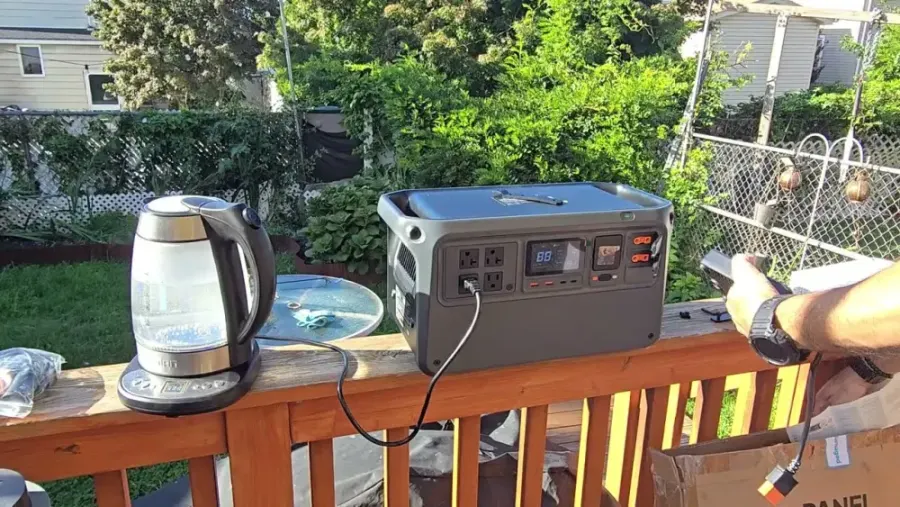
The Technology Man ran a bandsaw with an induction motor that had tripped many other stations he has tested.1 Space heaters, kettles and a tyre compressor ran without complaint elsewhere. It is not unlimited: one load in his testing had a start-up draw high enough to trigger overload protection, and several sources saw it shut down shortly after being pushed past its rating.2
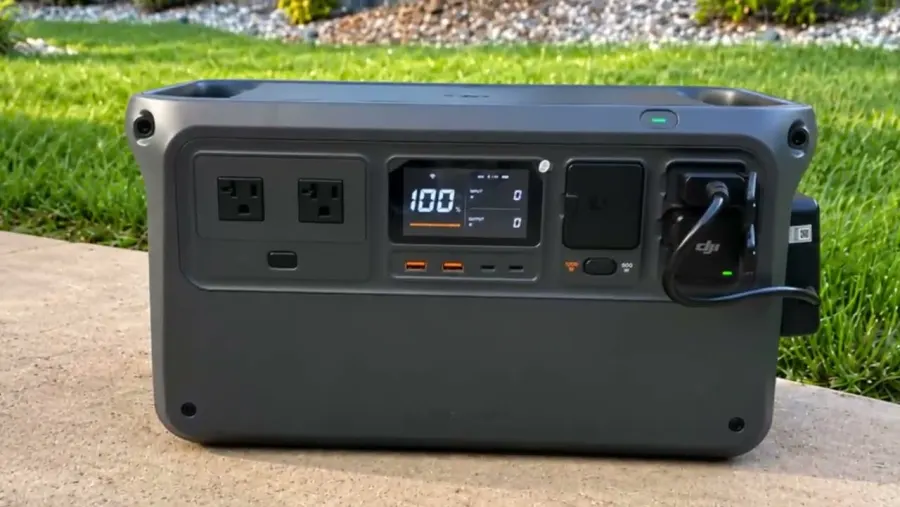
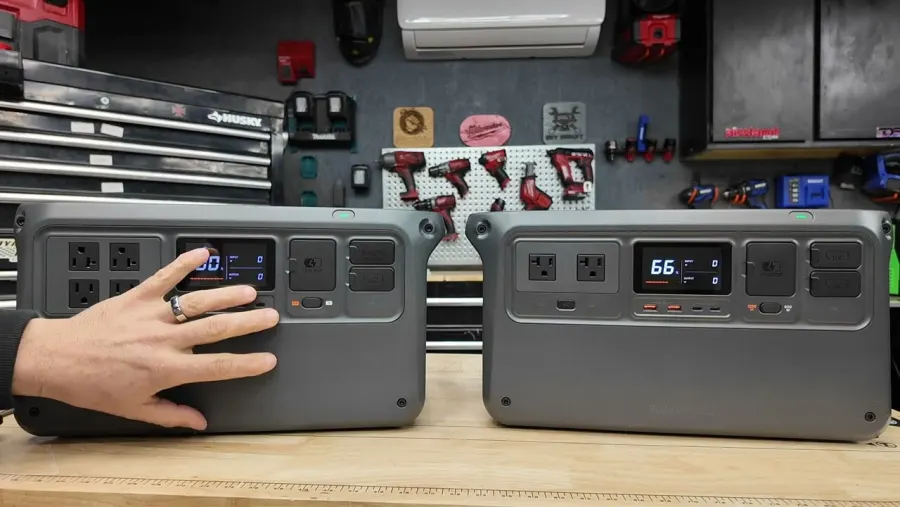
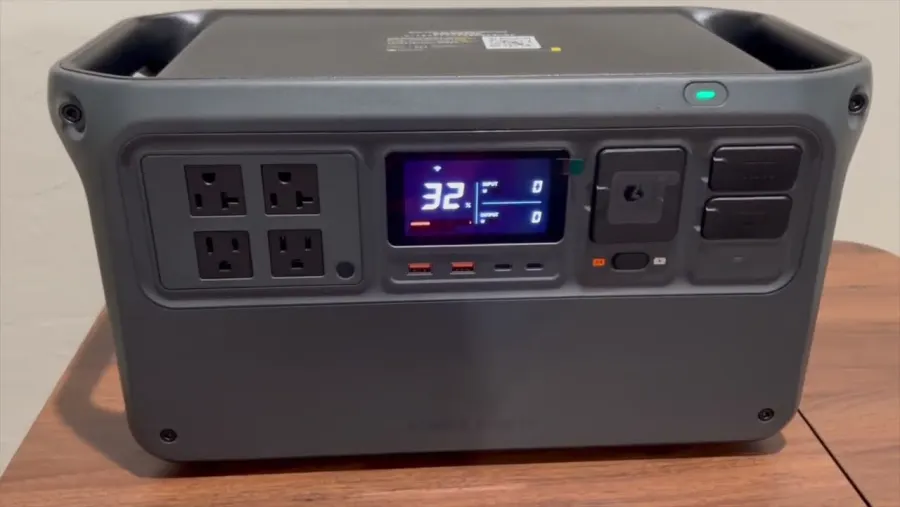
The ports are less generous than the inverter. DJI doubled the AC outlets over the first version and both USB-C ports charge a laptop at full speed, but there is no 12 V car socket or barrel connector on the front panel.3 A camping fridge that runs on 12 V needs a DJI adapter cable plugged into an SDC port, and those same ports are needed for solar and car charging.
Up to a day of fridge, half an hour of heater7.7/10
Most of the label reaches the outlet under heavy loads, and less under light ones. Watt-hours are how much energy the station stores, and DJI rates this one at 1024 Wh. The Technology Man ran it to empty on a heavy load: "It ran for just over 26 minutes and used 882 watt hours. That's 86% efficiency, which is a perfectly acceptable result."4
A second test of his came in lower, and he found the inverter draws power even with nothing plugged in.5 That idle draw matters for small loads left on overnight, so switch the AC outlets off when they are not in use.
In outage terms, GadgetGuy says it can "keep your Wi-Fi router running for three days or your refrigerator operating for up to a day".6 Shoestring Motoring kept a small fridge going for well over two days on one charge. Heat is the limit. Category 5 Reviews put it plainly: "A basic 1,500 watt heater ran, but it drained the battery in just over half an hour."7
A lunch-break wall charge, and no solar without the MPPT module7.0/10
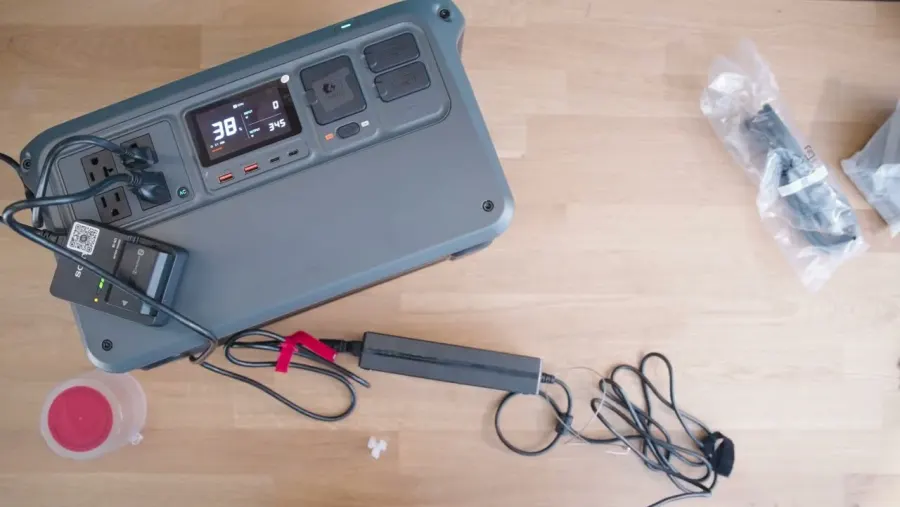
From a wall outlet this is one of the quickest stations in its class. DJI's claim is just under an hour for a full charge, and measured results land on either side of it. Category 5 Reviews: "It finished charging in 51 minutes and 24 seconds, beating the claim by about 5 minutes."8 Mispronounced Adventures saw thermal throttling slow its unit: "it reaches the 100% fully charged goal at 61 minutes which is not the advertised 56."9
A physical switch on the unit toggles between fast and standard charging, with no need to open the app. The slower mode is the one to use when there is no hurry, since it is easier on the battery.
Solar is where the station falls behind. In the words of Tiny House Expedition, "it lacks a built-in solar charge controller, which all other competitors have".10 Panels connect through a DJI MPPT module sold separately, and the high-power version is costly. The Solar Lab noted: "The 1.8 kW solar car charger adapter that I was talking about earlier is $329."11
With the right module the solar and car charging rates are high, and the station can power devices while it charges in a vehicle. Without one, the box contains a mains lead and nothing else.
A fast UPS and a basic app, with an idle shut-off to check8.2/10
The UPS function works as advertised. Plug the station into the wall, plug a computer into the station, and it takes over when the grid drops. The Technology Man checked the gap himself: "I did measure less than 10 milliseconds of actual break in power, which is impressive."12 A desktop workstation kept running through a simulated cut in The Review Hub's test data.
The fridge is the exception. The Review Hub found that when a compressor cycles off, the station can read the low draw as inactivity and switch its AC output off.13 Check the timeout settings in the app before trusting it with a fridge overnight.
The app now connects directly, without the dongle the first version needed. It shows input and output, switches ports remotely and updates firmware. It is plainer than the apps from EcoFlow and Bluetti, and there is no built-in light. DJI's expansion batteries connect through the SDC port for much longer runtimes.
Quiet fans and solid casework, with no weather rating8.9/10
Build quality and low noise are the most consistently praised things about this station. The switches, port covers and handles feel solid, and the fan is hard to hear at full charging speed. Outdoor Gear Lab's long-term experience is the strongest evidence: "We pushed this power station near its maximum output for months without the fans ever reaching intolerable levels."14
Measured noise under sustained heavy load was a little above DJI's headline figure, but still low enough to sit beside a desk or a camera. DJI rates the LFP cells for a long cycle life and pots the inverter to resist vibration and moisture.
There are caveats. The unit has no official water-resistance rating and some front connections are unsealed, so keep it out of rain. The Review Hub also notes that earlier firmware produced temporary fault warnings under high solar input near a full charge, and DJI's history in power stations is shorter than its main rivals'.
Fairly priced alone, costly once the modules go in the cart5.6/10
Value depends on how you plan to charge it. At $699 for the station alone, the output and charging speed are hard to match, and Android Authority considers the price competitive enough on its own to sway a buyer.15 It is also often discounted.
The sums change for anyone going off-grid. Solar charging, car charging and a 12 V outlet are each a separate purchase, and competitors include or build in all of them.
“These adapters are not cheap and quickly make the DJI one of the least value-oriented power stations in its class.”
For home backup charged from the wall, none of those extras are needed and the price holds up. For a van or campsite running on panels, total the adapters first and compare that figure with stations that have solar input built in.
Approx. 14.2 kg on two side handles5.7/10
The station is compact for its output but heavy for its capacity. At approx. 14.2 kg it weighs more than the first version and more than several rivals with the same battery size. The footprint is small and the side handles are sturdy, so moving it between a car, a campsite and the house is manageable.
How it carries depends on the person. The Technology Man still found it a one-hand carry, while The Solar Lab expects most people to use both hands. Android Authority points to the handle layout: "with no handle in the middle, trying to pick it up one-handed feels very unbalanced".16
Our verdict
Buy the DJI Power 1000 V2 for home backup, a home office or mains-charged work where a strong, quiet inverter and a fast wall charge matter most. Look elsewhere if solar is your main way to charge or a 12 V fridge is your main load, because the adapters add cost and compete for the same ports. Before paying, list the modules you will need and add them to the price of the station. If the total still beats a rival with solar built in, this is the quieter and more capable choice.
10 sources quoted in this story (16 notes)
- 1The Technology Man · 9:27 “It could run my 14-in bandsaw, which has an induction motor with a large startup draw, which has tripped many other power stations I've tested.”
- 2The Technology Man · 9:56 “The startup draw was too high and triggered overload protection on the power station.”
- 3dronexl.co · written review “This unit can deliver up to 2,600 watts of continuous AC power through a pure sine wave inverter.” but “There’s no built-in 12-volt car socket or barrel connectors on the front panel. If you want to run DC appliances like certain fridges or camping gear, you’ll need an adapter.”
- 4The Technology Man · 10:54 “It ran for just over 26 minutes and used 882 watt hours. That's 86% efficiency, which is a perfectly acceptable result.” but “I had 73% capacity remaining, so the inverter is using around 23 watts even without a load.”
- 5The Technology Man · 11:20 “I measured 789 watt hours, which is around 77% efficiency.”
- 6gadgetguy.com.au · written review “In a blackout, it can keep your Wi-Fi router running for three days or your refrigerator operating for up to a day.”
- 7Category 5 Reviews · 11:51 “A basic 1,500 watt heater ran, but it drained the battery in just over half an hour.”
- 8Category 5 Reviews · 8:21 “It finished charging in 51 minutes and 24 seconds, beating the claim by about 5 minutes.”
- 9Mispronounced Adventures · 19:52 “it reaches the 100% fully charged goal at 61 minutes which is not the advertised 56.”
- 10Tiny House Expedition · 1:31 “And there it is, folks, 100% in just 56 minutes. Man, that is a massive upgrade.” but “The biggest drawback I think that still persists from the first version is that it lacks a built-in solar charge controller, which all other competitors have.”
- 11The Solar Lab · 7:59 “And those accessories are kind of expensive. The 1.8 kW solar car charger adapter that I was talking about earlier is $329.”
- 12The Technology Man · 13:46 “I did measure less than 10 milliseconds of actual break in power, which is impressive.” but “It's a little more basic than EcoFlow and Bluetti's apps, but it still covers the essential functions.”
- 13The Review Hub · 6:19 “In the test results provided for this review, a desktop workstation continued operating when grid power was removed.” but “When the compressor cycles off, the station may interpret the low power demand as inactivity and shut down its AC output.”
- 14outdoorgearlab.com · written review “We pushed this power station near its maximum output for months without the fans ever reaching intolerable levels.”
- 15androidauthority.com · written review “That’s a quite competitive number, and on its own might be enough to sway you in DJI’s direction.”
- 16androidauthority.com · written review “At just over 31lbs, the Power 1000 V2 isn’t exactly light, but it’s also not anywhere near uncomfortable for me to carry” but “with no handle in the middle, trying to pick it up one-handed feels very unbalanced”