



The full story
By the Storedwatts editors · Published Nov 20, 2026
The DELTA 2 Max has been measured, timed and lived with by a wide spread of sources, from lab benches to buses and off-grid cabins. They agree on the basics and disagree on two things: what X-Boost is worth and how loud the fans get. Here is what the evidence says, strongest first.
About nine tenths of the 2048 Wh on AC, and a drain when the outlets sit idle8.0/10
Most of the rated capacity comes out of the AC outlets. Watt-hours (Wh) are how much the station stores, and EcoFlow rates this one at 2048 Wh. Todd Parker ran it to empty on AC and got "1870 Watt hours which translates to 91 percent of the capacity".1 HOBOTECH, Adventure Gear TV and StorageReview each measured a little less in their own tests, and City Prepping's result was the lowest of the group.
In fridge terms, that is about a day. There's A Trick For That ran a household fridge in regular use and passed the one-day mark before the station quit.2 Smaller loads stretch much further: Outdoor Gear 411 kept a powered cooler cold through a two-day test with battery to spare.
The catch is the inverter's own appetite. HOBOTECH found that "just leaving the AC inverter on alone and nothing else will use 540 W hours out of a 24hour period".3 Turn the AC outlets off when nothing is plugged in, or set them to time out in the app. Heavy heat loads also empty it quickly: a kettle or a coffee maker running nonstop gets an hour or two at most.
80% in 1.1 hours at the wall, and 1000W of solar that is hard to hit7.4/10
Wall charging is the strongest part of this station. EcoFlow claims 80% in 1.1 hours from a household outlet, and independent timing lands close to that. 4wdTALK calls it one of the fastest-charging stations available.4 Todd Parker's own run took slightly longer than the claim and he still called it very fast. A switch on the back selects the slower charge rate set in the app, a detail that tripped up Alaska Cabin Adventures.
Solar is more work. EcoFlow rates the input at 1000W, split across a pair of ports, and each port has a low voltage ceiling. HOBOTECH's view is that in the real world you will rarely see the full figure "unless you hit that magic 60 volts", which is hard to arrange with ordinary panels.5 Todd Parker makes the same point about large arrays for home backup.
A few smaller gripes recur. The solar adapter cable is not in the box, car charging from a 12 V socket is very slow, and Unbiased Product Reviews found the battery refuses a charge in freezing temperatures until it warms up. Plan on the wall as the main refill and solar as a supplement.
A clean 2400W for tools and kitchens, and an X-Boost that sags the voltage7.3/10
Up to its rating, the inverter is excellent. Watts (W) are how much it can run at once, and EcoFlow rates it at 2400W continuous with a 4800W surge, the brief start-up kick a motor needs. DIY Outdoor Life put welders on it and could not get the sine wave to distort.6 WoodRidge Creek ran a corded table saw and a miter saw through a work day, and There's A Trick For That started a dryer loaded with wet towels.
Above the rating, the picture changes. X-Boost is sold as a way to run bigger appliances, but it works by lowering the voltage, not by supplying more power. Unbiased Product Reviews measured it and found "it's actually running at 90 volts" while still topping out at the inverter's normal limit.7 That suits a simple heating element and little else. The Solar Lab's advice is blunt: do not buy an EcoFlow on the strength of the X-Boost number.

“18 minutes left and the output is 2355 W. Pretty much exactly what it was with the other one.” but “it did allow us to run about 2 and a half kW for about a minute and then it just stopped.”
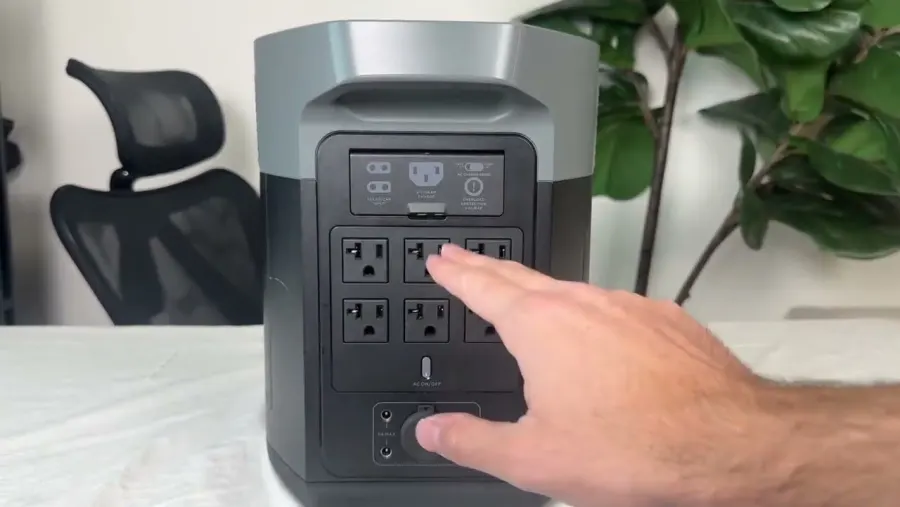
Short overloads are tolerated for seconds, not minutes. Adventure Gear TV added a compressor on top of a full load and the AC shut down almost at once, then came back on by itself. The DC side is thin too: the 12 V outputs are low-current, and 4wdTALK's car socket never worked. The AC outlets sit on the back while the screen faces front, which is awkward against a wall.
A polished app, a switchover that suits fridges and PCs, and room for two extra batteries7.4/10
The app is a real strength. It shows input and output live, sets charge limits and charging speed, and controls outlets remotely. City Prepping calls it "definitely the most mature" of the apps he has tested.8 The limits: many advanced settings live only in the app, WoodRidge Creek found the options confusing, and Gadgetoid wanted history instead of right-now figures.
The UPS function works for ordinary home gear. DIY Outdoor Life pulled the plug on a desktop, a router and a laptop without a battery, and all stayed on. HOBOTECH's laptop test passed as well. The switchover is not instant, though, and StorageReview, The Lab Daily and Bob Earnshaw all stop short of trusting it with servers or other sensitive equipment.
Expansion is built in. Two side ports take EcoFlow's own extra batteries, and Elma Chavez added one later simply to recharge less often. Todd Parker and HOBOTECH note the add-on packs cannot be charged or used on their own, only through the main unit. There is no built-in light.
Good for a cabin or a few circuits, not for a whole house7.3/10
As home backup, this is a station for essentials. City Prepping feeds an office through a transfer switch and runs a computer and an air conditioner together. Todd Parker backed up a handful of essential circuits with two extra batteries attached, and Alaska Cabin Adventures powers a whole small cabin through one inlet cable.
It cannot stand in for a whole-house system. There is no 30-amp or 50-amp outlet, and no 240-volt output for a well pump or an electric dryer circuit. WoodRidge Creek puts it plainly: "this only puts out 110. that's half of your panel".9 If panel integration is the goal, follow EcoFlow's requirements for its transfer hardware and use a licensed electrician where the maker calls for one.
Long-life LFP cells in a 50 lbs case, with fans that are quiet until pushed8.0/10
The battery is built to be used daily. The chemistry is LFP, and by Todd Parker's reading of the maker's figure it is "rated at 3 000 cycles", which he works out to years of daily cycling.10 EcoFlow also backs it with a longer warranty than the model it replaced. The casework draws steady praise: solid plastics, stout handles, and a 4wdTALK unit that held up after a year of knocks.
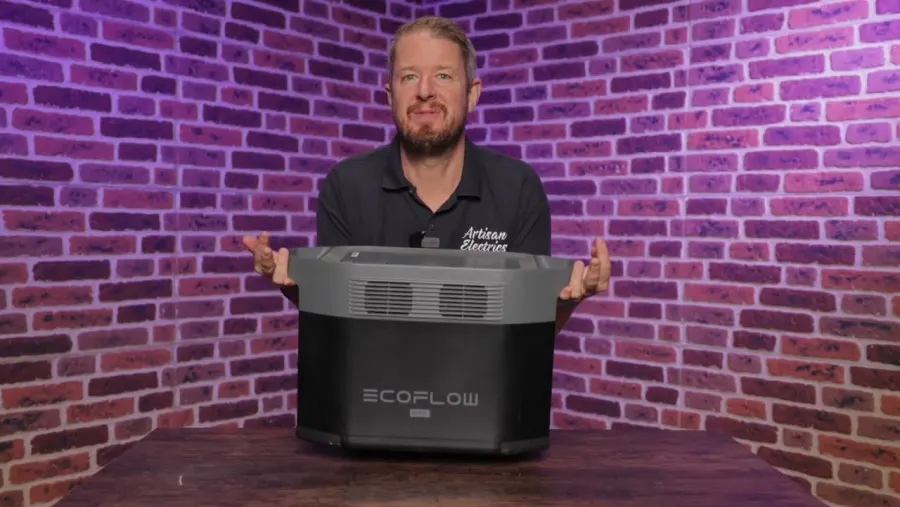
Fan noise depends on the load. At light draw it is close to silent, and Adventure Gear TV found the fan quieter than a household refrigerator. Under fast charging or a heavy load the fans are plainly there, and in a side-by-side test Artisan Electrics noticed the EcoFlow was "quite loud".11
A few faults are on the record. 4wdTALK's USB ports shut off unexpectedly until a factory reset, Unbiased Product Reviews saw the unit drop off Wi-Fi a handful of times in a year, and Gadgetoid found that charging an external battery cut the outputs. At 50 lbs with no wheels, it is a two-hand lift, and smaller adults will feel it.
Hard to defend at list, easier on one of its frequent sales5.5/10
Value is where opinion splits. The list price is $1,899, and several sources balk at it, while others who bought on sale call it a bargain. Sale prices far below list come up again and again, so the number on the day matters more than usual.
The total climbs once extras join the order. 4wdTALK likes the station but warns that "it can get pricey, especially if you start adding solar panels and extra smart batteries".12 WoodRidge Creek priced a fully expanded setup and concluded a fuel generator would be the cheaper route to the same energy. Gadgetoid and 4WDing Australia both ran the sums on shifting grid usage and found it would take many years to pay for itself that way.
Our verdict
Buy the DELTA 2 Max for a day of fridge and household essentials, a van or cabin that needs a quick refill, or a setup you plan to expand with EcoFlow's extra batteries. Skip it if you need 240-volt power, a 30-amp outlet or a large solar array, and do not size any load around the X-Boost figure. Before paying $1,899, check the current sale price, and budget for the solar adapter cable, which is not in the box.
9 sources quoted in this story (12 notes)
- 1Todd Parker · 2:07 “when I did an AC output test I got 1870 Watt hours which translates to 91 percent of the capacity”
- 2There's A Trick For That · 5:32 “So, over 24 hours of time with uh a fridge that you're using consistently all the time.”
- 3HOBOTECH · 6:09 “just leaving the AC inverter on alone and nothing else will use 540 W hours out of a 24hour period”
- 44wdTALK · 6:23 “if you're just using AC alone, it'll charge up to 80% in just over an hour, making it one of the fastest charging stations available”
- 5HOBOTECH · 22:17 “in the real world you're likely never to attain 1,000 Watts unless you hit that magic 60 volts that's really tough to do with solar panels”
- 6DIY Outdoor Life · 17:32 “I put welders on it I ran a bunch of silly stuff and I couldn't even get this thing to distort its sine wave”
- 7Unbiased Product Reviews · 1:02 “when you're running at 3600 watt it's actually running at 90 volts and it's not anywhere near 3600 Watts it still puts out up to 2400 Watts”
- 8City Prepping · 6:04 “compared to all the other apps I've tested on various units this one is definitely the most mature in Polish”
- 9WoodRidge Creek · 12:04 “this only puts out 110. that's half of your panel it's it's not going to be able to power the whole house”
- 10Todd Parker · 4:05 “the lfp battery is rated at 3 000 cycles that means you can cycle it every day for 8.2 years”
- 11Artisan Electrics · 13:57 “Well, one thing I've noticed is that the EcoFlow is quite loud.”
- 124wdTALK · 10:41 “if you need a high-capacity power station with rapid recharge times and smart features, the Delta 2 Max is worth every penny” but “it can get pricey, especially if you start adding solar panels and extra smart batteries”