


The full story
By the Storedwatts editors · Published Nov 20, 2026
Three units matter on this page. Watt-hours (Wh) are how much the station stores, watts (W) are how much it can run at once, and surge is the brief start-up kick a fridge or pump needs. The DELTA 3 Max is strong on the first two and quick to refill, with limits that show up on solar and at the top of its output.
A day of fridge or freezer, well under two hours of heater7.5/10
The 2048Wh battery is enough for about a day of refrigeration, and not much more. Momentum Productions put home-fridge runtime at "about 20 hours give or take"1, and WorkshopAddict and SmartNest Tech land in the same region for a freezer and a fridge. Root-nation's experience sets the boundary: once an outage runs past a day, this station alone is not enough.
Not all of the label reaches the outlet. Adventure Gear TV ran a fixed load from full to empty and reported: "The final number was 1,699 Wh, and that result gives it an AC inverter efficiency of about 83%"2. That is one test on one unit, but it is the only full drain with a stated figure in the evidence.
Heat is the load to avoid. With a space heater on its high setting, Ryzzun Reviews worked out that a full charge would last "around an hour and 25 minutes"3. Efficiency also draws some criticism: in The Solar Lab's side-by-side, a rival with the same battery capacity lasted noticeably longer4.
Microwaves, air fryers and saws, with trips recorded right at 2400W7.8/10
The inverter handles ordinary household and workshop loads with room to spare. EcoFlow rates it at 2400W continuous / 4800W surge, and output is widely liked. YardBrah stacked two appliances and read the meter aloud: "it is now pulling 2,420 watts"5. Andrew ran a microwave and an air fryer without trouble, and The Kelley's Reviews started the heaviest household-voltage tool on hand without an error.
The top of the range is less certain. Momentum Productions saw the unit overload at its rated continuous figure and concluded it was happier a step below that.

“I do think that the output of this battery is definitely more, so you're getting more output in terms of wattage” but “2,400 W overloaded both of them, even though the EcoFlow states that it can do 2,400 continuous.”
Renewable Heating Hub had a similar moment on a miter saw: most cuts went through cleanly, but a couple of hard pulls signalled an overload6. EcoFlow's X-Boost mode lets some heating appliances run past the rating at reduced voltage. Adventure Gear TV got a large kitchen load through that way, though the microwave laboured, and Calder Wrenlow's advice is to buy on the standard rating and treat X-Boost as a bonus.
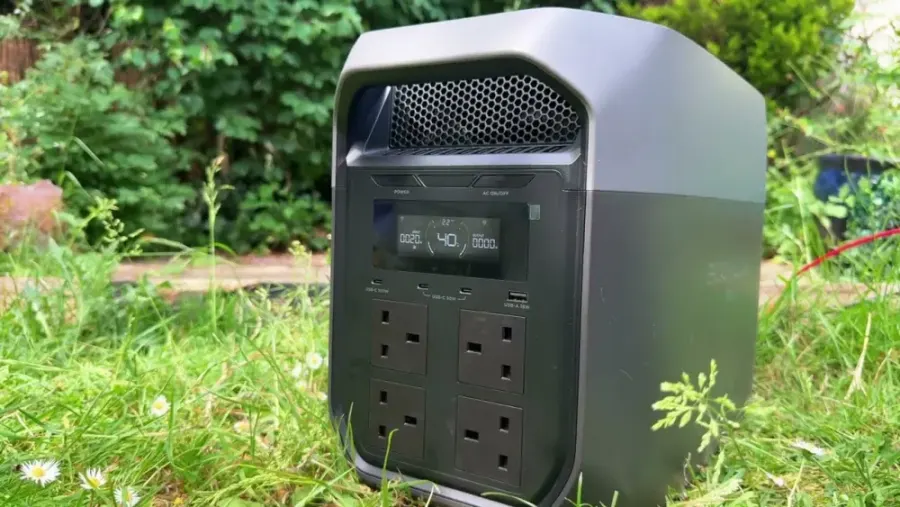
Two limits to know before buying. Design Guy was surprised by how few AC outlets a station this size carries, and Casey 250 notes the USB-C ports are slower than those on the DELTA 3 Plus. It also supplies standard household voltage only, so a well pump or dryer that needs split-phase power is out.
An hour and a bit at the wall, one 500W port for the sun7.5/10
Wall charging is the strongest part of this station. EcoFlow rates it at 0-80% in 68 min, and the hands-on accounts agree it gets most of its energy back in a little over an hour7. The Solar Lab makes the practical point that this is quick enough to fill up when bad weather is on the way. Calder Wrenlow adds that the last stretch to full slows down, so do not plan around the final percentage points.
Solar is where opinion splits. The input is capped at 500W through a single XT60 port. In use it performs: Adventure Gear TV reported "a solid 440 W"8 from its array on a sunny afternoon. SmartNest Tech speaks for the other side, calling the cap "not amazing for a 2000 W power station"9.
The single port has a second cost. Casey 250 points out that panels and EcoFlow's alternator charger share it, and the alternator charger needs an adapter, so a van owner will be swapping cables. Renewable Heating Hub sums up the solar side as fine for topping up and less suited to living off-grid full time.
A fast UPS, AC outlets you switch on by hand, and no battery port5.4/10
As a plug-in UPS it does the job; as a system to build on, it stops here. Root-nation states plainly that the switching time is "under 10 milliseconds"10, and WorkshopAddict pulled the plug on a freezer and watched it carry on. Calder Wrenlow would trust it with a desktop or networking gear, but not as a stand-in for a properly rated backup for critical medical equipment. For that, check with the device maker.
The catch is in the software. Root-nation found the station cannot turn its AC output on by itself and "requires manual activation"11. If the outlets are off when the power fails, nothing plugged into them is protected.
There is no expansion port on this model. Renewable Heating Hub and several others are blunt about it: what you buy is the whole system12. The Max Plus is the version that takes extra batteries and more solar. Nor is this a whole-house answer; it powers what you plug into it.
The app is mostly liked. Renewable Heating Hub found it stable, with scheduled charging for cheap overnight power and a mode that charges ahead of forecast severe weather. GADGET CRUNCH rates it among the better apps in the category but says some settings are poorly explained, and backuppowerhub.com needed a second try at Wi-Fi setup.
Sturdy at 20.3 kg, quiet at light loads, with a hum when pushed8.8/10
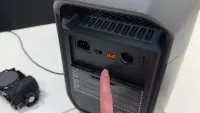
Build quality is the best-scored part of the DELTA 3 Max. The plastic shell is described as solid and well put together, the rear charging ports sit behind a cover, and The Solar Lab singles out the handles for making it easy to move. At 20.3 kg it is a two-hand carry over short distances, not something to haul far.
Noise depends on what it is running. Renewable Heating Hub found it almost silent at modest loads, with the fan spinning up only when worked hard, and Andrew calls it quieter than expected indoors.
“this is so quiet in its operation that you won't even know that it's plugged in and running either”
Under heavier draw the picture changes. Root-nation says fan noise rises with load, and Momentum Productions heard a "weird humming noise"13 and judged it slightly louder than the station beside it.
The LFP chemistry is the reason to expect a long service life, and it is widely welcomed for a station that will be cycled often. Calder Wrenlow adds the sensible caution that the lifespan figures are the maker's, and that real life depends on temperature, storage and charging habits14. The Solar Lab also notes a rival offers a longer warranty.
A strong buy at sale prices, a closer call at list6.9/10
Value depends on the price on the day. Listed at $899, it is a lot of battery and inverter for the money. Backuppowerhub.com, looking at a sale price, called the package "one of the best value propositions in this segment"15, and Casey 250 notes it undercuts what the DELTA 2 Max cost a year earlier.
Not everyone met it at that level. Design Guy cites a regular price well above the sale figures, and root-nation, quoting a far higher cost, calls it the most expensive station it has evaluated while still recommending it if the budget allows. The Solar Lab would spend a little more on the DELTA 2 Max instead.
The price also buys a closed box. If a second battery or a bigger solar array is likely within a few years, the saving over the Max Plus may not last.
Our verdict
Buy the DELTA 3 Max for selective backup: a fridge or freezer for about a day, a home office on its UPS, kitchen appliances in turn, and a fast refill from the wall when power returns. Look elsewhere if you need multi-day runtime, heavy solar charging or room to add batteries, because the 500W input and fixed 2048Wh will not change. Before you pay, compare the day's price with $899 and with the Max Plus. Once it is home, confirm the AC outlets are switched on, and keep sustained loads a little under the 2400W rating.
10 sources quoted in this story (15 notes)
- 1Momentum Productions · 2:36 “you can easily get a day of run time powering your home refrigerator, no problem. This one about 20 hours give or take.”
- 2Adventure Gear TV · 4:49 “The final number was 1,699 Wh, and that result gives it an AC inverter efficiency of about 83%, which is a solid, realistic result.”
- 3Ryzzun Reviews // Luis Angel · 1:47 “a fully charged Delta 3 Max would last around an hour and 25 minutes based on these power readings.”
- 4The Solar Lab · 2:59 “Whereas the EcoFlow is 27, which is a huge difference because they're the exact same battery capacity.”
- 5YardBrah · 13:49 “Okay, it is now pulling 2,420 watts. Both going.”
- 6Renewable Heating Hub · 1:47 “For the most part, it handled this energy-intensive task with relative ease, and was great to do the work where we wanted” but “there were a couple of moments where the saw tried to pull too much power, and the unit signaled an overload”
- 7Calder Wrenlow · 4:24 “That's a lot of energy back in a little over an hour.” but “Charging typically slows down near full, so those final 20 percentage points can take longer than you'd expect.”
- 8Adventure Gear TV · 5:36 “we're pulling in a solid 440 W. That is fantastic real-world performance, meaning you can get a truly meaningful charge during a sunny afternoon.”
- 9SmartNest Tech · 2:19 “you can get up to 1800 W of max input, which allows you to be able to charge it from EcoFlow claims from 0 to 80% about a little bit over an hour” but “You only get a a max input of solar up to 500 W, which honestly is not amazing for a 2000 W power station.”
- 10root-nation.com · written review “The switching time is under 10 milliseconds.”
- 11root-nation.com · written review “supports a UPS mode, allowing automatic switching from grid power to battery operation.” but “the station cannot automatically enable AC output under any conditions and requires manual activation.”
- 12Renewable Heating Hub · 5:12 “The app is great, too, stable and easy to use, and it's also super easy to add the unit” but “Our non-plus version doesn't expand, either. What you buy is what you get. 2 kWh, no extra battery ports.”
- 13Momentum Productions · 3:19 “One thing that I really like about the EcoFlow system is that there's actually a cover for the charger on the back.” but “There's just this weird humming noise. I don't know if you guys can hear it.”
- 14Calder Wrenlow · 6:25 “Those are manufacturer claims and real lifespan depends on temperature, storage conditions, charging habits, and how often you discharge it.”
- 15backuppowerhub.com · written review “The combination of 2,048Wh capacity, 2,400W output, 68-minute fast recharge, and LFP longevity at $749 represents one of the best value propositions in this segment.”