
The full story
By the Storedwatts editors · Published Nov 20, 2026
The outage question first: yes, it will run a fridge or freezer for days, and a microwave, a saw or a computer alongside it. The catches are the voltage it cannot supply, a solar input that is awkward to fill, and a price that needs a quick comparison before buying.
Most of the 3072Wh reaches the outlet, with an idle draw to watch9.4/10
Usable capacity is praised almost without exception. HOBOTECH's AC capacity test scored it at an "above average 88%" of the rating, and The Solar Lab's own run came in slightly lower and still earned what they called "an A+ in the lab". 1 2
In practical terms that means days, not hours, on a cold appliance. Digital Trends ran a garage freezer for "nearly three days" on one charge in an unconditioned space. 3
The caveat is the inverter's own appetite. The Solar Lab measured idle consumption at "about 24 watts per hour", so a station left switched on with nothing plugged in will drain itself over a long outage. 4 EcoFlow does not publish an idle figure, so check yours in the app.
A 3600W inverter that runs saws and microwaves, with a quirk at the RV outlet9.1/10
Output is the reason to choose this model over a smaller station. EcoFlow rates it at 3600W continuous / 7200W surge, and the measured tests back that up: HOBOTECH pushed the inverter well past its rating for several seconds before it gave up, and counted that as a pass. 5
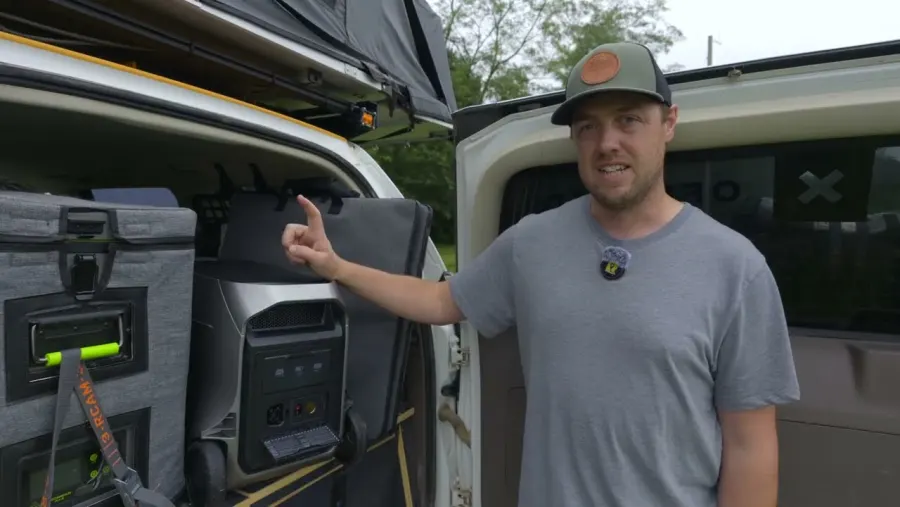
Everyday loads were uneventful. Revere Overland ran a household microwave from it at camp with no trouble, Hidden Spring Farm cut lumber with a saw, and a fridge compressor starting mid-load did not trip it. 6
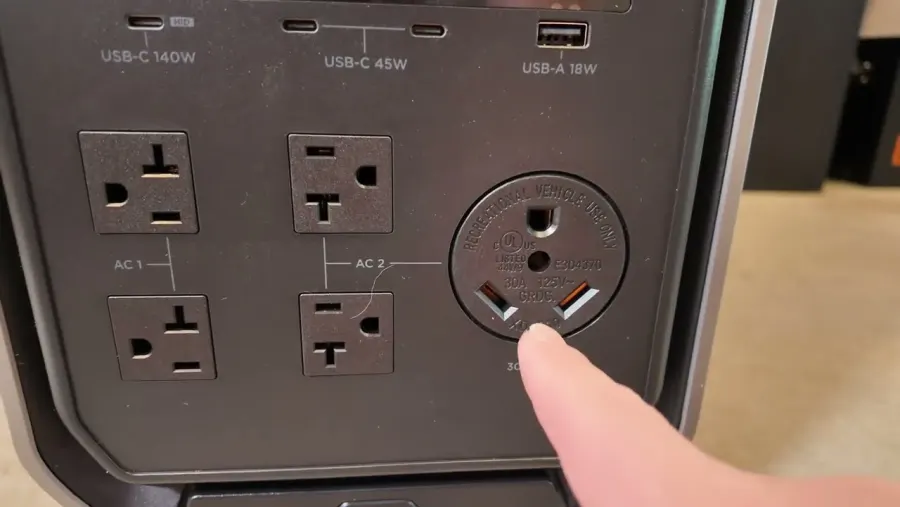
The Solar Lab found one behavior to know about. The large RV-style outlet surges better than the household sockets, but push the station past its rating and, in their words, "it'll shut down the 30 amp side". 7 The ports are also split between the front and the back, which makes cable routing fiddly in a tight space.
A switchover measured under the claim, and settings that live in the app9.4/10
The UPS function and the app are praised almost without exception. StorageReview timed the transfer from grid to battery at "8.25ms", inside EcoFlow's stated figure, and HOBOTECH cut the power to a running computer more than once without it noticing. 8
The app does more than monitor. It can give chosen outlets priority so a fridge keeps running as the battery runs low, and HOBOTECH calls it "pretty much the best app in the industry". 9 The trade-off, noted by Digital Trends, is that many of these functions cannot be reached from the unit's own buttons, and the screen is hard to read in direct sun.
Capacity can grow. The station accepts EcoFlow extra batteries, including those made for the DELTA Pro 3 and the DELTA 3 Max Plus, and they can be added or removed without shutting the system down. Valid Consumer Insights flagged that the adapter for the DELTA Pro 3 battery was not yet on sale on EcoFlow's page when they checked, so confirm it is available before buying a battery. 10
Feeds a transfer switch, never a split-phase load6.7/10
Home integration suits some houses and not others. The RV-style outlet can feed a manual transfer switch, so selected circuits in the breaker panel run from the station; Hidden Spring Farm simulated an outage and kept the basement lights on that way. A panel connection is a job for a licensed electrician.

“You can use your 30 amp to get you into a transfer switch.” but “it will never give you the ability to run 240 volts even if you bought another one.”
That limit is the one to take seriously. There is no split-phase output and no way to pair two units to get it, so an electric water heater, a well pump or central air on the higher household voltage will not run. Hidden Spring Farm's own water heater was one of the casualties.
The Solar Lab adds a practical warning tied to the surge behavior above: with the station wired to a transfer switch, someone plugging a heavy load into a front socket can overload it and drop power to the house circuits. 11
0–80% in 89 mins at the wall, and a low voltage ceiling on solar7.5/10
Charging is widely liked, mostly for its flexibility. EcoFlow's figure is 0–80% in 89 mins from a wall outlet, and the station can take wall and solar power together, or a generator at a higher rate for a faster refill. Revere Overland also charged it from a vehicle alternator while driving, using EcoFlow's separate alternator charger.
Solar is where the complaints sit. The input is rated at 1600W across separate controllers, which There's A Trick For That liked for flexibility and nearly filled in testing. HOBOTECH was less pleased: the ports only accept low-voltage arrays, which makes the full rating hard to reach with ordinary panel strings, and he measured the solar controller's efficiency below what he wants to see. 12
With a small array, expect a trickle. Hidden Spring Farm's panels fed it only a fraction of the rating, and Revere Overland needed most of a day of sun and alternator together to refill after a night at camp.
Wheels for 74.3 lb / 33.7 kg, and fan noise heard two ways7.8/10
Build quality is widely liked, and the weight is managed, not hidden. At 74.3 lb / 33.7 kg this is not a station to lift often, but it has a telescoping handle and rubber wheels that roll quietly indoors, and Revere Overland found it well balanced on them. The cells are LFP, the long-life chemistry.
Fan noise is reported both ways. RV.com found the unit "extremely quiet even under a heavy load", and The Solar Lab and There's A Trick For That agree it is quieter than rivals and older EcoFlow models. 13 HOBOTECH's meter told a different story during a hard run, which he summed up as "pretty darn loud". 14
Smaller gripes: Digital Trends doubts the plastic hinges on the port covers will last and notes the covers are not sealed against water, so it should not sit out in the rain. The Solar Lab wanted rubber bump stops on the handle for standing the unit upright.
Fair at today's price, with an older DELTA Pro undercutting it6.0/10
Value divides opinion, and almost all of the disagreement comes from which price was being judged. The station launched with a far higher list price that Digital Trends found hard to justify; at the level it sells for now, $1,599, the same review says the value shifts firmly in its favor. 15
The awkward comparison is inside EcoFlow's own range. The Solar Lab points out that the original DELTA Pro has sold for less while carrying "600 watt hours more" battery. 16 They still recommend the Ultra Plus, for its newer design and quieter fans.
Budget for the extras too. The price is for the station alone; expansion batteries, solar panels, the alternator charger and any transfer-switch work are separate costs.
Our verdict
Buy the DELTA 3 Ultra Plus if your outage list is single-phase: fridge, freezer, microwave, furnace blower, computers, and tools in the garage. It returns a high share of its 3072Wh, its inverter has real headroom, and the UPS and app are among the best liked in the category. Skip it if anything essential in your house needs split-phase power, because no accessory or second unit will add that. Before ordering, compare $1,599 against the current price of EcoFlow's older DELTA Pro, and confirm the expansion adapter you need is in stock.
7 sources quoted in this story (16 notes)
- 1HOBOTECH · 7:17 “results of the AC battery capacity test that scored 2690 watt hours out of 3072 for above average 88%”
- 2The Solar Lab · 5:49 “It was 85% efficient, which is really good. That's like an A+ in the lab.”
- 3digitaltrends.com · written review “My Danby garage freezer ran for nearly three days on a single charge, even in an unconditioned space.”
- 4The Solar Lab · 6:05 “The idle consumption on this power station was about 24 watts per hour.”
- 5HOBOTECH · 9:55 “The inverter capacity test on a 3600 watt inverter. We able to push 4600 watts for just under 5 seconds. That's a pass.”
- 6Revere Overland · 4:31 “This thing has 7200 W peak output and 3600 W output continuous. So, running a household microwave is absolutely no problem for this thing.”
- 7The Solar Lab · 6:51 “And it surges really well. We found that using the 30 amp, it'll surge much better than using a combination of these regular house plugs on the front.” but “when you surge this unit past its rated output of 3600 watts, it'll shut down the 30 amp side.”
- 8storagereview.com · written review “We recorded transfer times of 8ms on the DELTA 3 Max Plus and 8.25ms on the DELTA 3 Ultra Plus.”
- 9HOBOTECH · 16:28 “EcoFlow does obviously offer a Bluetooth and Wi-Fi app. It can do just about anything. It's pretty much the best app in the industry.”
- 10Valid consumer insights · 3:59 “One Delta 3 Ultra Plus expands 11 kilowatt hours with two of EcoFlow's Delta Pro 3 extra batteries.” but “But EcoFlow's own page says the adapter you need is coming soon.”
- 11The Solar Lab · 8:52 “if you had this tied in like a transfer switch or something and someone walked up to it and plugged something in, you killed the transfer switch.”
- 12HOBOTECH · 13:12 “we're able to push 800 watts of solar in along with 1,800 watts of AC power combined for 2600 watts” but “I was bummed that the Ultra models don't offer any higher voltage solar charging, as getting 1,600 watts out of 60 volts isn't the easiest thing to do with solar panels”
- 13rv.com · written review “The power station’s digital display is bright, easy to read, and helpful, while the unit itself remains extremely quiet even under a heavy load.”
- 14HOBOTECH · 10:45 “It's been 5 minutes. It's working absolutely fine. Nothing out of the ordinary.” but “So, 60 dB from a meter away. That's pretty darn loud.”
- 15digitaltrends.com · written review “At the heavily discounted street price of around $1,499–$1,599, the value equation shifts dramatically in the Ultra Plus’s favor” but “MSRP of $2,899 is hard to justify when EcoFlow’s own DELTA Pro often costs less”
- 16The Solar Lab · 9:30 “The Delta Pro original one is 1399. It has a 3600watth battery, so 600 watt hours more.”