


The full story
By the Storedwatts editors · Published Nov 20, 2026
The DELTA Pro has been on sale long enough to have a real track record, including units followed for years. That makes its strengths and its limits unusually clear. Here is what the evidence says, starting with how much of the battery you can use.
Most of the 3600Wh reaches the outlet, and a fridge runs a day or more7.6/10
The DELTA Pro returns most of its rated 3600Wh on AC. Watt-hours are how much a station stores, watts are how much it can run at once, and surge is the brief start-up kick a fridge or pump needs. HOBOTECH got "3290 watt hours out of 3600 or a very impressive 91 percent"1, and Outdoor Gear Lab's measured AC figure was among the highest in its test group.2
For the outage question, that means a kitchen fridge for a day or longer, depending on the fridge. On Projects With Everyday Dave's unit, "the fridge ran almost exactly 1.5 days"3. Other sources report anything from most of a day to about a week on more frugal fridges.
There are two caveats. The inverter draws a steady trickle just to stay on, which Marine X and The Solar Lab both flag, so small loads left running for days get less than the label suggests. And heavy loads empty it fast: Long Long Honeymoon estimated two to three hours for an RV air conditioner or a space heater on a single unit.
Two space heaters and a welder, with cut-outs recorded near the 3600W line7.2/10
EcoFlow rates the inverter at 3600W continuous / 7200W surge, and for ordinary household loads that rating holds up. Jungle River ran two space heaters together, Kevin Builds welded from it on a job site, and Projects With Everyday Dave held it well above the rating for some time before it tripped.4
Sustained loads close to the limit are less certain. The Solar Lab's older unit failed on that point: "I ran an efficiency test at 3,500 W. So, 100 W underneath that 3,600 max, and it overloaded."5 TechTablets saw one cut-out below the rating and a clean run at a higher load on another attempt. TechUtopia also recorded an overload as combined output neared the limit.
Very large motors are beyond it. Everyday Dave's heat pump demanded more start-up current than the system could supply. Will Prowse also dislikes how closely the household outlets are packed, which makes bulky plugs a squeeze.
2.7 Hours at the wall, an EV-station option, and one input at a time8.4/10
Charging is the DELTA Pro's most consistently praised trait. HOBOTECH filled it from the wall in 2.7 hours at the maximum built-in rate6, and Outdoor Gear Lab clocked an even quicker refill.
“No other power station could charge at its incredible pace of 1,412 Wh/hr. That means we got a full charge in a little over two hours.”
It also takes up to 1600W of solar by EcoFlow's figure, and it can charge from a public EV station with an adapter. Everyday Home Repairs and Storage Review both single that out as unusual.
The catches are practical ones. Will Prowse notes it accepts only one input at a time7, so solar and wall power cannot be combined on a single unit. Projects With Everyday Dave found the solar adapter cable was not in the box, and that the station will not accept a charge in very cold weather. The slow charge setting takes many hours, so check which mode is selected.
A generator plug into a transfer switch, and two units before a dryer will run8.1/10
Hooking one DELTA Pro to a house is simple if a transfer switch with a generator inlet is already in place. Projects With Everyday Dave describes that as the one requirement for a plug-in setup with no wiring work.8 RV owners have it easier still, since the RV outlet on the front takes a shore-power cord directly.
A single unit supplies standard household voltage only. Everyday Home Repairs, who backed up a home this way, put the limit plainly: "you're only going to be able to power your 120 volt circuits all your 240s have to be off"9. Split-phase loads such as a dryer or a well pump need two units joined by EcoFlow's hub.
Expansion is the strong point. Storage Review describes extra battery ports allowing "a battery capacity of up to 25kWh"10 across the ecosystem. The add-on batteries have drawbacks of their own: Will Prowse notes they cannot be stacked, and Tech Made Easy found the connecting cable short and stiff.
An app Will Prowse rates the best, and a switchover short of a true UPS8.6/10
The EcoFlow app is praised almost without exception. Will Prowse calls it "the best wi-fi app for any solar generator that's on the market"11, and others value the remote monitoring, adjustable charge rate and settable charge limits. TechUtopia adds that the depth of settings brings a steeper learning curve.
The backup switchover is quick enough for most electronics, and TechTablets and Projects With Everyday Dave both saw it take over without trouble. Outdoor Gear Lab is stricter: "its cutover time of 30ms or less isn't quite fast enough to be considered an uninterrupted power supply"12. Sensitive equipment may notice the gap.
A smaller gripe comes from Jungle River, who found that the main unit and an extra battery showed mismatched charge levels as they drained.
Years of knocks survived, with heat, fan noise and 99 lb to move6.4/10
Build quality suits some uses better than others. The long-term record is encouraging: The Solar Lab calls its much-used unit "built like a tank" after years of scratches and drops, yet the same unit overheated at the end of a hard run, which is among that channel's biggest complaints.13
Fan noise is the other recurring point. TechTablets found it clearly audible to anyone sitting beside it under high load14, while Storage Review noted the fans spin down quickly as demand falls. Marine X advises leaving room for airflow instead of pushing it tight against a wall.
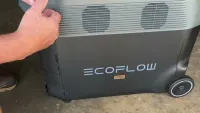
The case is all plastic, and Gear Junkie and Long Long Honeymoon both point out it is not weatherproof. At 99 lb, it is a station to park in one place. It has wheels, though Long Long Honeymoon wanted sturdier ones. Gab and Bren also hit a reboot loop after a firmware update.
A good buy below list, and a steep total once batteries are added7.3/10
Value is widely liked, mostly because the DELTA Pro now sells for less than it once did. The list price is $2,999.99 for the station alone, and several sources found it well under that. The Solar Lab's view is that "at its price is still a really good buy"15, and Outdoor Gear Lab notes it undercuts the newer DELTA Pro 3.
Silver Cymbal narrows the case to buyers who can live with household voltage only, for whom it is "an absolute bargain"16. That condition matters, since split-phase power means buying a second unit and a hub.
At full price the mood is cooler. Long Long Honeymoon calls it a lot of money17, and Tech Made Easy points out that expansion batteries are priced separately and add up quickly. Everyday Home Repairs judged a full two-unit home setup out of reach for most homeowners.
Our verdict
Buy the DELTA Pro if you want a proven 3600Wh station for a fridge, a freezer and household-voltage circuits, or to plug into an RV, and you like the idea of adding batteries later. Skip it if one box must run split-phase appliances, or if 99 lb is more than you can move. Keep long loads comfortably under 3600W, give it room to breathe, and compare the selling price with $2,999.99 and with the DELTA Pro 3 before you pay.
10 sources quoted in this story (17 notes)
- 1HOBOTECH · 10:26 “3290 watt hours out of 3600 or a very impressive 91 percent this is definitely above average for the industry”
- 2outdoorgearlab.com · written review “We measured an AC power output capacity of 3,060Wh, one of the highest of our test group.”
- 3Projects With Everyday Dave · 15:53 “the fridge ran almost exactly 1.5 days it was 31 hours and 59 minutes and it consumed 2.44 kilowatt hours”
- 4Projects With Everyday Dave · 13:54 “finally hit the overload 4300 Watts for quite a while there before it tripped” but “my heat pump has a massive starting current of over 200 amps and that was just too much for the system to deliver”
- 5The Solar Lab · 4:48 “Another thing is this has Anderson ports and barrel ports. Other power stations are getting away from that, too” but “I ran an efficiency test at 3,500 W. So, 100 W underneath that 3,600 max, and it overloaded.”
- 6HOBOTECH · 4:21 “so i was in fact able to charge this from the wall at 2.7 hours using the maximum charge rate built into this” but “it'll take several days to charge this thing if you want to plug it into 12 volt source”
- 7DIY Solar Power with Will Prowse · 8:50 “but you can only do one input at a time”
- 8Projects With Everyday Dave · 1:45 “the one thing that is required for this to be a simple no wiring no inspection Plug and Play activity is a transfer switch with a generator plug”
- 9Everyday Home Repairs · 7:54 “so it actually works which is pretty awesome” but “that's really the main drawback of the system is you're only going to be able to power your 120 volt circuits all your 240s have to be off”
- 10storagereview.com · written review “two extra battery ports that allow for connections to other devices in the EcoFlow ecosystem, allowing for a battery capacity of up to 25kWh”
- 11DIY Solar Power with Will Prowse · 6:05 “by far this is the best wi-fi app for any solar generator that's on the market”
- 12outdoorgearlab.com · written review “its cutover time of 30ms or less isn't quite fast enough to be considered an uninterrupted power supply.”
- 13The Solar Lab · 9:58 “Plus, this thing is built like a tank. We've had it for 5 years, we've scratched it, dropped it, whatever” but “This one's overheating at the end, and that's one of our biggest complaints.”
- 14TechTablets · 1:40 “the ecoflow Delta Pro does have a good build quality to it” but “it is quite loud the way to describe it that if you're sitting next to it yes you are definitely going to hear it especially under high loads”
- 15The Solar Lab · 9:29 “we still firmly believe that the Delta Pro at its price is still a really good buy.”
- 16Silver Cymbal · 0:49 “if you only need 120 the original Delta Pro is still again an absolute bargain”
- 17Long Long Honeymoon · 1:29 “but for many people it will be a turnkey power station solution” but “this unit costs more than three thousand dollars it's a lot of money”