



The full story
By the Storedwatts editors · Published Nov 20, 2026
The DELTA Pro 3 is EcoFlow's single-box answer to home backup: a large LFP battery, a split-phase inverter and a path to more batteries. The evidence is strong on capacity, charging and noise, and more mixed on surge handling and price. Here is what holds up and where the catches are.
Most of the 4096Wh reaches the outlet, with measurements that disagree9.3/10
Most of the rated 4096Wh comes out as usable AC power, though how much depends on whose test you read. Watt-hours (Wh) are how much a station stores; watts (W) are how much it can run at once. OutdoorGearLab's measurement worked out to "an efficiency of over 93%"1, and Jasonoid and Adventure Gear TV landed in the same place.
Others got less. The Solar Lab Plus retested its unit and reported "we got an efficiency rating of 84.5%"2, down from its first run, and City Prepping and 51 Drones also came in under the best results. Plan around the lower end and treat anything more as a bonus.
In household terms that is a night or more of essentials. Ozzie Reviews ran an upright freezer and a fridge freezer "constantly for 17 hours"3, and OutdoorGearLab got through several overnight outages with a fridge, TV and space heater running together. Put a whole house on it and the hours shrink fast.
The catch is the inverter's own appetite. The Solar Lab Plus measured an idle draw it called not that good, higher than the station it uses as its benchmark for a poor result4. HoboTech notes the inverter cuts its consumption when nothing is plugged in, but the simple habit is to switch AC off when it is not needed.
A steady 4000W from one box, and trips well short of the 8000W surge figure8.0/10
The inverter holds its full 4000W continuous rating without complaint. Adventure Gear TV and Everyday Solar both pushed it to the limit with stable voltage, and Jasonoid's sustained maximum-load test ended without a shutdown. OutdoorGearLab ran a fridge, lighting, a kettle and a space heater, plus an electric stove from the 240 V outlet.
Surge is the brief start-up kick a motor or compressor needs, and here the 8000W maker figure looks optimistic. 51 Drones found that when a "surge got to just over 6,000 watts" the station faulted every time5, and The Solar Lab Plus saw the same ceiling. HVACR Survival's clothes dryer knocked it out6, and Jungle River keeps the electric water heater switched off for the same reason.
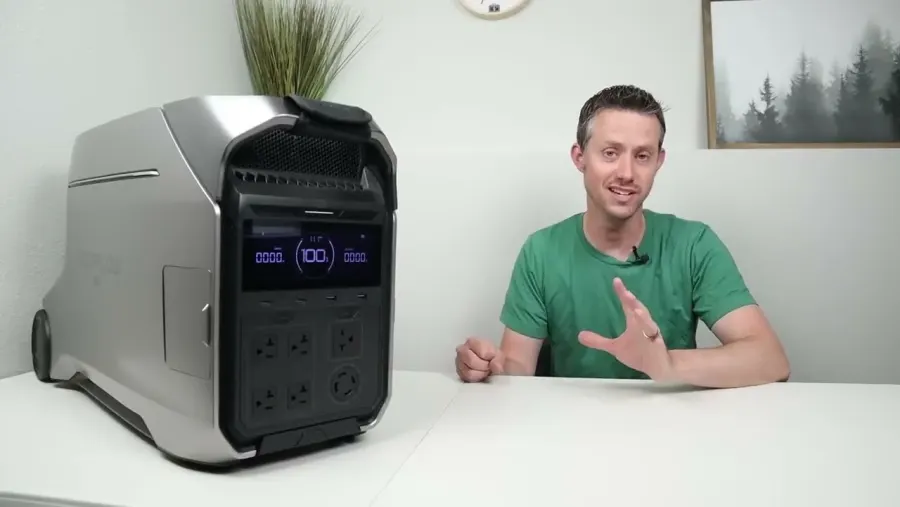
Port selection is generous: more than one split-phase outlet, an RV outlet and a high-current DC output that CleanTechnica wired straight to a trailer's battery terminals. One limit to know is that the 120 V and 240 V outputs cannot be used at the same time, as City Prepping and Jungle River both found.
Feeds a generator inlet by itself, and the automatic panel adds an electrician8.5/10
Split-phase output from a single unit is the feature that sets this station apart for home use. City Prepping points out that most rivals need two units or a hub to make 240 V. Everyday Solar plugs it into a generator inlet behind an interlock, and Jasonoid ran every load in the house through a transfer switch with no shutdowns.
That manual route works, but someone has to be home and remember the procedure. Automatic switchover means EcoFlow's Smart Home Panel 2, which is a separate purchase and a wiring job.
“A portable unit that requires no permit and no permanent modification sidesteps every one of those barriers.” but “EcoFlow's own smart home panel 2 is exactly that, but it costs an additional $1,500 and requires the electrician the headline promised you would not need.”
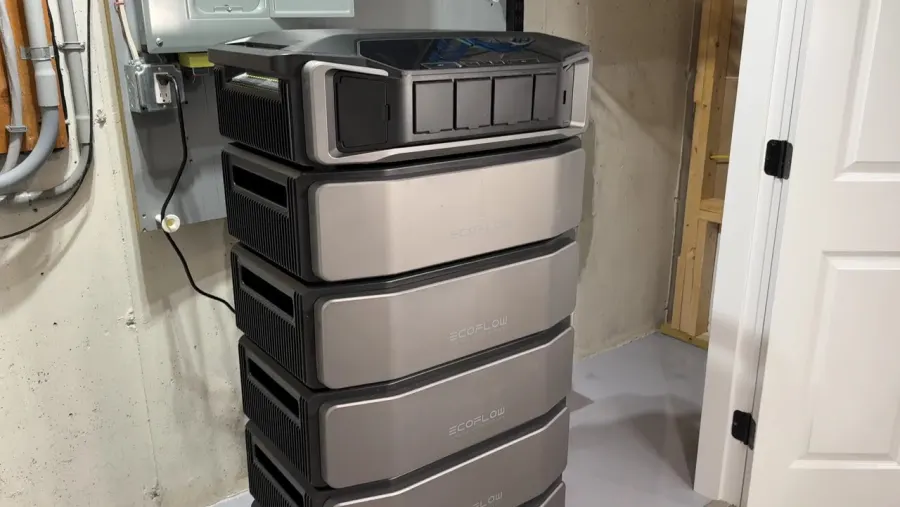
There is one more limit on the AC side. Jasonoid found that fast charging from a 240 V input disables the AC outlets7, and City Prepping and The Solar Lab report the same. HVACR Survival and Silver Cymbal confirm that charging from a 120 V source while supplying 240 V works, and HoboTech reports full 240 V output while charging, so check this against your own setup. Extra batteries stack on top, and more units can join through the panel.
Most of a charge in under an hour on a strong source, and 2600W of solar across two ports8.8/10
Charging is quick for a battery this size. HoboTech puts the headline figure plainly: "0 to 80% in 50 minutes"8, and PCMag and Adventure Gear TV cite the same. A full charge from an ordinary household outlet takes a good deal longer, a few hours in PCMag's and The Solar Lab Plus's runs, and OutdoorGearLab never saw the full advertised rate from the wall.
The maker's 2600W solar limit is split between a high-voltage and a low-voltage port. Jasonoid, Everyday Solar and Jungle River all got most of that from large arrays feeding both. Jungle River warns that the low-voltage port has a far lower voltage ceiling, so a high-voltage string must never be plugged into it9.
Small portable panels are a different story. 51 Drones saw a trickle from a folding set and estimated days of sun for a full charge. A fixed array or a generator suits it better; HoboTech charged it rapidly from a propane generator at altitude.
An app rated above its rivals, and a switchover computers ride through8.8/10
The app is widely liked and often called the best in the category. City Prepping, who has tried nearly every maker's software, says "EcoFlow really stands out"10. PCMag found it easy to configure and monitor, and it can schedule charging for off-peak hours.
As an uninterruptible supply it switches to battery fast enough for desktop computers. Jasonoid timed the switchover and got "9.7 milliseconds"11, quicker than the maker's claim. HVACR Survival adds that routing through the Smart Home Panel 2 slows the switchover to the panel's own speed.
The complaints are small but real. The Solar Lab Plus watched the charge-time estimate sit on the same last few minutes for far longer than that. CleanTechnica wanted a phone alert when the station shuts its output off, and JOHNNY'S WEEKENDS learned from EcoFlow that it will never talk to the Smart Generator over Bluetooth because the hardware is not there.
Quiet enough for a bedroom, 51.5 kg on wheels, and fault reports to weigh8.8/10
At normal household loads this station is close to silent. 51 Drones says of the fan, "it's nothing that you wouldn't be able to sleep to"12, and Jasonoid calls the casework extremely solid. Push it toward full output and the fans become clearly audible, as Adventure Gear TV's and HVACR Survival's meters showed.
It is heavy. At 51.5 kg, OutdoorGearLab says it takes two people to get it into a vehicle or up stairs13. Wheels and a telescoping handle cover flat ground, though the handle on Ozzie Reviews' unit would not stay retracted.
A few faults are on record. CleanTechnica's unit began warning of electrical shorts and cutting its output, a problem not seen again after a firmware update14, and once drained itself without drawing from the attached extra battery. 51 Drones had it shut down from heat near the end of a full-load run.
“About the only application I’d avoid using them for is critical, unattended power backup.”
A large sum at list, and a different proposition on sale5.0/10
Value divides opinion, and the split follows the price paid. At $3,399 it is a major purchase, and DIY Solar Fun with Ray Loveless says so flatly: "a very expensive power station"15. Silver Cymbal and Brains Report both point to rivals that cost less.
Sale prices change the sums. Working from a discounted price, 51 Drones called the cost per watt-hour "incredibly affordable for a power station"16. PCMag judges it money well spent for anyone who needs high capacity and split-phase output in a portable unit.
Budget for the extras too. Only the AC charging cable is in the box, and the Smart Home Panel 2 and expansion batteries are priced separately.
Our verdict
Buy the DELTA Pro 3 if you want essential circuits and the odd 240 V load covered from one quiet unit, with a clear path to more batteries. Skip it if your must-run list includes a dryer or electric water heater, or if nobody can help you move 51.5 kg. Before ordering, list the start-up surges of your largest appliances, decide between a manual inlet and the Smart Home Panel 2, and wait for a sale rather than paying $3,399.
11 sources quoted in this story (16 notes)
- 1outdoorgearlab.com · written review “Our testers measured 3,790 Wh from its advertised 4,096 Wh rated battery capacity, resulting in an efficiency of over 93%.”
- 2The Solar Lab Plus · 3:07 “back when we originally tested the Delta Pro 3, we got an efficiency rating of 89%. When we tested it this time, we got an efficiency rating of 84.5%.”
- 3Ozzie Reviews · 11:38 “I've run my upright freezer and upright fridge freezer constantly for 17 hours off the Eco flow”
- 4The Solar Lab Plus · 5:04 “The 4,096-W hour battery is pretty big and it's going to last you a long time depending on what loads you are running” but “when we did it this time, it got a 43-W idle draw, which is not that good”
- 551 Drones · 15:38 “So basically, if you have it, the Delta Pro 3 can power it. and in some cases for a very long time.” but “that surge got to just over 6,000 watts and the Delta Pro 3 faulted each of those times.”
- 6HVACR Survival · 13:03 “As you can see there, our sine wave is perfectly smooth.” but “As you can see there, the dryer took it out and so it was not able to handle it. It can't run a dryer.”
- 7Jasonoid - Solar Power, Batteries, and More! · 23:52 “we are charging at 4,000 watts that is super fast charging with the 240 volts input” but “whenever you are charging with 240 volts input that super fast charging it will disable both of these inverters”
- 8HOBOTECH · 16:51 “The Delta Pro 3 also charges way faster than the Ankor. It can do 0 to 80% in 50 minutes.”
- 9Jungle River · 1:11 “you just want to make sure that you'd never put the uh High Voltage in the low voltage Port because that can only handle 60 volts”
- 10City Prepping · 4:08 “The app is a main feature that separates EcoFlow from its competition. I've tested nearly every manufacturer's model, and while there are one or two that get close, EcoFlow really stands out.”
- 11Jasonoid - Solar Power, Batteries, and More! · 10:54 “so it's 9.7 milliseconds so it is fast F than advertised”
- 1251 Drones · 14:20 “it's nothing that you wouldn't be able to sleep to. It just sounds like you have like a fan, but on very low speed.”
- 13outdoorgearlab.com · written review “The Delta Pro 3 requires two sets of hands to lift into vehicles and up stairways.”
- 14cleantechnica.com · written review “keep the unit from having any major problems or heat shutdowns (something I didn’t experience even before the fan)” but “my Delta Pro 3 started warning me about electrical shorts and shutting off electrical output”
- 15DIY Solar Fun with Ray Loveless · 0:16 “so this is a very expensive power station”
- 1651 Drones · 4:52 “It's at 66 cents per watt hour. That's incredibly affordable for a power station”