

The full story
By the Storedwatts editors · Published Nov 20, 2026
The Explorer 2000 v2 is Jackery's fixed-capacity station in this size, and the evidence on it is broad: measured capacity tests, outage runs on real fridges and freezers, and months of van and RV use. The picture is consistent on what it stores and how fast it refills. It is less flattering on solar and on anything involving a home panel.
Most of the 2042Wh arrives at the outlet, and a fridge runs past breakfast8.2/10
Usable capacity is the strongest part of this station. Watt-hours (Wh) are how much a station stores, and watts (W) are how much it can run at once. Jackery rates this one at 2042Wh, and Outdoor Gear Lab reports "We measured 1,740 Wh of power output" at the outlets.1
For the outage question, en.techreviewer.de puts a household fridge at "approx. 14 - 16 hours" on a charge.2 Cameron Home Solutions ran a fridge and a freezer together and watched the display's estimate carry them deep into the night. Small loads stretch much further: a compressor cool box in a van or truck runs for days.
Two things eat into that. The Solar Lab called it "90% efficient in our testing" but measured idle consumption of "about 17 watts", so switch the AC outlets off when nothing is plugged in.3 Heat-making appliances are the other drain: a space heater, a hob or a microwave left running will empty it in a couple of hours.
Fridges, microwaves and an air conditioner at 2200W, and circular saws that shut it off6.7/10
The 2200W inverter runs almost any single household appliance, and it is less certain with tools that start hard. Surge is the brief start-up kick a motor or compressor needs, and Jackery rates this station's surge at double its continuous output. Fridges and most power tools start without a shutdown, as en.techreviewer.de found.4
The record of everyday loads is long: a full-size fridge with its compressor cycling, a microwave at full power, a hair dryer and curling iron together, a portable air conditioner, a pressure washer and an air compressor. Brief runs a little over the rating are tolerated for a short while before it cuts out.
Circular saws are where it fails. Fer's Reviews found that "the saw creates a power Spike that this unit cannot handle", and Revere Overland's saw tripped it as well.56 The Solar Lab's measurement helps explain why.

“underneath you can run some decent loads for like a minute or 2 minutes that are over the 2200 watt inverter limit” but “It doesn't surge as much as it advertises. I think the most we saw it go to was about 3100 watts.”
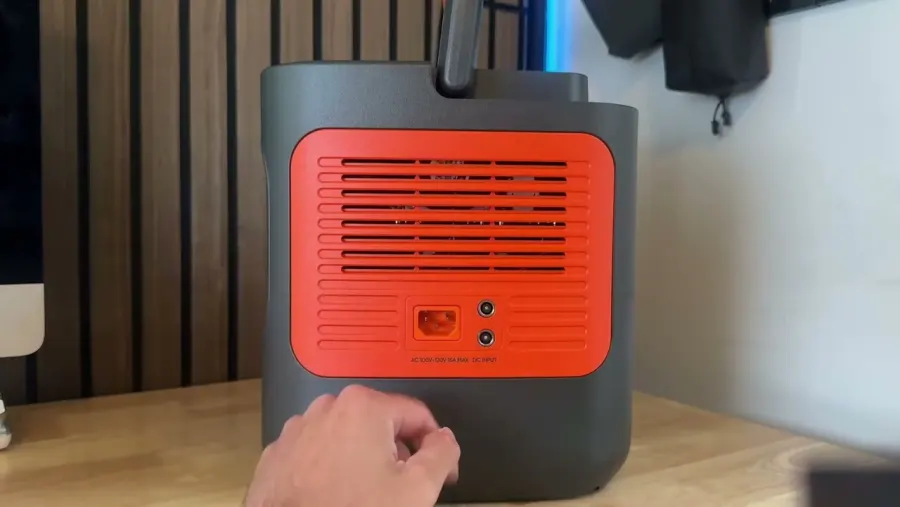
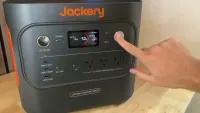
Ports are the smaller complaint. There are three AC outlets, a car socket, one USB-A port and two USB-C ports, only one of which is high powered. There is no RV outlet.
1.7 Hrs at the wall on emergency mode, and 400W of solar through a Jackery plug5.5/10
Wall charging is fast and solar charging is the weak point. From a household outlet the station fills in 1.7 Hrs, which Design Guy confirms applies to the emergency setting.7 That setting has to be switched on by hand, as The Solar Lab points out, and the standard mode is slower.8 A quieter charge mode exists for overnight top-ups.
Solar input stops at 400W across two ports, low for a battery this size. Minute Man Solar called the solar input "the biggest frustration that I've had with the 2000 V2", citing the barrel-style Jackery connector and the difficulty of running a long cable to panels placed far away.9 Panels from other makers need an adapter.
Within that ceiling, Jackery's panels perform well. Revere Overland reported "I'm actually getting about 190 watts maximum, which is really impressive from a 200 watt solar panel".10 Even with a full pair in clear sun, a refill takes most of a day, and a car socket takes roughly a full day. The station can be drained much faster than the sun can refill it.
No battery port, and a transfer switch before it touches a house circuit3.0/10
Home integration is the clear weakness. Expansion is not offered: there is no port for an extra battery and no way to link two units. TechRadar puts it plainly: "What you buy is what you get."11
Outdoor Gear Lab, which otherwise rates the station highly, says that for a home battery backup system built from several batteries it is "likely not ideal".12 Tommy Callaway makes the same point against Jackery's expandable models: the port that links them to more capacity is missing here.
Powering house circuits is possible in a limited way. Revere Overland notes that it requires a transfer switch to be installed, and that everything running at once has to stay under the inverter's 2200W limit.13 That is a job for a licensed electrician, and it suits a few chosen circuits, not a whole house.
A switchover routers ride through, a basic app and a screen that sleeps early7.1/10
The backup function works as described for ordinary electronics. With the station plugged in between the wall and a device, en.techreviewer.de says it takes over "within less than 20 ms" when the grid fails.14 Shane Starnes kept a monitor and router on through the handoff without a flicker.
The caveat comes from The Lab Daily, which found it fine for a router and a desktop but would not treat it as a replacement for a dedicated UPS in every situation.15 TechRadar also found the function did nothing until the power source was selected in the settings, so test it before relying on it.
The app is well liked for what it does: battery level, input and output, and switching outlets on or off from another room. It stays close to those basics, and The Review Hub noticed an occasional delay in commands. The display shows a runtime estimate that many found useful, though it turns itself off quickly by default. A built-in light is a small bonus in an outage.
Hard to hear while charging, 17.5 KG on a fixed handle, and ports left uncovered7.8/10
Build quality and noise are consistently praised. Watson's Reviews described the station while running as "quieter than the ambient room noise", and several others could not hear it charge at all.16 The fans do come on under heavy loads, as a steady background sound more than a whine, and en.techreviewer.de judged it borderline for use right beside a bed.
At 17.5 KG it is light for a 2042Wh LiFePO4 station, and the handle is solid with no wobble. TechRadar's unit survived rough handling, including a fall from a car boot. Jackery rates the cells for thousands of charge cycles and extends the warranty for units bought from its own site.
The gaps are modest. The ports have no covers, which matters around dust and damp. Brutal Reviews collects buyer complaints of early failures, dead ports and slow support; those are secondhand reports, not its own findings, but they are on the record. Minute Man Solar, usually a fan of Jackery's support, had trouble getting a technical answer about solar voltage.
Well priced per watt-hour, as long as fixed capacity is acceptable7.2/10
Value is widely liked. Jackery lists it at $999 for the station alone, and Outdoor Gear Lab names it a favorite with one of the best prices per Wh among the models it tested.17 Tommy Callaway makes a similar case against Jackery's larger expandable units, which cost far more and weigh far more.
The price varies by seller, and Jackery's own site has been cheaper than Amazon at times. The counterargument comes from The Solar Lab, which would spend extra on the expandable Plus model if the budget allows. Next Pick found a rival of similar capacity selling for less. For a buyer who will never add batteries or a large solar array, the money is well spent.
Our verdict
Buy the Explorer 2000 v2 as a plug-in backup for a fridge, a freezer, a router and kitchen appliances, or as a house battery for a van or RV that mostly recharges from the wall. Skip it if the plan involves a large solar array, extra batteries later, a home panel or a circular saw. Before relying on it, switch on emergency charging, set up and test the UPS mode, and budget for Jackery panels or an adapter if solar is part of the plan.
10 sources quoted in this story (17 notes)
- 1outdoorgearlab.com · written review “We measured 1,740 Wh of power output, which is enough to more than cover most people's camping needs or a brief power outage.” but “While that is only 84% of the advertised 2,042 Wh capacity”
- 2en.techreviewer.de · written review “Household refrigerator (~120 W): approx. 14 - 16 hours” but “Depending on usage, approximately 10 to 15% is lost through the inverter.”
- 3The Solar Lab · 4:27 “This thing was 90% efficient in our testing, which is amazing. We usually say over 80 is good.” but “Idle consumption was also about 17 watts. Not as low as some other jackaries we've seen.”
- 4en.techreviewer.de · written review “Even devices with higher inrush currents are no problem for the Explorer 2000 v2. Refrigerators or power tools start reliably without the power station shutting down.”
- 5Fer's Reviews · 7:25 “I tested it with a heater and a hot air gun letting them run for a while and it performed perfectly without shutting off” but “the Power Station turns off when you try to run it because the saw creates a power Spike that this unit cannot handle”
- 6Revere Overland · 9:57 “Okay, the circular saw overdid it.”
- 7Design Guy · 3:03 “On emergency supercharge, it recharges from 0 to 100% in 1.7 hours.” but “Across its two DC 8020 ports combined, max solar input caps out at 400 watts.”
- 8The Solar Lab · 3:43 “You have to turn on emergency charging to get it to go up to 1,800 W.”
- 9Minute Man Solar · 6:55 “while we're getting an impressive 1,700 watts of input” but “this brings me all to the solar input, which has been the biggest frustration that I've had with the 2000 V2”
- 10Revere Overland · 15:50 “With these panels in direct sunlight, I'm actually getting about 190 watts maximum, which is really impressive from a 200 watt solar panel”
- 11techradar.com · written review “you turn your power station on, follow the simple instructions on the screen, and you are ready to go.” but “This means you cannot expand capacity or functionality as your needs change. What you buy is what you get.”
- 12outdoorgearlab.com · written review “if you are building out a home battery backup system, where daisy-chaining multiple batteries is common, the 2000 v2 is likely not ideal.”
- 13Revere Overland · 13:23 “If you have the right setup in your house, you can actually power your entire house off this battery pack.” but “it does require a transfer switch to be installed and it requires you to be careful about what's running cuz you can't pull more than 2,200 watts”
- 14en.techreviewer.de · written review “If the power fails, the UPS function of the power station automatically takes over within less than 20 ms.”
- 15The Lab Daily · 3:36 “The switch time is listed at 20 milliseconds, and in my use, it was fine for things like my router and desktop setup.” but “I wouldn't treat it like a full replacement for every dedicated UPS setup in every situation”
- 16Watson's Reviews · 5:38 “It's currently quieter quieter than the ambient room noise. This thing is ultra quiet.”
- 17outdoorgearlab.com · written review “This is our favorite power station, and it comes at one of the best prices per Wh of any model we tested.”