



The full story
By the Storedwatts editors · Published Nov 20, 2026
The E1500LFP is bought on price, and the measured tests mostly back the purchase. What follows covers how much energy really comes out, where the inverter gives up, and the habits that keep the battery from draining itself.
Near the full 1536 Wh under load, far less when the inverter idles7.2/10
Most of the rated 1536 Wh reaches the outlet when the load is heavy and steady. Watt-hours (Wh) are how much energy a station stores, watts (W) are how much it can run at once, and surge is the brief start-up kick a fridge or pump needs. HOBOTECH's high-load test returned a share of the label that few stations match, and Projects With Everyday Dave, ReeWray Outdoors and The Solar Lab reported results in the same range.

“it scored 1433 Watt hours out of 1536 for a competition crushing 93 percent” but “so if you left the inverter on it would totally kill the battery in about 1.2 days”
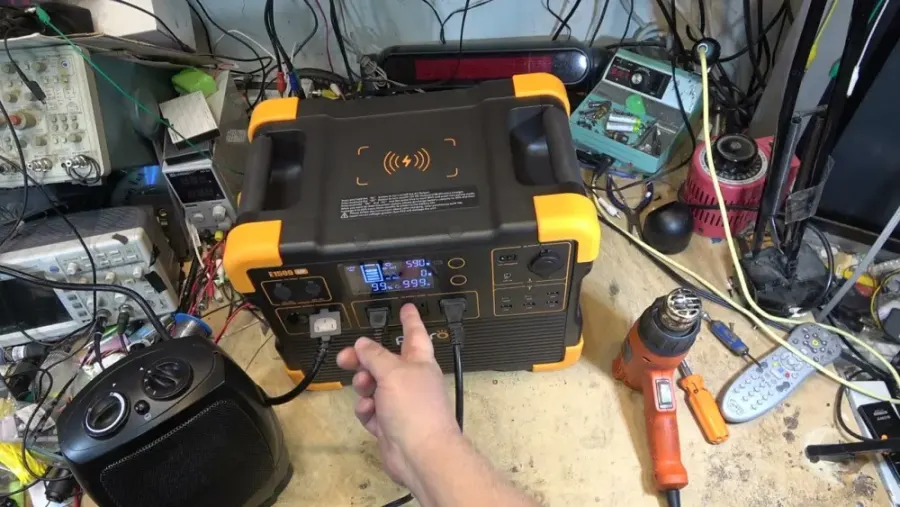
For the outage question, The Old Jarhead ran his refrigerator from it and reported: "after 16 hours it was sitting at 47%"1. That points to a fridge carried through a night with room to spare, though the result depends on the fridge.
The catch is the inverter's appetite when little is plugged in. On a fridge that cycles on and off, Projects With Everyday Dave got much less out: "which is 64% of the rated capacity and this is because the inverter consumes power on idle"2. Cleversolarpower by Nick and HOBOTECH both found that an inverter left on with no load would empty the battery within days. Switch the AC output off when nothing is running.
The percentage readout is also less steady than the battery behind it. The Lab Daily and Lab Review both saw it jump around in early cycles, and Adventure Gear TV suspected the gauge was inaccurate.
Among the cheapest watt-hours on sale, until an expansion battery joins the order8.8/10
Value is the reason to buy this station, and it is consistently praised. At $549 for the station alone, the cost per stored watt-hour sits near the bottom of the market. RANDOMFIX put it plainly: "this is the lowest price per wat hour out of any power station I've ever tested"3. HOBOTECH and Projects With Everyday Dave both doubted any major brand could match the features at the price.
The price has moved a great deal over time, so the figures quoted in older coverage vary widely. 12voltvids looked when it cost far more and did not find it cheap, and noted that the add-on battery costs nearly as much as the station itself4. The Solar Lab made the same point from the other side: at a high list price, more polished rivals beat it. The case for it rests on paying the low price.
Clean power at 2200 W, and uneven behavior past the line6.7/10
At or under its 2200 W continuous rating, the inverter runs ordinary household loads without complaint. Cleversolarpower by Nick ran a microwave and found the sine wave barely moved, The Drive washed a car with a pressure washer, and ReeWray Outdoors started an air conditioner with no trouble5.
Above the rating, the tests conflict. HOBOTECH pushed past it and found "it actually lasted at 2400 Watts for two minutes"6, and Projects With Everyday Dave saw a similar hold. The Solar Lab found the opposite.
“We found that it just kept shutting down the second you tried to push it beyond its 2,200W power rating.”
The maker's 4400 W surge figure draws open doubt. The Solar Lab and The Old Jarhead saw nothing to support it, and Projects With Everyday Dave warns it will not start most larger induction-motor tools. Adventure Gear TV also had the inverter shut off under a cooktop load well below the rating with charge still showing7.
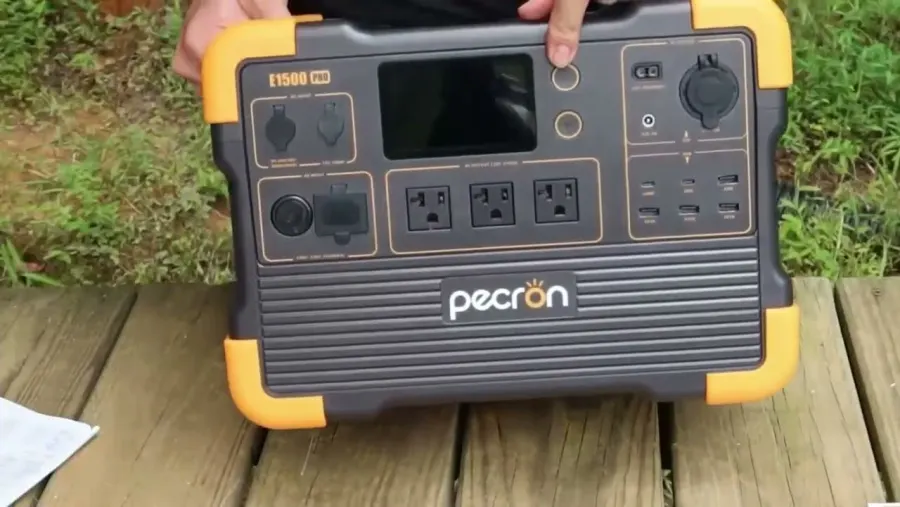
The ports are a strength with a few rough edges. The high-current DC output on an XT60 connector is singled out again and again as useful for van builds and diesel heaters. The wireless pad is picky about phones and cases, RANDOMFIX could not get a laptop to charge from the fast USB-C port, and Lab Review found the AC outlets fill up quickly.
Under two hours from the wall, with a voltage gap between the solar ports6.8/10
Wall charging is quick and simple. Pecron rates a full charge at 1.8 hours, and the measured results land close: "Charging from 0 to 100% took me 1 hour and 45 minutes"8, said Cleversolarpower by Nick. The charger is built in, so there is only a cord and no power brick, though The Old Jarhead found that cord short.
The charge rate cannot be turned down. RANDOMFIX and ReeWray Outdoors both looked for a setting in the app to slow it and found none. When solar and wall power are connected together, it favors the panels and trims the wall input.
Solar is where opinion divides. Input is listed at 1000 W across two ports, and the ports accept different voltage ranges. HOBOTECH's warning: "this is going to be confusing to most because there's a gap in voltage between the two inputs"9. Adventure Gear TV notes the main input wants several panels wired in series, and Projects With Everyday Dave found the solar controller slower to track than rivals.
With enough panel in good sun, The Solar Lab and The Lab Daily both got strong, quick refills. AskIve Solar had a rougher time, watching input swing up and down on a parallel array. Cold weather is a limit too, per RANDOMFIX: "once it gets down to 32° Fahrenheit it will no longer accept a charge"10.
A switchover that keeps a computer on, and an app that may not connect6.6/10
The UPS function is the feature that earns its keep. With the station between the wall and the equipment, a power cut goes unnoticed by what is plugged in. ReeWray Outdoors pulled the plug and saw "immediate switch over no changes that's exactly what you want to see in a UPS"11. The Lab Daily's computer stayed on through a simulated outage, and TechRadar notes the output ceiling is lower in this mode.
The app is the weaker half. Projects With Everyday Dave reported: "I had trouble getting the app to connect I tried several times and gave up"12, and RANDOMFIX lost a long stretch to a Bluetooth link that would not pair. The Drive connected easily but saw little use for it, since it cannot set a charge or discharge limit.
Capacity can grow with expansion batteries, which several sources count as a main reason to choose it. HOBOTECH found those batteries an awkward size next to the station. Smaller gripes: the display shows only net power in or out, an output has to be switched on to read the battery level, and there is no built-in light.
Sturdy casework, a hum that bothers some, and a warranty reported two ways5.6/10
The case feels tough, and the noise is the open argument. The rubber corner bumpers and grippy handles are liked across the board, and 12voltvids found it well built inside. On sound, WayPoint Survival and HomeTech Review judged it quiet enough to sleep near13, and ReeWray Outdoors heard an inoffensive white noise. Cleversolarpower by Nick heard something else.
“if you have a normal conversation in the room, you would have to elevate your voice to talk to each other because this one is quite loud.”
Reliability evidence is thin and mixed. Lab Review has had no trouble under everyday loads. The Solar Lab got an overheating warning during a heavy-load test, and Atony relays an account of a unit that stopped holding a charge, which Pecron replaced under warranty14.
Warranty length is stated differently from source to source, and HOBOTECH, ReeWray Outdoors and Projects With Everyday Dave all found it short next to the larger brands15. Check the term on the listing before buying.
38.4 lbs that most adults can lift by the side handles8.3/10
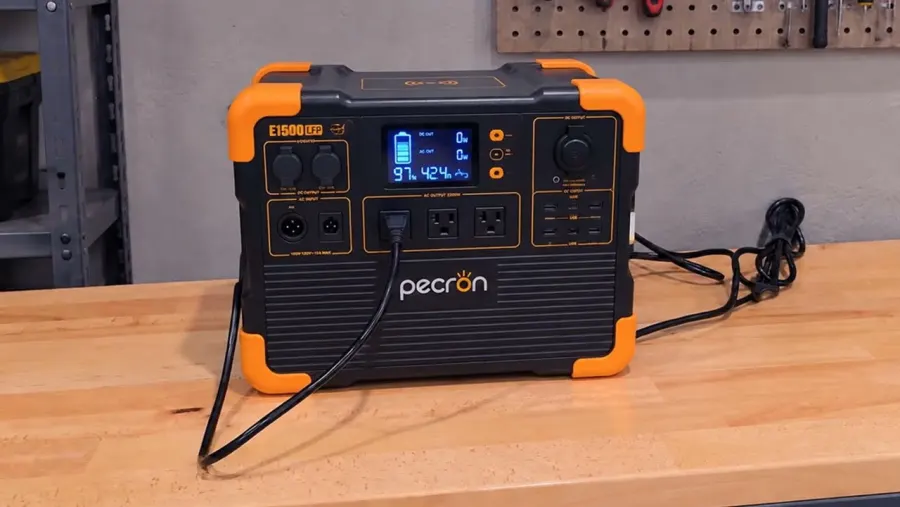
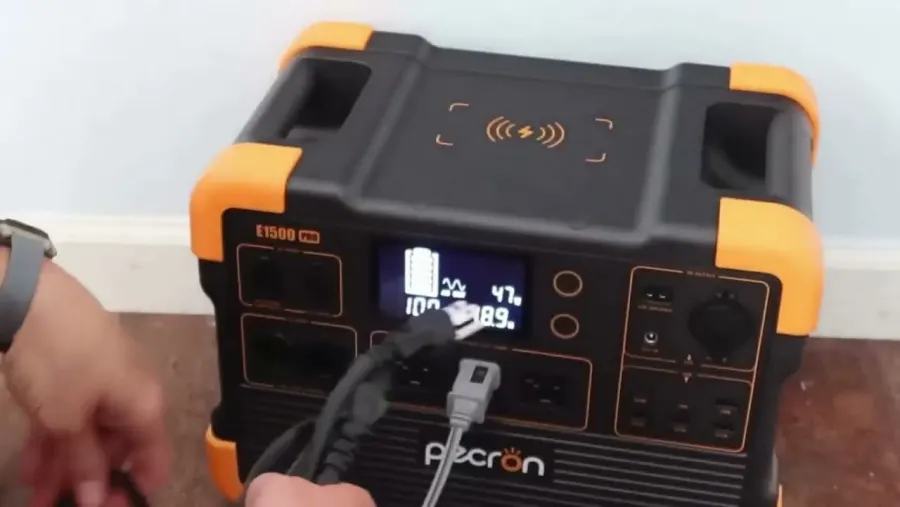
For its capacity, this is an easy station to move. At 38.4 lbs with a handle on each side, it goes from a closet to a truck bed without drama, and The Old Jarhead could carry it by one handle. The Drive found it compact next to rivals.
It is still a two-hand lift for many people. The Lab Daily likes that the side handles keep the weight close to the body but would not call it a casual grab, and Lab Review was glad the handles were there. The expansion batteries are heavier and, per Projects With Everyday Dave, much harder to grip.
Our verdict
Buy the E1500LFP for outage backup or a van build when the price is low and the job is a fridge, a router, lights and the occasional microwave. Pass on it if noise in a quiet room matters, or if the plan depends on starting large motors or running right at the inverter's limit. Before paying, check the current price against $549 and read the warranty term on the listing. Once it is home, make a habit of switching the AC output off when nothing is plugged in.
10 sources quoted in this story (15 notes)
- 1The Old Jarhead · 3:37 “after 16 hours it was sitting at 47% so it used 40% of the battery capacity so about 600 wat hours to run 16ish hours”
- 2Projects With Everyday Dave · 1:33 “which is an impressive 92% of its rated capacity that's one of the best I've seen on these all-in-one power stations” but “which is 64% of the rated capacity and this is because the inverter consumes power on idle even when the fridge is not consuming any power”
- 3RANDOMFIX · 11:07 “this is the lowest price per wat hour out of any power station I've ever tested”
- 412voltvids · 46:11 “the second battery pack is almost as expensive as the unit itself”
- 5ReeWray Outdoors · 16:38 “this 2200 watt AC inverter can definitely handle a startup from an 8000 BTU air conditioner so no problems there”
- 6HOBOTECH · 6:30 “it actually lasted at 2400 Watts for two minutes that's pretty crazy”
- 7Adventure Gear TV · 5:42 “my cooktop was only pulling about 1300 Watts I do still have at least 20% battery capacity remaining and the AC inverter shut off”
- 8Cleversolarpower by Nick · 12:49 “Charging from 0 to 100% took me 1 hour and 45 minutes.”
- 9HOBOTECH · 1:29 “from AC wall power with its built-in 1400 watt charger it can top up in 1.8 hours” but “this is going to be confusing to most because there's a gap in voltage between the two inputs”
- 10RANDOMFIX · 28:38 “once it gets down to 32° Fahrenheit it will no longer accept a charge”
- 11ReeWray Outdoors · 14:22 “immediate switch over no changes that's exactly what you want to see in a UPS”
- 12Projects With Everyday Dave · 0:46 “if the power goes out it will switch to battery back up in milliseconds your devices won't even know what happened” but “I had trouble getting the app to connect I tried several times and gave up”
- 13WayPoint Survival · 5:56 “because it's completely silent you're not going to have to worry about a lot of noise while you sleep at night”
- 14Atony · 7:00 “One experience involved a unit that had trouble charging, only fully charged once, and later would not hold a charge.”
- 15HOBOTECH · 21:51 “it has a long life lfp battery and a bright easy to read screen” but “the warranty isn't really as long as the competition while two years is all right the other major players are now offering five in six years”