


The full story
By the Storedwatts editors · Published Nov 20, 2026
The Classic is the simplest of EcoFlow's DELTA 3 family: the same 1024 Wh battery with fewer ports and no expansion. The sources agree on most of it, and split on whether the savings justify what was left out.
A high measured yield, with fridge runtime that depends on the fridge7.5/10
Most of the stored energy reaches your appliances. Watt-hours (Wh) are how much a station stores, and The Solar Pit drew "940 W hours out of the rated 1,024W hours of capacity" in a full discharge test.1 The Solar Lab, using its own method, was nearly as pleased: "It was 83% efficient, which is basically an A."2
Standby draw is low too, so less of the battery is spent keeping the inverter awake. Small steady loads such as laptops, lights and a router barely dent it, and a portable fridge ran full-time on a multi-day trip with top-ups along the way.
The catch is the size of the battery, not its efficiency. Estimates for a full-size fridge vary from source to source, and smartenergyedge.com cautions that the capacity "does not guarantee a full night of refrigerator backup".3 Heaters, microwaves and cooktops run, but they empty it quickly.
An hour from the wall, a 500 W ceiling on solar6.8/10
Wall charging is the strongest part of this station. EcoFlow lists 0-100% in 60 min, and the independent timings land close to it: The Solar Pit reports "0 to 80% in about 45 minutes"4 and The Solar Lab clocked "about 55 minutes from zero to full".5 The charge rate can be turned down in the app if you are sharing a circuit.
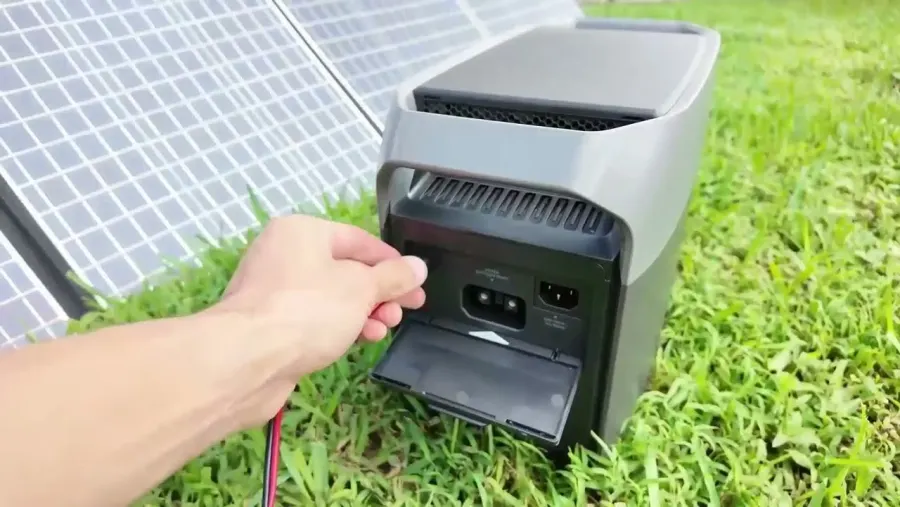
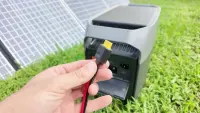
Solar is where opinion cools. The single input tops out at 500 W, which is fine for a couple of portable panels and low next to rivals that accept more. A full solar refill takes strong sun and well-aimed panels, and one cloudy stretch left a fridge short overnight.
Car charging also goes through that solar port, so the cable matters. The Review Hub found that with the wrong adapter the unit may treat the source like a car outlet and charge slowly.6
A full 1800 W inverter, few outlets and no car socket6.6/10
The inverter does what the label says. Watts (W) are how much a station can run at once, and surge is the brief start-up kick a motor needs; EcoFlow rates this one at 1800 W continuous and 3600 W surge. The Solar Pit ran it from full to empty at close to the continuous limit without a cut-out.7
In everyday use that covers an induction cooktop, a coffee percolator, a blender, power tools and a fridge. EcoFlow's X-Boost mode lets some heavier appliances run by lowering voltage, but it does not make this a bigger inverter, and it is best left off for voltage-sensitive gear.
The port list is the complaint almost everyone shares. There are fewer AC outlets than on the DELTA 3 Plus, a short row of USB ports, and no 12 V output of any kind. A 12 V fridge has to run through the AC inverter, which wastes some battery.

“there is no 12volt car socket on this unit at all. Not even in the trap door.”
A fast switchover on a battery that cannot grow6.9/10
As a backup supply for a desk or a network shelf, it works. Plugged between the wall and your gear, it takes over when the grid drops, and Ready Current puts it simply: "this thing kicks on in 10 milliseconds".8 The Review Hub had a router and computer setup ride through a brief cut as hoped.
The app is well regarded for monitoring, charge limits and charge speed, and the screen is bright enough to read outdoors. It is not trouble-free: some features need an active connection, and The Review Hub notes reports of scheduling turning AC output off at the wrong time.9
The firm limit is capacity. There is no expansion port, so 1024 Wh is all it will ever hold. There is also no built-in light, and it cannot signal EcoFlow's smart generator to start.
12.1 kg that suits the trunk more than the trail8.3/10
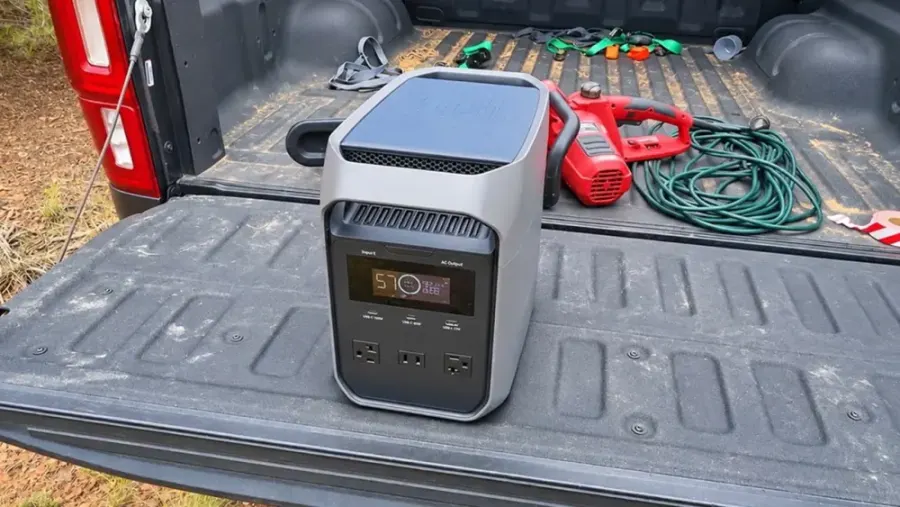
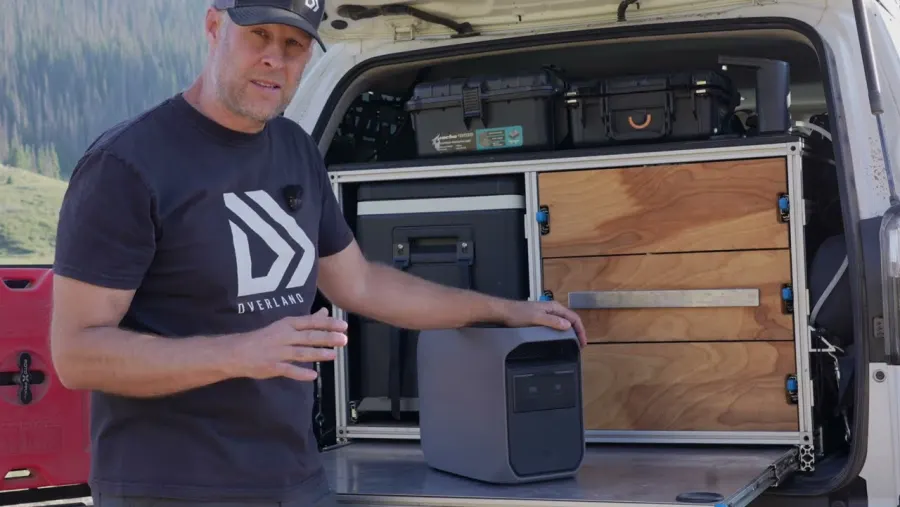
It is easy to move for a station of this capacity. The handles on the top sides are thicker than on the DELTA 2, the case is compact enough to leave room in a packed vehicle, and Ready Current calls it "pretty lightweight if you want to carry it single-handedly".10
That praise has a range limit. At 12.1 kg it is a house-to-car and car-to-campsite load, and EnergyProjects is blunt about anything further: "this is not something you would want to carry over a long distance".11 If you plan to carry a station daily, a smaller one will serve better.
Quiet under load, with one broken panel reported8.7/10
Build and noise are consistently praised. The casework feels solid and well finished, the plastics come across as durable, and The Solar Pit found temperatures stayed in check under a stress test. The cells are LFP, a chemistry chosen for long cycle life.

“It's actually pretty rare that you get a cheap power station that is also very quiet.”
The quiet is not total. In a silent bedroom The Review Hub could hear the unit with AC output on, along with a light click from the inverter before heavier loads. Ready Current had a plastic piece on the back break on one unit.12 The station is also not waterproof, so keep it under cover at camp.
The cheapest DELTA 3, with the cuts to match8.8/10
Value is the main reason to pick the Classic. At $599 from EcoFlow, and often less on sale, it is the lowest-priced model in the DELTA 3 line with the same capacity as the Plus. For a buyer who charges from the wall and needs only this much storage, the missing extras cost nothing.
The dissent is about what the money buys elsewhere. The Solar Lab points to rivals with more plugs and ports at a similar price and concludes "it just doesn't seem to do enough".13 If you need a car socket or expansion, the cheaper station becomes the expensive mistake.
Our verdict
Buy the DELTA 3 Classic for light home backup: a fridge, a router and chargers through a short outage, refilled from the wall in about an hour. Skip it if you rely on 12 V gear, want a large solar array, or may need more runtime later, because capacity is fixed at 1024 Wh. Before paying, count the outlets you need and compare the current price with rivals that offer more ports. If you plan to use solar or car charging, confirm you have the right cable for its single input.
6 sources quoted in this story (13 notes)
- 1The Solar Pit · 6:33 “During testing, I got 940 W hours out of the rated 1,024W hours of capacity, giving us a 91.7% usable capacity, which is an exceptional result.”
- 2The Solar Lab · 3:43 “It was 83% efficient, which is basically an A. It means when you're running loads and stuff, it's not wasting a ton of power just converting it from DC to AC.”
- 3smartenergyedge.com · written review “The 1,024Wh battery is enough for many short backup tasks” but “but it does not guarantee a full night of refrigerator backup or several hours of high-power appliance use”
- 4The Solar Pit · 7:59 “The max input rating of,400 watts. You can charge this up from 0 to 80% in about 45 minutes.”
- 5The Solar Lab · 1:42 “In our testing, it charged in about 55 minutes from zero to full.” but “it also has a 500 W solar input, which is kind of low compared to some of the other products out there”
- 6The Review Hub · 5:17 “With the wrong adapter, charging can be limited because the unit may treat it more like car charging.”
- 7The Solar Pit · 2:35 “the system had no issues with discharging from 100% to 0% at close to max continuous output of that 1,800 watts for the entire test” but “I was unable to perform the DC discharge capacity since there is no car socket available.”
- 8Ready Current | Portable Power & EDC Gear · 3:50 “this thing kicks on in 10 milliseconds. So, the uninterrupted power just kicks on almost instantly”
- 9The Review Hub · 7:12 “I have seen reports of scheduling behavior causing AC output to shut off at the wrong time.”
- 10Ready Current | Portable Power & EDC Gear · 1:33 “it only weighs 27 lb, so it's pretty lightweight if you want to carry it single-handedly”
- 11EnergyProjects · 1:17 “The unit weighs approximately 12.1 kg and measures just under 40 cm across, so it can be transported between your home, vehicle, and campsite” but “but this is not something you would want to carry over a long distance.”
- 12Ready Current | Portable Power & EDC Gear · 4:04 “this runs at about 30 decibels. So, it's really quiet.” but “I don't really like this plastic piece in the back. I did have it break on one of my units.”
- 13The Solar Lab · 2:40 “you can get this thing for $388, which is the cheapest Delta that they have for sale.” but “This is fine, but it just doesn't seem to do enough, especially considering it's still $400.”