



The full story
By the Storedwatts editors · Published Nov 20, 2026
The Yeti 1500 is Goal Zero's 1505 Wh LiFePO4 station, and the evidence on it is fairly consistent. Capacity, output and build hold up well; weight and price are where the complaints gather. The chapters below run from what the battery gives back to what it costs.
Measured tests return most of the 1505 Wh9.4/10
Most of the rated capacity reaches your appliances. Watt-hours (Wh) are how much energy a station stores, and some is always lost in the inverter on the way out. Adventure Gear TV ran the Yeti down and logged the result, and Backwoods Pursuit's repeated tests landed in the same range or slightly higher.
“I got 1,306 Wh out of that 1,505 Wh battery for a return of about 87%.”
In practice that means days, not hours, on a small load. GearJunkie expects a portable fridge to run for upwards of a week 1, and Adventure Gear TV cooked a full air fryer cycle, preheat included, on a single charge. Lectric Boil got through a whole weekend without topping up from solar.
The caveat is the outage question. Nobody in this evidence measured a full-size household fridge to empty, so treat the camping-fridge figures as a best case. One account had a fridge and lights lasting a couple of evenings, and the same source warns that the pack runs out quickly if you ask it to carry a whole house.
A 2,000W inverter, with one heater cut-out on record8.9/10
The Yeti runs the appliances that matter in an outage or at camp. Watts are how much it can power at once, and surge is the brief start-up kick a fridge compressor or pump needs. Adventure Gear TV sums up the spec: the inverter is "rated for 2000 W of continuous output with surges up to 3600 W" 2.
The port selection is consistently praised. There is a row of AC outlets, more than Outdoors Allie had seen on a unit this size, plus several USB-C ports including a high-wattage one that Adventure Gear TV measured at very nearly its rating. Field & Stream liked being able to plug in several devices without swapping cables.
One report cuts against the rest. Crestwell HVAC Revenue Intelligence tried a space heater for a quick warm-up and "the unit cut out after a few seconds" 3. It is a single account, but if a heater or a big motor is your main load, test it before you depend on it. There is no wireless charging pad either.
Approximately 1.1 hours from the wall, and solar ports that favor Goal Zero panels7.8/10
Wall charging is the Yeti's quickest trick. Goal Zero rates a full charge at approximately 1.1 hours on the fast setting, and Backwoods Pursuit's timed run came in right on that figure 4. GearJunkie's advice for a campground is to borrow someone's wall plug for an hour.
Fast mode pulls a lot from the outlet. Outdoors Allie warns it can trip a household breaker if other things share the circuit, and Backwoods Pursuit's fix is the low setting, which draws less and takes longer.
Solar is capable but more particular. The maker allows up to 900W of panels, and Backwoods Pursuit saw "over 140 watts on a 200 watt panel" 5 from Goal Zero's own Nomad. The inputs use Goal Zero's connectors, though. Lectric Boil needed an adapter for existing panels and wishes the station had the standard solar plugs other brands use 6. Adventure Gear TV is no fan of the barrel plug either.
52.8 lbs, eased by good handles3.1/10
Weight is the clear weakness. At 52.8 lbs the Yeti is heavier than some comparable stations, and almost every account of moving it includes a complaint. Backwoods Pursuit calls it something you have to be ready to carry.
“At nearly 53 pounds, it’s a little cumbersome to move around, especially if you’re hauling it to a campsite or lugging other gear.”
The handles help. They are rubberized over aluminum and placed so the load feels smaller than it is, according to Outdoors Allie 7. Adventure Gear TV also points to the tie-down channels, which let you strap the station into a vehicle so it stays put.
That makes this a station you drive to a spot, not one you walk to it. Plan for two hands, and a second person on stairs.
Aluminum on most sides and a rain rating8.6/10
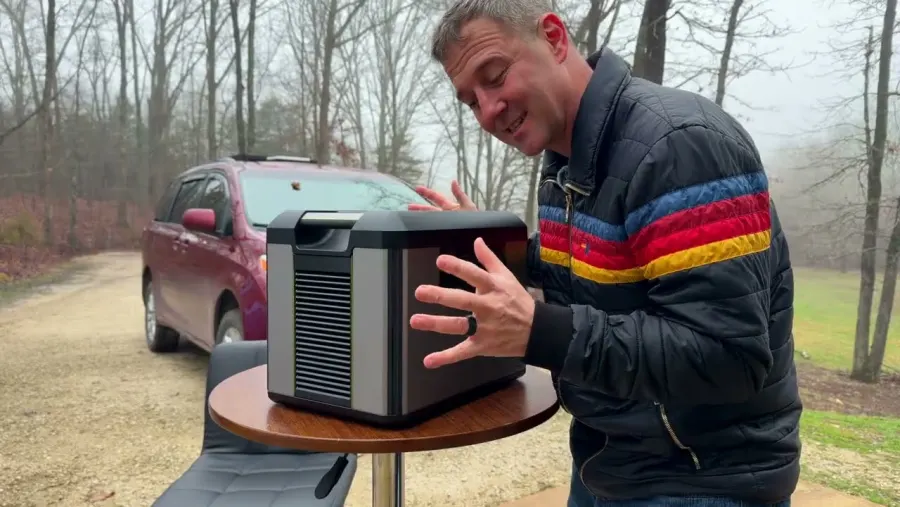
The case is the part that sets the Yeti apart from most stations its size. Nearly every face is aluminum with rubber at the corners, and GearJunkie describes a "rugged, IPX4-rated case" 8 made to go in and out of the elements. Outdoors Allie adds that it has been tested for bumps, drops and vibration.
Longevity is a maker's claim at this point, not a measured one. GearJunkie notes the LiFePO4 cells "promise 4,000 cycles, or roughly 10 years of average use" 9. Adventure Gear TV's longer-term unit showed only minimal wear compared with other stations kept as long.
The small gripes are about the power button. Adventure Gear TV notes that its position could let water pool on it in a downpour 10, and Backwoods Pursuit found it a little less sturdy than the other buttons.
A well-liked app and a quick grid switchover9.0/10
The app and display are praised almost without exception. The app connects over Bluetooth or Wi-Fi, switches ports on and off, tracks usage and sends alerts when the station is full or running low. Adventure Gear TV gives it "an A+ for features and utility" 11.
The screen is easy to read and shows power in, power out and charge remaining. For home backup, Design Guy cites automatic switching from grid to battery "in under 15 milliseconds" 12. That is the maker's figure; nobody here timed it.
The one complaint is minor: the built-in light is described as useful but dim.
The price is the sticking point5.0/10
Value suits some buyers and not others. At $1,499.95 the Yeti costs more than much of its competition, and Design Guy's side-by-side with a cheaper rival ends bluntly: you are "practically paying double" 13 for the Goal Zero, even after crediting it with more capacity and inverter headroom.
The defense comes from the outdoor press, which has used it for home backup, road trips and camp. GearJunkie admits it costs more than some rivals and still calls it more a necessity than a want.
“The Goal Zero is worth every penny. Full stop.”
Where you land depends on the job. If the weather rating and the metal case matter to you, the premium buys something specific. If the station will sit indoors charging phones and a laptop, a smaller or cheaper one does that job for less.
Our verdict
Buy the Yeti 1500 if you want one tough station for a truck, a base camp and the occasional outage, and you value fast wall charging and a case that tolerates rain. Skip it if you will carry it far alone or if price per watt-hour is your first test, because cheaper stations cover the basics. Before you order, lift something that weighs 52.8 lbs, and check that your solar panels fit Goal Zero's inputs or budget for an adapter. If a space heater or a big motor is on your list, try it early.
7 sources quoted in this story (13 notes)
- 1gearjunkie.com · written review “If you’re bringing a portable fridge along, you can expect to keep it running for more than a week.”
- 2Adventure Gear TV · 4:36 “The AC inverter is rated for 2000 W of continuous output with surges up to 3600 W.”
- 3Crestwell HVAC Revenue Intelligence · 0:43 “can deliver up to 2,000 watts of continuous power, meaning you can run a mini fridge, a CPAP machine, or even a small power tool without tripping the breaker” but “I tried to run a one 500 watt space heater for a quick warm up, and the unit cut out after a few seconds.”
- 4Backwoods Pursuit · 7:29 “it fully recharged, or actually got up to 98% in 1 hour and 6 minutes. It was up to 80% in well under 1 hour.”
- 5Backwoods Pursuit · 8:26 “it got over 140 watts on a 200 watt panel, their 200 watt Nomad panel.”
- 6Lectric Boil · 2:18 “You can recharge this with your home wall outlet in under an hour from 0 to 80%, so it's a super fast charge.” but “This works great for the Goal Zero solar panel, but I would love for this thing to have an MC4 solar input or an XT60.”
- 7Outdoors Allie · 3:42 “They're in a great spot that makes it easy to carry, so that 52 plus pounds doesn't feel like so much.” but “This guy weighs 52.75 lb, so she's hefty”
- 8gearjunkie.com · written review “Featuring a rugged, IPX4-rated case, this updated model is built to be bopped around, in and out of the elements.”
- 9gearjunkie.com · written review “LiFePO4 batteries increase reliability tenfold and promise 4,000 cycles, or roughly 10 years of average use.”
- 10Adventure Gear TV · 3:42 “these two things that I'm pointing out right here are minimal wear compared to some of the other portable power stations that I've tested long term” but “the position of this button would allow in a downpour moisture to accumulate on top of it.”
- 11Adventure Gear TV · 9:23 “Overall, I'd give this app an A+ for features and utility.”
- 12Design Guy · 5:11 “For Goal Zero Yeti 1500, you get automatic power switching from the grid to battery in under 15 milliseconds.”
- 13Design Guy · 1:46 “You are practically paying double for the Goal Zero.”